
Benefits of Folding Power Wheelchairs for Travel
Table of Contents
- Why Folding Power Wheelchairs for Travel Change the Game
- Lightweight Carbon Fibre Powerchairs: Portability Without Compromise
- Airline Approved Electric Wheelchairs: What You Need to Know
- How to Transport a Power Wheelchair on a Plane
- Manual vs Electric Folding Mechanisms: Which Suits Your Travel Style?
- Maintenance, Storage, Insurance and Warranty for Travel Damage
- Choosing the Right Folding Power Wheelchair for Your Travels
- Frequently Asked Questions
Last Updated: September 21, 2026
Why Folding Power Wheelchairs for Travel Change the Game
Folding power wheelchairs are electric mobility aids built with a collapsible frame, so the chair can be folded for storage or transport without dismantling it. For anyone who travels, that single design decision changes almost everything about how a journey works. (Source: IATA Dangerous Goods Regulations)
The shift from heavy, fixed-frame powerchairs is the real story here. A traditional powerchair is often too bulky for a car boot and too heavy for one person to lift, which quietly ties the user to their home. At Etech Mobility, we understand the challenges customers face when getting a chair into a vehicle. A folding frame removes that barrier. The chair goes in the boot, the battery comes out, and the trip happens.

This guide covers what actually matters when you travel with a powerchair: airline rules, battery handling, folding mechanisms, maintenance, and how to choose the right model.
Lightweight Carbon Fibre Powerchairs: Portability Without Compromise
Carbon fibre is the material that made genuinely light powerchairs possible. It has a high strength-to-weight ratio and resists corrosion, so a carbon fibre frame can stay rigid while weighing a fraction of a steel equivalent.
The material comparison matters when you are the one lifting the chair:
| Material | Weight | Strength | Cost | Best For |
|---|---|---|---|---|
| Carbon fibre | Lightest | High | Highest | Frequent travel, solo lifting |
| Magnesium alloy | Very light | High | Mid | Flat storage, everyday portability |
| Aluminium | Moderate | Good | Lower | Occasional lifting, budget builds |
The Evora Carbon from Etech Mobility is a good example of what carbon fibre delivers in practice. It weighs 13 kg, folds to just 22 cm wide, and runs on quiet 250W brushless motors with a removable 24V lithium battery. That combination of low weight and narrow fold is what makes a chair genuinely travel-friendly.

Airline Approved Electric Wheelchairs: What You Need to Know
Airline approved electric wheelchairs are chairs that meet carrier requirements for carriage in the cabin or hold, most often defined by battery type and how the battery can be isolated. The chair itself is rarely the problem; the battery is where bookings fall apart.
Most folding powerchairs use lithium-ion batteries, and airlines treat these under dangerous goods rules rather than as ordinary luggage.
-
Up to 100 Wh per battery, the common case for folding powerchairs. Most carriers accept these as checked or gate-checked mobility aids with no special approval, provided the battery is protected against short circuit.
-
100-160 Wh per battery, accepted by many carriers but usually requires the airline's prior approval at the time of booking, and often a limit of one or two spare batteries.
-
Above 160 Wh, generally not accepted on passenger services without specific dangerous goods clearance, which most travellers will never obtain.
-
The battery is removable, so it can be carried separately in the cabin where the carrier requires it
-
Terminals are taped or capped to prevent short circuit
-
The battery is protected against crushing and puncture in transit
-
You can state the watt-hour rating on request, ideally with the label visible or a photograph of it
-
You have given any advance notice the carrier asks for, some require 48 hours, some ask at booking
-
You know whether the chair travels in the cabin, at the gate, or in the hold
How to Transport a Power Wheelchair on a Plane
Transporting a power wheelchair on a plane comes down to three things: the battery, the fold, and the paperwork. Get those right and the process is far less stressful than most people expect.
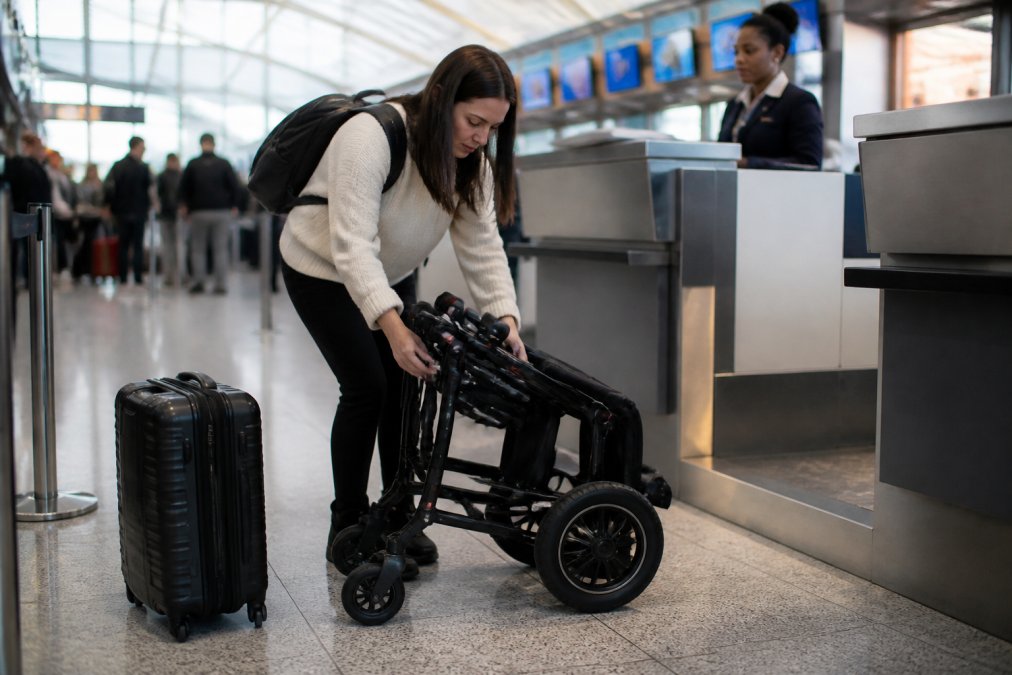
At the airport and at the gate
Arrive early and go straight to the check-in desk with your chair rather than leaving it to the gate. Tell staff you are travelling with a powerchair and confirm where the chair will be stowed. Remove the battery if your airline requires it and keep it with you in the cabin where permitted. Fold the chair down, and if you can, bag or cover it to reduce the chance of transit damage.
Manual vs Electric Folding Mechanisms: Which Suits Your Travel Style?
Manual folding suits most travellers, but the automatic option is worth the extra if lifting and bending are difficult. A manual mechanism is lighter, has fewer parts to fail, and costs less. An electric folding mechanism does the work for you at the push of a button or a remote. Selecting the right folding chair ensures that your mobility equipment fits seamlessly into your chosen accessible holiday accommodation.
Maintenance, Storage, Insurance and Warranty for Travel Damage
Travel damage is usually caused by handling, not by the chair itself, and a few habits prevent most of it. The two decisions that matter most are where the chair is stowed and how it is protected while it is out of your sight.
Gate checking versus hold stowage
Gate checking means you keep the chair with you until you reach the aircraft door, then hand it over to be placed in the hold at the last moment. Hold stowage means it is checked in at the desk and disappears into the baggage system. Gate checking is generally the gentler option because the chair spends less time in transit and is handled by fewer people, but it depends on the airport and the carrier, and it is not always offered.
Whichever applies, the protection routine is the same:
- Remove the battery and carry it in the cabin where the carrier permits it
- Fold the chair fully and secure the fold so it cannot spring open in transit
- Pad the controller, joystick and any exposed cabling, these are the parts most often damaged
- Cover the frame with a purpose-made travel bag or, failing that, a heavy-duty bag with the chair's dimensions marked on it
- Label the chair clearly with your name, flight number and a contact number
- Photograph the chair folded and undamaged before you hand it over
Pre-flight and post-flight checklist
Before departure: charge the battery to full, check tyre pressure and brake function, confirm the battery label is legible, and pack the charger in your cabin bag rather than the hold.
Long-term storage and battery care
Store the chair folded, dry, and out of direct sunlight. For the lithium-ion battery, charge it to roughly half capacity if it will sit unused for weeks, then top it up before use. Avoid leaving it fully flat for long periods, as this shortens battery life. If the chair is stored somewhere cold, let it return to room temperature before charging.
Insurance and warranty cover
Check that your travel policy covers mobility equipment specifically, not just 'baggage'. Many standard policies cap baggage claims at a level well below the cost of a powerchair, and some exclude mobility aids entirely unless they are declared. Ask three questions before you buy cover: is the chair covered while checked in, is the battery covered separately, and is there a single-item limit that would leave you short?
Choosing the Right Folding Power Wheelchair for Your Travels
Match the chair to how you actually travel, not to the longest list of features. A chair that folds narrow suits a small car boot; a chair that folds flat suits tight storage at home.
Work through these questions before you buy:
- How far do you need to go on one charge, and can you charge the battery off the chair?
- Can you lift the folded weight yourself, or do you need help?
- Does the folded width fit your boot and your doorways?
- Will you be on smooth floors and pavements, or rougher ground?
- Is the battery removable for air travel?
Frequently Asked Questions
Are folding electric wheelchairs any good for travel?
Yes. Folding power wheelchairs are built for travel because they collapse into a compact size and weigh far less than fixed-frame models. For example, the Evora Carbon folds to 76 x 22 x 69 cm and weighs 13 kg, while the MagNeo folds to just 35 cm tall and weighs 12.3 kg. Both are airline-friendly and fit into most car boots, making them practical for holidays, day trips and everyday errands.
Are foldable wheelchairs allowed on planes?
Airlines generally accept folding power wheelchairs, but you must follow battery rules. Most airlines require lithium-ion batteries to be removed and carried in the cabin, and they must not exceed 160 Wh. The Evora Carbon and MagNeo both use quick-release 24V lithium batteries that are designed for this. Always check with your airline before booking and arrive early to complete the battery declaration at the desk.
Are carbon fibre power wheelchairs easier to transport?
Carbon fibre powerchairs are significantly easier to transport because the material is strong but very light. The Evora Carbon weighs just 13 kg, so one person can lift it into a car boot without help. It also folds to only 22 cm wide, the narrowest fold available, which means it slides into tight spaces like caravans, small boots and storage cupboards. This makes it a practical choice for anyone who travels regularly.
What should I consider when choosing a powerchair for international travel?
Check three things: battery compliance, folded dimensions and weight. Look for an airline-friendly removable lithium battery under 160 Wh, such as the 24V 10Ah battery on the Evora Carbon. Then measure your car boot and any tight doorways at home. Finally, confirm the weight is manageable for you or a caregiver to lift. The MagNeo at 12.3 kg and the Evora Carbon at 13 kg are both designed for easy lifting and storage.