
Benefits of Ultra-Lightweight Mobility Scooters
Table of Contents
- Why Ultra-Lightweight Mobility Scooters Matter for Independence
- Reduced Fatigue and Physical Effort in Daily Life
- Portable Mobility Scooters for Car Boot Travel
- Lightweight Mobility Scooters for Public Transport Access
- Safety, Comfort and Stability Without the Weight
- Understanding Lightweight Mobility Scooter Weight Limits
- How to Choose a Mobility Scooter That Fits Your Life
- Frequently Asked Questions
Last Updated: October 9, 2026
Why Ultra-Lightweight Mobility Scooters Matter for Independence
Ultra-lightweight mobility scooters have transformed how people with limited mobility maintain independence. These compact devices weigh far less than traditional powerchairs, making them practical for daily errands, social visits, and travel. At Etech Mobility, we've helped thousands of customers across the UK discover how the right lightweight mobility solution restores confidence in managing everyday tasks without relying on others.
The appeal of ultra-lightweight mobility scooters goes beyond portability. When you can lift your device into a car boot unaided, a trip to the shops, a visit to friends, or a holiday becomes achievable. Reduced fatigue and effort often makes the difference between staying home and staying active.
Lightweight mobility scooters bridge the gap between manual wheelchairs and heavy powerchairs, delivering electric-powered independence without transport-blocking bulk. For people with age-related mobility decline, progressive muscle-wasting conditions, or chronic mobility-limiting conditions, this balance is essential.
Reduced Fatigue and Physical Effort in Daily Life
The most immediate benefit of an electric lightweight mobility scooter is dramatically reduced physical strain. Manual wheelchairs demand constant upper-body effort, exhausting users with arthritis, shoulder pain, or limited arm strength. Electric scooters eliminate that effort.
Without fighting the mechanics of propulsion, you conserve energy for shopping, socialising, and exploring your neighbourhood. Many users now manage journeys that previously left them exhausted; the difference between arriving tired and arriving ready to enjoy it is significant.
Comfort becomes possible on longer outings. Extended footplates, supportive cushioning, and reclining backrests on models like the Y20 Luxe mean you sit properly supported, not perched on a basic transit seat.
For caregivers, this shift matters too. If you've been pushing a manual wheelchair or helping someone transfer in and out of vehicles, an electric scooter reduces your physical burden. The user gains independence; the carer gains relief from constant assistance.
Portable Mobility Scooters for Car Boot Travel
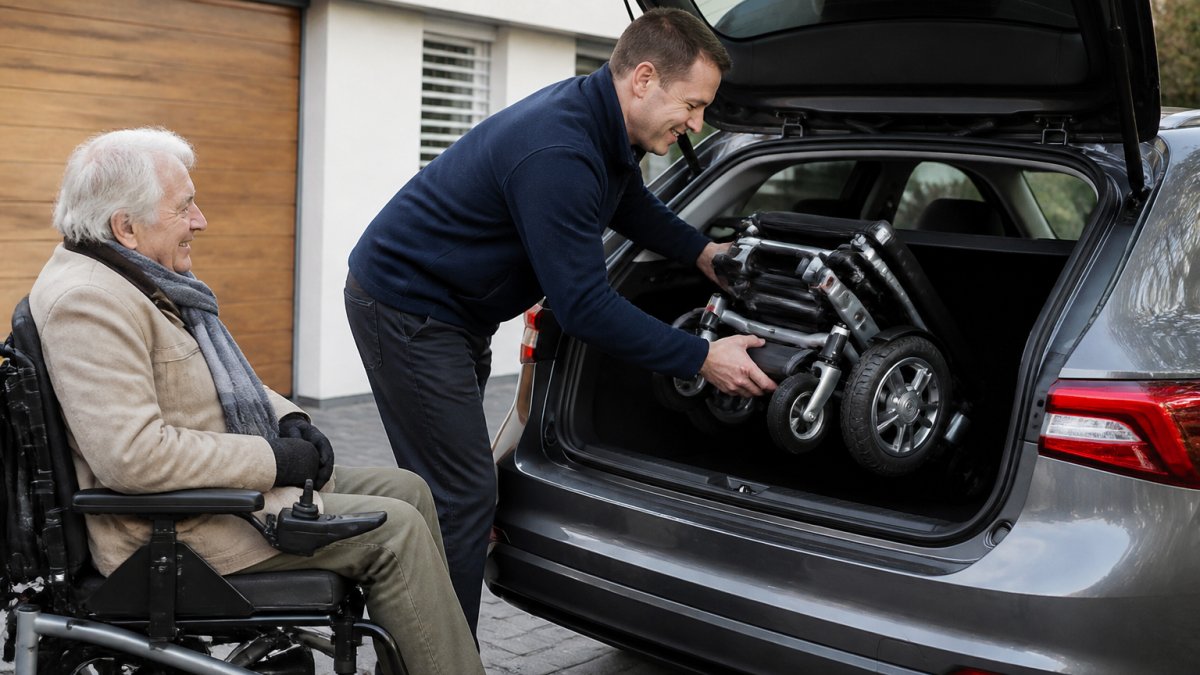
Portability changes everything for people without specialist vehicles. A lightweight mobility scooter that folds flat and weighs under 20 kg fits most standard car boots, opening genuine travel options for users otherwise confined to home.
The MagNeo, our lightest electric wheelchair at just 12.3 kg, folds to only 35 cm tall, small enough for compact boots, tight storage, even under stairs. Traditional powerchairs weigh 40+ kg and barely fold, so independence becomes about taking your scooter with you, not just using it locally.
Real-world lifting matters. Can you physically lift your device into a car boot unaided? If not, your scooter depends on whoever drives you. At 12.3 kg or 15.4 kg, many users manage alone; at 30+ kg, most cannot.
Battery design matters for travel. Quick-release, airline-friendly batteries let you charge off-board and fly without complications. The LiteMax 2 with its standard 12Ah battery meets airline regulations, making holidays genuinely possible.
| Weight Range | Realistic Lifting | Best For | Trade-offs |
|---|---|---|---|
| Under 15 kg | Most users solo | Frequent travellers, small car boots | May sacrifice range or comfort |
| 15-20 kg | Fit users, with effort | Regular car travel, occasional help | Moderate compromise across features |
| 20-30 kg | Requires assistance | Home-based primarily | Limited portability despite folding |
| 30+ kg | Not portable practically | Outdoor terrain, not travel | Heavy, rarely leaves home |
Lightweight Mobility Scooters for Public Transport Access
Public transport becomes viable when your device is portable enough to handle safely, but portability alone doesn't guarantee access. The practical test: can you fold or dismantle the scooter, lift the heaviest single piece, and store it without blocking aisles or exits?
On buses, most operators require folding scooters and wheelchairs to be carried as luggage, since the designated wheelchair space is reserved for passengers who remain seated in their device. The realistic question isn't "will the driver let me on" but "can I fold it, lift it, and stow it before the bus moves off".
On trains, the picture is more accommodating but more variable. Many operators ask that folding scooters and wheelchairs be booked in advance, especially for longer journeys, so staff can arrange assistance and confirm space. Ramps and boarding assistance are usually available at staffed stations, but unstaffed stations and step-free access vary widely by route.
Coaches and long-distance services typically treat folding scooters as luggage subject to size and weight limits, and some require a removable battery carried separately. Always check the operator's conditions before travel; acceptance is decided by the carrier, not the scooter's marketing description.
For users without private transport, this is transformative. Taking a scooter on a bus to visit friends, attend appointments, or explore independently restores autonomy heavy devices cannot match, no specialist transport or constant companion needed. But the advantage only holds if you've checked the carrier rules, practised folding and lifting at home, and know the heaviest single piece you'll handle on the day.
Safety, Comfort and Stability Without the Weight
Lightweight construction doesn't mean fragile. Magnesium-alloy frames like the MagNeo's are lighter than aluminium yet strong and durable. Brushless motors deliver smooth, quiet performance with virtually no maintenance, and modern lithium batteries far outlast older lead-acid designs. (Source: guidelines for accessible public transport)
Stability comes from wheel size and suspension, not weight. The Aeron's large rear wheels and front wheels provide a stable, comfortable ride over pavements and parks. The Horizon 7's all-round suspension smooths bumps across grass and gravel. Neither requires a heavy frame to feel secure.
Safety features are standard on quality lightweight scooters: electromagnetic and electronic braking, IPX4 water resistance, anti-tip wheels, and anti-rollback support. UKCA and CE certification confirms rigorous safety standards.
Comfort features often surprise people expecting to sacrifice support for portability. Extended footplates, lift-up armrests, and supportive cushioning are available even on ultra-lightweight models. The LiteMax 2 includes an extended footplate and thickened breathable cushion. The Y20 Luxe adds a reclining backrest and premium leather upholstery.
MagNeo – 12.3kg Ultra-Lightweight Magnesium Electric Wheelchair →
The real safety consideration isn't the device, it's suitability. A scooter rated for 120 kg used by a 100 kg user is safe. The same scooter used beyond its weight capacity becomes unstable. Always match capacity to user weight.
Understanding Lightweight Mobility Scooter Weight Limits
Weight capacity and actual user weight must align for safety and performance. A scooter's weight limit is the point beyond which stability, braking, and motor performance degrade. Most lightweight electric scooters carry around 120 kg, while heavier-duty portable models reach 160-180 kg through split-frame designs that separate the main frame from the motor section, making each piece easier to lift.
Range also depends on user weight. Manufacturers quote "up to" figures, typically 15-20 miles per battery, but actual range varies with weight, terrain, temperature, and speed; a lighter user achieves better range on the same device. For range extension, some models offer a standard 12Ah or long-range 20Ah battery, while others use a twin-slot design letting you add a second battery to roughly double range.
The trade-offs nobody mentions
Reduced weight is not free. Every kilogram saved comes from somewhere: a smaller battery, lighter frame, narrower wheels, or less suspension. Ultra-light models often trade range, stability, comfort, or terrain capability for portability. The honest question is whether your typical journeys are short, paved, and car-assisted, or longer, mixed-surface, and independent.
Total cost of ownership
Purchase price is only the first cost. Warranties vary by model and brand, so check coverage before comparing prices. If you travel by public transport or plane, factor in carrier charges for the device or battery. Refurbished models can cut upfront cost significantly while still including a warranty.
Matching capacity to real life
A scooter rated for 120 kg used by a 100 kg user is safe; used beyond its weight capacity it becomes unstable. Match capacity to user weight, then check the resulting range covers your longest regular journey with contingency. If you're close to the limit, or your journeys are long or on mixed surfaces, a slightly heavier model with higher capacity and larger wheels may serve you better than the lightest option. Portability is only valuable if the scooter is safe and capable enough to be used regularly.
How to Choose a Mobility Scooter That Fits Your Life
Choosing the right lightweight mobility scooter depends on answering a few practical questions honestly.
First: where will you use it? Indoor-only users need something compact and manoeuvrable (58 cm width is ideal for tight corridors).
Second: how will you transport it? Can you lift 12-15 kg regularly? If yes, ultra-lightweight models like the MagNeo work.
Third: how far do you need to go? Local errands within 10 miles suit most lightweight scooters on a single battery. Regular longer journeys need dual-battery options or higher-capacity models.
Fourth: what's your budget? Entry-level models like the LiteMax 2 start at £794.99 with excellent portability. Mid-range options like the Aeron (£849.99) add larger wheels and stability.
| Your Priority | Best Match | Key Features | Starting Price |
|---|---|---|---|
| Maximum portability | MagNeo | 12.3 kg, 35 cm folded, airline-friendly | £999.99 |
| Budget + portability | LiteMax 2 | 19.8 kg, flexible batteries, 58 cm width | £794.99 |
| Stability + range | Aeron | Large wheels, 20-mile range, reliable | £849.99 |
| Heavy-duty + portable | Converge 180 | 180 kg capacity, splits to 16 kg | £1,599.99 |
| All-terrain + comfort | Y20 Luxe | Reclining seat, multi-terrain, quick-release motors | £1,499.99 |
Don't guess at suitability; what sounds ideal in theory often doesn't match real life. A scooter needing two hands to fold is impractical with arthritis.
At Etech Mobility, we're committed to helping you find the right match for your lifestyle. Our team guides you toward genuine independence.
Lightweight mobility scooters restore independence in ways heavier devices cannot match. Portability isn't a luxury; it's the difference between staying home and staying active.
The key is honest assessment: match the device to your actual weight, real journey distances, genuine lifting ability, and typical terrain.
Get in touch with Etech Mobility today.
Frequently Asked Questions
What are the main benefits of using ultra-lightweight mobility scooters?
Ultra-lightweight mobility scooters deliver independence for daily errands, shopping, and social visits whilst being easy to lift and transport. They reduce physical strain on caregivers, fit into smaller car boots, and often fold compact enough for storage in tight spaces. Models like the MagNeo at 12.3 kg offer genuine everyday range with dual batteries, making them practical for both indoor shopping centres and smooth outdoor pavements without the burden of heavy equipment.
Can an ultra-lightweight mobility scooter fit in a car boot?
Yes. Ultra-lightweight models are specifically designed for car transport. The MagNeo folds to just 35 cm tall and weighs 12.3 kg, sliding easily into small boots. The LiteMax 2 at 19.8 kg with a 58 cm width navigates tight spaces well. Even heavier-duty options like the Converge 180 split into a 16 kg main frame, making car loading manageable. Always measure your boot space and check the folded dimensions before purchasing.
Who benefits most from lightweight mobility scooters?
Ambulatory users managing short journeys, seniors with age-related mobility decline, people with chronic conditions limiting stamina, and those with progressive muscle-wasting conditions all benefit significantly. Caregivers particularly value ultra-lightweight models because they can lift and load them without injury risk. Active users wanting to maintain outdoor independence for parks, cafes, and local errands find them ideal. If you've struggled with heavy manual wheelchairs or need reliable daily independence, a lightweight electric option may transform your mobility.
What should I check before taking a mobility scooter on public transport?
Check that your scooter is airline-friendly if flying (most removable batteries must be 24V). For trains and buses, verify the folded dimensions fit doorways and storage areas. Models with airline-friendly batteries like the LiteMax 2 and MagNeo are approved for travel. Contact your transport provider beforehand to confirm their wheelchair and scooter policies, as rules vary. Compact folding design and lightweight construction make public transport journeys far more practical.