
Best Lightweight Folding Powerchair 2026
Table of Contents
- How We Chose the Best Lightweight Folding Powerchair Models
- Quick Comparison: Top Folding Powerchairs at a Glance
- 1. Etech Mobility Evora Carbon, Best Ultra-Lightweight Option
- 2. Etech Mobility Vector Carbon, Best for Style and Everyday Use
- 3. Etech Mobility Vantage Carbon, Best Dual-Function Chair
- 4. Freedom Chair DE08L, Best for Active Outdoor Users
- 5. Motion Healthcare Foldalite Pro, Best for Higher Weight Capacity
- 6. Pride Jazzy Carbon Ultra Lite, Best Quick-Fold Carbon Frame
Last Updated: August 17, 2026
Finding the best lightweight folding powerchair in 2026 is harder than it should be. The market is flooded with options that look similar on paper but perform very differently in practice. At Etech Mobility, we've worked with thousands of customers across the UK who needed a folding powerchair that genuinely fits their life: one that slides into a car boot without a struggle, clears airport security without drama, and lasts through a full day of errands without range anxiety. This guide ranks the top models available right now, with honest assessments of what each one actually delivers.
A folding powerchair is a motorised mobility aid designed to collapse into a compact form for easy transport and storage, typically featuring a lithium-ion battery, joystick controller, and a frame light enough to lift unassisted. The difference between a good one and a frustrating one often comes down to three things: total weight, how the folding mechanism works in daily use, and whether the battery is airline approved.
Quick Picks:
- Best Ultra-Lightweight: Etech Mobility Evora Carbon - 13kg carbon fibre frame with 22cm fold
- Best for Style and Everyday Use: Etech Mobility Vector Carbon - sporty design, 13.8kg
- Best Dual-Function: Etech Mobility Vantage Carbon - powered and self-propel in one chair
- Best for Active Outdoor Users: Freedom Chair DE08L - 27-mile range with front suspension
- Best for Higher Weight Capacity: Motion Healthcare Foldalite Pro - supports up to 150kg
- Best Quick-Fold Carbon Frame: Pride Jazzy Carbon Ultra Lite - 14.5kg with quick-release design
How We Chose the Best Lightweight Folding Powerchair Models
Every model in this list was assessed against criteria that matter to real users: total weight and portability (prioritising chairs where the heaviest liftable section stays under 16kg), battery specifications against Civil Aviation Authority guidance on mobility aids and lithium batteries, folding mechanism practicality, frame durability based on construction material and weight capacity, and maneuverability for both indoor and outdoor use.
Model |
Weight |
Max Load |
Battery Range |
Airline Approved |
|---|---|---|---|---|
Etech Evora Carbon |
13kg |
120kg |
19km |
Yes |
Etech Vector Carbon |
13.8kg |
120kg |
14km |
Yes |
Etech Vantage Carbon |
16kg |
120kg |
13km |
Yes |
Freedom Chair DE08L |
15.5kg (heaviest section) |
Not specified |
Up to 27 miles |
Not specified |
Motion Healthcare Foldalite Pro |
25kg |
150kg |
9 miles |
Not specified |
Pride Jazzy Carbon Ultra Lite |
14.5kg |
Not specified |
Not specified |
Yes (dual battery options) |
Quick Comparison: Top Folding Powerchairs at a Glance
The six chairs below cover many needs, from ultra-compact travel chairs to higher-capacity outdoor performers. The lightest options cluster around 13-14.5kg and are built from carbon fibre frames, allowing single-handed lifting into a car boot and airport transport. Step up to chairs like the Freedom Chair DE08L or Motion Healthcare Foldalite Pro and you gain real outdoor range and higher weight capacity, but total weight increases significantly.
For Etech Mobility chairs, contact the team directly for current pricing and availability, as stock levels change.
1. Etech Mobility Evora Carbon, Best Ultra-Lightweight Option
The Evora Carbon is the lightest folding powerchair in this guide at 13kg. Most adults can lift this chair into a car boot unassisted, carry it through an airport, or hand it to cabin crew without needing a second person.
The genuine carbon fibre frame delivers this weight without sacrificing structural integrity. The ultra-narrow 22cm fold fits into compact car boots, overhead lockers on some services, and narrow home storage spaces that would defeat a standard folding chair. The 250W brushless motors provide responsive performance on pavement and smooth indoor surfaces, while the airline-friendly battery means this chair clears the hurdle that stops many users from flying with their mobility aid.
Pros:
- Lightest chair in this guide at 13kg
- 22cm fold: genuinely compact storage
- Airline-friendly battery for travel
- Durable carbon fibre construction
- 250W brushless motors
Cons:
- Specific range and seat width not published in current spec sheet
Best for: Frequent travellers, users with limited upper body strength, anyone storing a chair in a small flat or compact car.
2. Etech Mobility Vector Carbon, Best for Style and Everyday Use
The Vector Carbon is a 13.8kg carbon fibre folding powerchair with sporty blue-accent wheels and a design that reads more like considered engineering than a medical device. For users who spend time in public spaces and care about how their chair presents, this matters.
The weight sits at 13.8kg, retaining all the practical portability advantages of an ultra-lightweight folding powerchair. The airline-friendly battery makes it a strong option for users who travel regularly. The 250W brushless motors deliver consistent performance on pavement and indoor surfaces, with a 120kg maximum load capacity clearly stated.
Pros:
- 13.8kg: close to the lightest in class
- Distinctive sporty design with blue-accent wheels
- 250W brushless motors
- Airline-friendly battery
- 120kg max load capacity
Cons:
- Folded width not specified in detail: confirm with Etech Mobility for tight-space storage
- No advanced suspension system noted in specifications
Best for: Everyday users who want a lightweight, portable folding powerchair with a modern aesthetic for social outings and public spaces.
3. Etech Mobility Vantage Carbon, Best Dual-Function Chair
The Vantage Carbon does two things: it motors you from A to B or you can propel it manually using the large rear wheels. That dual capability is genuinely useful for users whose mobility needs vary day to day, or for situations where the battery needs to be conserved.
The large rear wheels handle uneven pavement, dropped kerbs, and light outdoor terrain more comfortably than the smaller castors found on compact urban chairs. The genuine carbon fibre frame keeps the chair lightweight despite the larger wheel size. The 200W brushless motors are slightly less powerful than the 250W units in other Etech Mobility models, but remain adequate for pavement and indoor use. The airline-friendly battery and 120kg max load capacity are consistent across the Etech Mobility carbon range.
Pros:
- Powered and self-propel functionality in one chair
- Large rear wheels for outdoor performance
- Carbon fibre frame: lightweight and durable
- Airline-friendly battery
- 120kg max load capacity
Cons:
- 200W motors are less powerful than the 250W units in other Etech Mobility models
- Larger rear wheels may affect folded dimensions compared to smaller-wheel models
Best for: Users who want flexibility between powered and manual propulsion, or those who frequently use their chair on varied outdoor surfaces.
4. Freedom Chair DE08L, Best for Active Outdoor Users
The Freedom Chair DE08L uses a detachable frame that separates into two sections, the heaviest of which weighs 15.5kg. This is heavier than the Etech Mobility carbon range, but the trade is significant: this chair delivers a travel range of up to 27 miles with three batteries, front suspension for shock absorption on uneven ground, and 250W brushless motors with electromagnetic brakes.
For users who spend real time outdoors, the DE08L's terrain performance is a meaningful step up from ultra-compact urban chairs. The front suspension absorbs surface irregularities that would translate directly to the user in a rigid-frame chair. The joystick controller can be configured for user or attendant operation, which adds flexibility for users whose control ability varies.
Pros:
- Up to 27-mile range with three batteries
- Front suspension for outdoor terrain
- Electromagnetic brakes for incline safety
- Dual joystick control (user or attendant)
- Detachable frame for transport
Cons:
- Heaviest section at 15.5kg: more effort to lift than carbon fibre options
- Additional batteries required for maximum range, increasing cost
- Pricing at £2,700.95 (VAT-free) is higher than the Etech Mobility carbon range
Best for: Active users who prioritise range and outdoor terrain performance over ultra-compact portability.
5. Motion Healthcare Foldalite Pro, Best for Higher Weight Capacity
Weight capacity is the specification that many lightweight folding powerchair guides skip over. The Foldalite Pro supports users up to 150kg, a threshold that excludes most chairs in the ultra-lightweight category. If your weight is above the 120kg limit common to carbon fibre travel chairs, this is the most relevant option in this guide.
The sophisticated suspension system is the other headline feature, providing stability on both pavement and indoor surfaces while absorbing road vibration. The trade-off is total weight: the Foldalite Pro comes in at 25kg and realistically requires two people or a vehicle with a powered boot lift. The 9-mile range is also more limited than the Freedom Chair DE08L.
Pros:
- 150kg weight capacity: highest in this guide
- Sophisticated suspension system for comfort
- Anti-tip wheels for stability
- Joystick controller
- Folds for transportation
Cons:
- 25kg total weight: not a single-person lift
- 9-mile range limits longer journeys
- Heavier than all carbon fibre options in this guide
Best for: Users who need a higher weight capacity or prioritise suspension comfort over ultra-compact portability.
6. Pride Jazzy Carbon Ultra Lite, Best Quick-Fold Carbon Frame
At 14.5kg without batteries, the Pride Jazzy Carbon Ultra Lite sits at the lighter end of the carbon fibre folding powerchair category. The quick-fold design is its defining feature: the chair collapses in a single motion, which is genuinely important for users with limited hand strength or those who fold and unfold their chair multiple times daily.
The tight turning circle makes this chair effective indoors. The adjustable control position allows the joystick to be positioned for individual comfort. Dual battery options extend the travel range beyond a single battery's capacity.
Pros:
- 14.5kg: lightweight carbon fibre frame
- Quick-fold mechanism: single-motion collapse
- Tight turning circle for indoor use
- Dual battery options for extended range
- Adjustable control position
Cons:
- Special offer pricing (£2,150, RRP £2,650) may require showroom collection
- Battery weight adds to the 14.5kg frame weight
- Less detail available on maximum load capacity in public specifications
Best for: Users who fold and unfold their chair frequently and need reliable single-motion collapse with good indoor manoeuvrability.
Carbon Fibre Powerchair Benefits: Why the Frame Material Matters
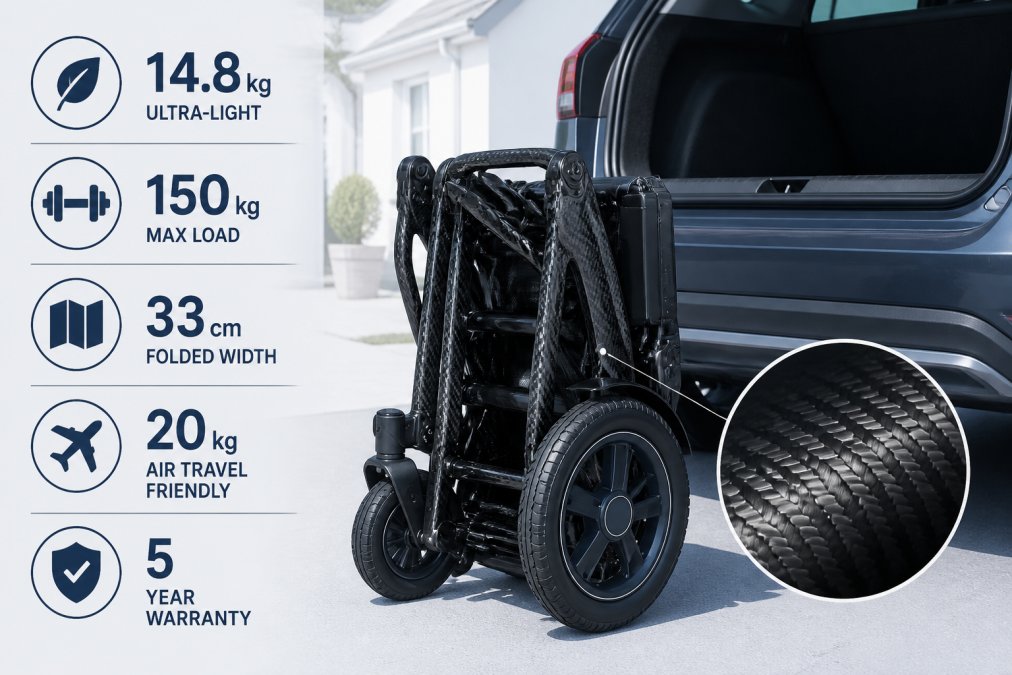
Carbon fibre is not a marketing term in this context. It is a structural material that changes the practical experience of owning a folding powerchair in ways that aluminium frames cannot match.
The core advantage is the strength-to-weight ratio. A carbon fibre frame can achieve the same structural rigidity as an aluminium frame at roughly half the weight. For a folding powerchair, this translates directly into a chair that a single adult can lift into a car boot or carry through an airport without assistance. A lighter frame also means less energy demand on the motor, which extends the effective travel range per charge.
Frame durability is the other argument for carbon fibre. The material does not corrode, does not fatigue in the way metal does under repeated stress cycles, and maintains its structural properties over the long term. For a mobility aid folded and unfolded hundreds of times per year, this matters for long-term ownership costs.
Lightweight Electric Wheelchair Travel: Airports, Public Transport, and Beyond
Travelling with a folding powerchair involves more planning than most guides acknowledge. The battery is the critical compliance point.
The Civil Aviation Authority's guidance on travelling with mobility aids specifies that lithium-ion batteries must meet watt-hour limits to be carried onto aircraft. Most airline-approved batteries in folding powerchairs sit below 300Wh, which clears the standard threshold for cabin carriage. However, individual airlines set their own policies. Always confirm with your airline at least 48 hours before travel.
A quick-release battery is a significant practical advantage at airports. For public transport, the key specifications are folded width and total weight. A 22cm folded width clears spaces that a 30cm chair would not.
Practical travel checklist for folding powerchair users:
- Confirm battery watt-hours with the manufacturer
- Notify your airline at least 48 hours before travel
- Check folded dimensions against your car boot measurements before purchasing
- Carry the manufacturer's battery specification sheet when flying
- Confirm whether your chair qualifies for priority boarding assistance
Folding Powerchair Battery Regulations: What You Need to Know Before You Fly
Battery compliance is the single most common source of confusion for folding powerchair users planning air travel. Getting it wrong can mean your chair is refused at the gate.
The standard threshold for lithium-ion batteries on commercial aircraft is 300 watt-hours per battery. Batteries below this limit can typically be carried in the cabin with airline approval. Batteries between 300Wh and 160Wh per battery may be subject to additional restrictions depending on the airline. Batteries above 300Wh are generally not permitted in the cabin.
All three Etech Mobility carbon models in this guide specify airline-friendly batteries, which indicates compliance with standard aviation watt-hour limits. The Freedom Chair DE08L and Pride Jazzy Carbon Ultra Lite also offer airline-compatible options, though multi-battery configurations may require individual airline approval.
Before booking any flight, contact the airline with your chair's battery watt-hour specification and request written confirmation of their policy. A confirmation email protects you if there is a dispute at the gate.
Choosing the right folding powerchair is one of the most consequential decisions for daily independence, and the wrong choice leaves users either struggling with a chair that's too heavy to manage alone or under-served by a chair that can't handle their real-world needs. Etech Mobility specialises in lightweight folding electric wheelchairs and mobility scooters built specifically for everyday independence, with a carbon fibre range that starts at 13kg and includes airline-friendly batteries across the range. If you're unsure which model fits your lifestyle, contact the Etech Mobility team for personalised guidance and free UK delivery on your order.
Frequently Asked Questions
What is the lightest folding powerchair currently available?
The Etech Mobility Evora Carbon weighs just 13kg, making it one of the lightest folding powerchairs on the market. Its genuine carbon fibre frame achieves this without sacrificing frame durability. The Vector Carbon is similarly lightweight at 13.8kg. For context, many standard folding powerchairs weigh 25kg or more, so a carbon fibre model offers a significant advantage for anyone who needs to lift the chair into a car boot or carry it up steps.
Can I take a folding powerchair on an aeroplane?
Yes, provided the lithium-ion battery meets airline watt-hour limits. Most UK airlines follow Civil Aviation Authority guidance, which typically permits batteries up to 300Wh without special approval. Models described as airline-friendly — including the Etech Mobility Evora Carbon, Vector Carbon, and Vantage Carbon — are designed with batteries that fall within these thresholds. Always confirm the exact watt-hour rating with your airline before travelling, as individual carrier policies vary.
Are carbon fibre powerchairs worth the higher cost?
For frequent travellers and anyone who lifts their chair regularly, a carbon fibre powerchair offers clear practical advantages: the frame is significantly lighter than aluminium equivalents, resists corrosion, and maintains structural integrity over time. The long-term ownership cost calculation also includes fewer replacements due to greater frame durability. If you rarely travel and primarily use your chair at home, a heavier aluminium model at a lower price point may suit your needs just as well.
What weight capacity do lightweight folding powerchairs support?
Most lightweight folding powerchairs have a user weight limit between 100kg and 150kg. The Etech Mobility Evora Carbon and Vector Carbon both support up to 120kg, while the Motion Healthcare Foldalite Pro accommodates up to 150kg. Always check the manufacturer's stated weight capacity before purchasing, as exceeding it affects both safety and the chair's warranty. If you are close to the upper limit of a model, choosing one with a higher-rated frame is advisable.
How do I choose the right folding powerchair for travel?
Start with total weight: if you need to lift the chair into a car boot unaided, aim for under 15kg. Check the folded dimensions against your boot space and any airline size restrictions. Confirm the battery watt-hour rating is airline-approved. For longer outings, compare travel range figures — some models offer extended range with a spare battery. Finally, assess the joystick controller position, seat width, and backrest angle to ensure the chair suits your posture and any specific physical requirements.