
Best Portable Mobility Scooter 2026: Top Picks
Table of Contents
- Quick Comparison: Portable Mobility Scooters for 2026
- How We Chose the Best Portable Mobility Scooters
- 1. EtechMobility MS-270: The Lightest Option at 21 kg
- 2. Phantom Automatic Folding Scooter: Push-Button Convenience
- 3. Sentinel Class 3: For Longer Distances and Road Use
- Lightweight Mobility Scooter for Public Transport: What to Check
- DVLA Mobility Scooter Regulations: What You Need to Know
- Carbon Fibre Mobility Scooter Benefits: Are They Worth It?
- Frequently Asked Questions
Last Updated: September 20, 2026
Quick Comparison: Portable Mobility Scooters for 2026
The best portable mobility scooter 2026 buyers can choose matches how you travel, not the longest spec sheet. At Etech Mobility, three questions decide almost every purchase: how heavy is it, how far does it go, and where will you store it.
Here is the short version before the detail:
| Model | Weight | Range | Top Speed | Price | Best For |
|---|---|---|---|---|---|
| EtechMobility MS-270 | 21 kg | 18 km (11 miles) | 4 mph | £695.50 | Lightest lifting, car boots |
| Phantom Automatic Folding | 23.8 kg | 16 km (10 miles) | 4 mph | £899.99 | Push-button folding |
| Sentinel Class 3 | Approx. 105 kg | Dual 24V 20Ah batteries | 8 mph | £1,595.99 | Road use, longer distances |
How We Chose the Best Portable Mobility Scooters
We judged these three on what breaks a buying decision: frame weight, folded dimensions, battery removal, and behaviour out of the car.

1. EtechMobility MS-270: The Lightest Option at 21 kg
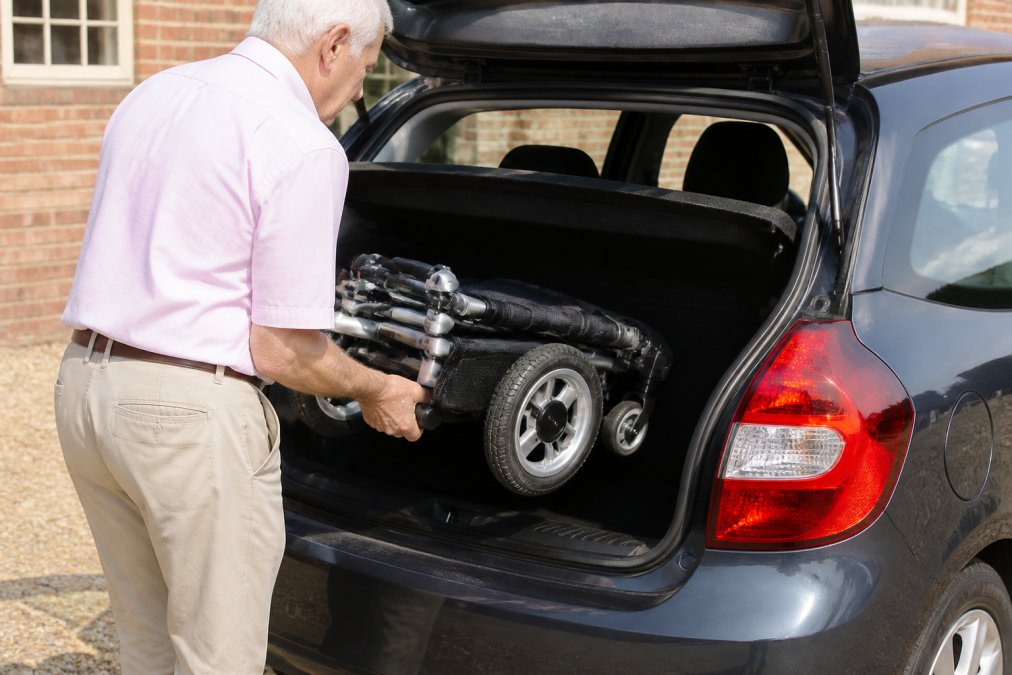
The MS-270 is our top pick for lifting a scooter in and out of a car alone. At 21 kg for the frame, with a 2.6 kg battery that lifts out separately, the heaviest single piece is manageable for most people.
Price: £695.50
2. Phantom Automatic Folding Scooter: Push-Button Convenience
The Phantom solves a specific problem: folding a scooter by hand when your grip or shoulders will not cooperate. Press a button and it folds itself.
Price: £899.99
3. Sentinel Class 3: For Longer Distances and Road Use
The Sentinel is not a portable scooter in the lift-it-yourself sense. It weighs around 105 kg and is built for distance, comfort and road legality rather than car boots.
Price: £1,595.99
Lightweight Mobility Scooter for Public Transport: What to Check
A lightweight mobility scooter for public transport needs three things: a folded footprint that fits a bus wheelchair space, a battery you can remove and carry, and a weight you can manage at a station without help.
- Folded dimensions against the space you actually use. A folded length of 98 cm fits most bus wheelchair bays; anything over 110 cm is a judgement call for the driver.
- Battery removal so you can carry it separately up a ramp. A 2.6 kg lithium-ion pack is a one-hand lift; a sealed 12 kg pack is not.
- Turning radius for aisles and ticket halls. Under 1.2 m lets you turn inside a standard bus bay without a three-point shuffle.
- Anti-tip wheels for ramps and kerbs, and a kerb-climbing height you can clear.
- Total weight of the heaviest single piece, not the scooter as a whole, the number that decides whether you travel alone.
Bus and train operators set their own rules
Buses and trains generally accommodate scooters within their wheelchair spaces, but operators set their own conditions, so confirm before you travel. Common patterns include a maximum folded length and weight per piece, and some ask that the battery be removed and carried separately.
Air travel: the battery rule that catches people out
If you plan to fly with a portable scooter, the battery decides whether it travels at all. Lithium-ion batteries are treated as dangerous goods, and the rules are set by the airline and airport, not the scooter maker.
Lightweight Mobility Scooter →
- Check the watt-hour rating on the battery label before you book. If only amp-hours and volts are shown, multiply them (for example, 24V x 12Ah = 288 Wh).
- Ask the airline in writing and keep the reply, a verbal assurance at check-in is not enough if gate staff disagree.
- Arrive early and expect the scooter to be gate-checked rather than sent to the hold.
- Carry the battery in the cabin where the rules allow, never in checked luggage.
Car boot fitment: the dimensions that matter
Public transport is only half the journey. Most owners also need the scooter to fit a car boot, and the difference between a hatchback and a saloon is often decisive.
- A small hatchback with the rear seats up typically offers around 90-100 cm of boot length and 50-60 cm of height. A scooter folded to 98x52x40 cm will usually go in, but check the boot lip height, lifting over a high lip is harder than to a low one.
- A saloon has a narrower boot opening than its quoted volume suggests. Measure the aperture, not the floor, because the folded scooter must pass through the opening first.
- An estate or SUV with a flat load lip and low floor is easiest, often letting you slide the scooter in rather than lift it.
DVLA Mobility Scooter Regulations: What You Need to Know
Class 2 scooters are for pavements and footpaths at up to 4 mph and need no registration. Class 3 scooters can use the road at up to 8 mph and must be registered with the DVLA.
Carbon Fibre Mobility Scooter Benefits: Are They Worth It?
Carbon fibre mobility scooter benefits come down to weight saved per pound spent: a carbon fibre frame can be noticeably lighter than aluminium for the same strength, which matters if you lift the scooter yourself. But the frame is only one line in the total cost of ownership.
What the premium buys
The trade-off is cost: carbon fibre frames cost more to make, so they sit at the top of the price range. For someone who lifts a scooter daily into a car, that premium buys real independence; for someone who leaves it in a hallway and uses it locally, an aluminium alloy frame does the same job for less.
The ownership costs nobody quotes at the till
The purchase price is the smallest part of what a scooter costs over its life. A realistic five-year view:
- Battery replacement. Lithium-ion packs are consumables, with a useful life of around 500 to 800 full charge cycles, for a daily user, replacement in years three to five. Budget for one replacement pack over five years, and check its current price before you buy the scooter; some packs cost a meaningful fraction of the scooter itself.
- Tyres. Honeycomb and solid puncture-proof tyres last far longer than pneumatic ones and never need a repair, but are replaced as a unit. Pneumatic tyres are cheaper to replace but puncture more often.
- Servicing. An annual check of brakes, tyres, battery connections and the folding mechanism is the sensible interval. Many local mobility dealers do this for a modest fee, and some manufacturers offer a service plan.
- Charging. A full charge on a 24V 12Ah pack draws roughly 0.3 kWh, a few pence at typical domestic rates, negligible compared with battery replacement.
- Insurance and breakdown cover. Not compulsory, but many owners take it out for road-use Class 3 scooters. Premiums vary widely, so get a quote before assuming it is cheap.
A worked comparison
Take the two lightest options here. The MS-270 at £695.50 and the Phantom at £899.99 differ by just over £200 up front. Over five years, if each needs one battery replacement, the gap narrows or widens depending on each model's replacement pack price, so ask for that figure before you buy.
Service intervals at a glance
| Item | Typical interval | What to check |
|---|---|---|
| Battery | Replace at roughly 500-800 charge cycles | Range dropping, longer charge times |
| Brakes | Annually, or sooner if you notice drag | Adjustment and pad wear |
| Tyres | Inspect annually | Cracking, flat spots on solid tyres |
| Folding mechanism | Annually | Loose hinges, stiff latches |
| Charger and cabling | Annually | Fraying, heat, damaged plugs |
A simple log of when you charge and service turns a vague worry about running costs into a figure you can plan for.
Frequently Asked Questions
What are the best folding mobility scooters for 2026?
The best folding mobility scooters for 2026 balance low weight with reliable range. Top contenders include models like the EtechMobility MS-270 at 21 kg, the automatic-folding Phantom at 23.8 kg, and the road-legal Sentinel for longer trips. Look for lithium-ion batteries, a quick-release mechanism, and a frame weight you can lift into a car boot without help. Always check the user weight limit and whether the folded dimensions fit your vehicle.
Do I need to register my mobility scooter with the DVLA?
You do not need to register a Class 2 mobility scooter, which is limited to 4 mph and used on pavements. Class 3 scooters, which can travel up to 8 mph on the road, must be registered with the DVLA. Check the DVLA website for current rules, as requirements can change.
Are there weight limits for portable mobility scooters?
Yes, every portable mobility scooter has a maximum user weight limit. The MS-270 supports up to 130 kg (20.4 stone), the Phantom up to 150 kg (23.6 stone), and the Sentinel up to 240 kg (37 stone). Exceeding this limit can affect stability, braking, and battery range. Always check the specification before buying, especially if you carry shopping or other items.
Can I take a lightweight mobility scooter on public transport?
Many lightweight folding scooters are accepted on buses, trains, and trams, but policies vary by operator. The MS-270 folds to 98x52x40 cm, which can fit in luggage areas. Always check with the specific transport provider in advance. Some operators require the scooter to be folded and stored, while others have designated spaces. A lightweight model makes boarding and alighting much easier.
What are the benefits of a carbon fibre mobility scooter?
Carbon fibre mobility scooters offer a higher strength-to-weight ratio than aluminium or steel, so the frame is lighter without sacrificing durability. That makes lifting and transporting the scooter easier, particularly for caregivers. Carbon fibre also resists corrosion. The trade-off is a higher upfront cost. If you need to lift the scooter regularly or have limited strength, the weight saving can justify the investment.