
CareCo Alternative for Lightweight Wheelchairs: 2026
Table of Contents
- Why Look Beyond One Retailer for Lightweight Wheelchairs
- Transit vs Self-Propelled: Choosing the Right Type of Lightweight Wheelchair
- Best Lightweight Transit Wheelchair Options from Etech Mobility
- Carbon Fibre Electric Wheelchair Benefits: Is the Evora Carbon Worth It?
- Folding Mechanisms, Portability and Boot Compatibility
- Mobility Equipment VAT Relief UK: What Wheelchair Buyers Should Know
- Conclusion
Last Updated: August 18, 2026*
Shopping for a lightweight wheelchair can feel overwhelming given the range of options available. This guide breaks down what to look for in lightweight wheelchairs, covers key technical differences between models, and explains where Etech Mobility's range fits into the picture. We cover frame materials, weight capacity, folding mechanisms, VAT relief, and the ergonomic needs of carers, topics most product pages skip entirely.
A CareCo alternative for lightweight wheelchairs is not simply about finding a cheaper price. It is about finding the right combination of portability, safety certification, boot compatibility, and long-term durability for your specific situation.
Why Look Beyond One Retailer for Lightweight Wheelchairs
Relying on a single retailer for a mobility aid limits your options. The lightweight wheelchairs market has expanded considerably, with aluminium alloy powerchairs and full carbon fibre electric wheelchairs now offering narrower price gaps between entry-level and premium models.
Comparing across providers gives you access to better specifications at similar price points and often to after-sales support that high-street chains cannot match. Specialist retailers focusing exclusively on folding electric wheelchairs offer deeper product knowledge, faster parts availability, and more responsive customer service than generalist mobility shops.
According to NHS guidance on choosing a wheelchair, users benefit from trialling different models and seeking advice from occupational therapists before purchasing, particularly when the chair will be used daily.
Transit vs Self-Propelled: Choosing the Right Type of Lightweight Wheelchair
The most important decision is choosing between a transit wheelchair and a self-propelled model.
A transit wheelchair is designed to be pushed by an attendant. It has smaller rear wheels, typically around 20 cm in diameter, reducing overall weight and folded dimensions significantly. Transit models are carer-friendly: lighter to lift, easier to fold, and more compact in a car boot.
A self-propelled wheelchair has large rear wheels, often 60 cm or more in diameter, that the user can grip and push independently. This requires reasonable upper body strength. For users with arthritis in the shoulders or limited grip strength, a powered model often makes more sense than a manual self-propelled chair.
Frame Materials: Aluminium Alloy vs Carbon Fibre
Aluminium alloy is the standard frame material for most lightweight wheelchairs. It offers a good strength-to-weight ratio, resists corrosion, and keeps costs accessible. Most chairs in the £794 to £1,095 range use aerospace-grade aluminium alloy frames.

Carbon fibre is the premium alternative. It is stiffer, lighter, and naturally corrosion-resistant. The Etech Mobility Evora Carbon weighs just 13 kg, roughly 7 kg lighter than heavier aluminium powerchairs. That difference is significant when lifting the chair into a car boot alone.
Weight Capacity, Seat Width and Comfort Padding
Weight capacity is a safety-critical specification. Most lightweight electric wheelchairs support between 100 kg and 160 kg. Always check the maximum load rating against the user's weight with a margin, not at the exact limit.
Seat width determines both comfort and doorway compatibility. Chairs in the Etech Mobility range offer seat widths between 40 cm and 45 cm. For narrower doorways, the folded width matters more than the seated width, a chair that folds to 22 cm wide, as the Evora Carbon does, will fit through spaces that defeat most competitors.
Padded upholstery quality varies widely. Look for thickened breathable cushions with at least 3 cm of foam depth.
Best Lightweight Transit Wheelchair Options from Etech Mobility
Etech Mobility's range covers four distinct price points, each suited to a different user profile. All models carry UKCA certification and include free UK delivery.
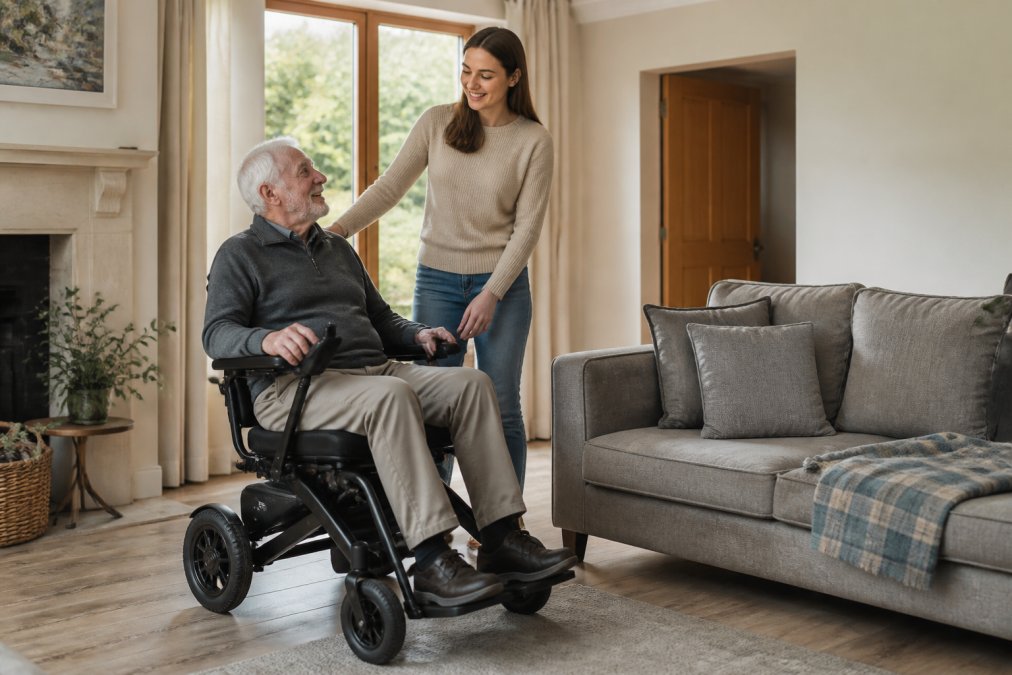
| Model | Price | Weight | Max Load | Range | Best For |
|---|---|---|---|---|---|
| LiteMax 2 | £794.99 | 20 kg | 120 kg | Up to 25 miles | Budget-conscious buyers, indoor/outdoor |
| Firefly | £849.99 | 14.5 kg | 100 kg | Up to 12 miles | Ultra-light portability, daily trips |
| LitePro 2 | £899.99 | 20 kg | 120 kg | Up to 24 miles | Dual-battery flexibility |
| Freedom Elite ST | £1,095.50 | 26 kg | 160 kg | Up to 22 km | Multi-terrain, heavier users |
| Evora Carbon | £1,249.99 | 13 kg | 120 kg | Up to 12 miles | Maximum portability, travel |
Etech Mobility Firefly - 14.5 kg Folding Powerchair (£849.99)
The Firefly is the lightest aluminium-framed powerchair in the Etech Mobility range at 14.5 kg without the battery. It folds in approximately two seconds and stores in a folded footprint of 27 x 57 x 70 cm, using an airline-friendly quick-release 10.4 Ah lithium battery. The 280W brushless motor system is quiet and responsive, with an LCD joystick showing real-time battery status. Range is up to 12 miles on a single charge.
The seat width is 40 cm between the cushion edges, making it one of the narrower options for indoor manoeuvrability. Maximum load is 100 kg. Anti-tip wheels, anti-rollback support, and electromagnetic brakes are standard.
Best for: Active users who prioritise lifting ease and travel convenience over maximum range or load capacity.
LiteMax 2 - Affordable All-Rounder at £794.99
The LiteMax 2 weighs 20 kg with a 30 cm rear wheel and 19 cm front wheel configuration that improves stability. It offers a choice of standard 12 Ah or long-range 20 Ah battery, giving a range of up to 15 miles or 25 miles respectively. The 46 cm seat width between armrests is generous for this price point, and the thickened breathable cushion provides meaningful comfort on longer outings. Front and rear shock-absorbing suspension makes a noticeable difference on uneven pavements.
The LiteMax 2 folds to 26 x 58 x 78 cm and carries UKCA certification. Remote control for carer operation is included as standard.
Best for: First-time powerchair buyers who want a reliable, versatile daily mobility aid at the lowest entry price.
LitePro 2 - Dual-Battery Flexibility at £899.99
The LitePro 2 addresses range anxiety through its dual-battery system, allowing a second 10 Ah battery to be added alongside the standard unit, doubling the range from 12 to 24 miles without carrying a spare separately. The intelligent control system adapts to live riding conditions, translating to smoother performance on inclines and uneven surfaces. At 20 kg with a folded size of 74 x 28 x 65 cm, it is compact enough for most car boots.

Maximum load is 120 kg, and the 46 cm seat width between armrests matches the LiteMax 2. Brushless 250W motors per side keep the drive quiet and largely maintenance-free.
Best for: Users who regularly travel beyond 12 miles in a day and want the security of extended range without switching chairs.
Freedom Elite ST - Multi-Terrain Capability at £1,095.50
Most lightweight powerchairs are built for smooth surfaces. The Freedom Elite ST handles gravel, hard sand, and short grass through its 32 cm rear wheels with TPE honeycomb front tyres. The brushless motor drive totals 600W across two 300W units, supporting a maximum load of 160 kg, the highest capacity in the Etech Mobility range.
Twin battery slots allow a second battery to be mounted simultaneously, and the battery can be removed while the chair remains folded in the boot. Range is up to 22 km on a single battery. Folded dimensions are 44 x 62 x 76 cm.
Best for: Users who need multi-terrain capability, heavier load support, or who regularly use the chair outdoors on mixed surfaces.
Carbon Fibre Electric Wheelchair Benefits: Is the Evora Carbon Worth It?
The Evora Carbon weighs 12.9 kg without its battery, making it one of the lightest powerchairs available in Britain. The full carbon fibre frame is naturally corrosion-resistant, which matters for users who travel frequently or live in coastal areas where aluminium frames can degrade. Carbon fibre also has a higher stiffness-to-weight ratio than aluminium, meaning the frame flexes less under load.
The Evora Carbon's folded width of just 22 cm is its most distinctive specification. That measurement means it fits into car boots, caravans, and narrow storage spaces that would exclude many other models.
Practical specifications: 250W brushless motors, 24V 10 Ah airline-friendly battery, up to 12 miles range, 45 cm seat width, 120 kg maximum load, IPX4 water resistance, and dual electromagnetic braking. It carries UKCA, CE, and BS EN 12184:2022 (Class 2) certification.
At £1,249.99, the Evora Carbon costs more than the aluminium alternatives. Whether it is worth it depends on how often you lift the chair alone. If the answer is daily, the weight saving justifies the price difference for most buyers.
Folding Mechanisms, Portability and Boot Compatibility
The folding mechanism is where many lightweight wheelchairs fail in practice. A chair that requires two hands, a specific sequence of steps, or significant force to fold is not genuinely practical for a user with limited dexterity or a carer working alone.
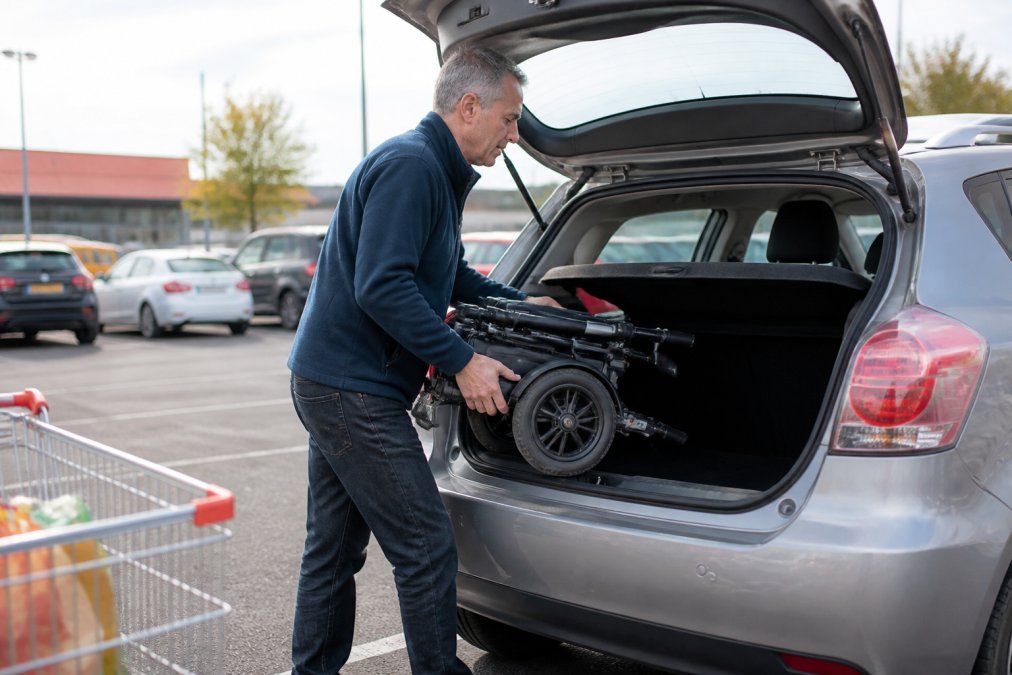
The Firefly and Evora Carbon both fold in approximately two seconds with a single lifting motion. The LitePro 2 and LiteMax 2 use a similar quick-fold mechanism. The Freedom Elite ST takes slightly longer due to its larger frame, but remains manageable for most users.

Boot compatibility is not just about folded length. Width and height matter equally. A folded chair that is 70 cm tall will not fit under the parcel shelf of many hatchbacks. The Evora Carbon's folded dimensions of 76 x 22 x 69 cm make it the most boot-friendly option. As Which? guidance on mobility scooters and wheelchairs notes, buyers should measure their boot opening height and width before purchasing, not just the boot depth.
Quick-release wheels on some models allow the chair to be broken down further for very tight storage. Puncture-proof tyres across the Etech Mobility range eliminate the risk of a flat tyre leaving a user stranded.
Ergonomic Assessment for Carers
The ergonomic needs of the carer are rarely discussed in wheelchair buying guides. A carer who lifts a 26 kg chair from a car boot multiple times a day is at genuine risk of musculoskeletal injury, particularly to the lower back and shoulders.
Health and Safety Executive guidance on manual handling recommends that lifting tasks be assessed individually, with particular attention to load weight, lift frequency, and the posture required. For carers, the total weight of the powerchair, including battery, is the figure that matters.
For carers who are not very tall or who have their own back or shoulder conditions, the Firefly at 14.5 kg or the Evora Carbon at 13 kg are the most appropriate options.
Mobility Equipment VAT Relief UK: What Wheelchair Buyers Should Know
VAT relief on mobility equipment is one of the most underused financial benefits available to wheelchair buyers.
VAT relief allows eligible individuals to purchase certain disability aids, including electric wheelchairs, without paying the standard 20% VAT rate. The relief applies at the point of sale, not as a rebate claimed afterwards.
To qualify, the buyer must have a physical or mental impairment that has a long-term and substantial adverse effect on their ability to carry out everyday activities. This is the definition used under the HMRC guidance on VAT relief for disabled people framework. You do not need a formal diagnosis letter in every case, but you must meet the eligibility criteria and make a declaration to the supplier.
The practical saving is meaningful. On a £1,249.99 purchase like the Evora Carbon, VAT relief reduces the cost by approximately £208. On the Freedom Elite ST at £1,095.50, the saving is approximately £182.
Choosing the right lightweight wheelchair involves more decisions than most buyers anticipate, from frame material and folding mechanism to boot compatibility and carer ergonomics. Etech Mobility's range addresses each of these considerations directly, with models spanning £794.99 to £1,249.99 and covering everything from ultra-light carbon fibre travel chairs to multi-terrain powerchairs for heavier users. Every model carries UKCA certification, includes free UK delivery, and is backed by UK-based customer support. Contact Etech Mobility to discuss which model fits your specific needs and to confirm VAT relief eligibility before you order.
Frequently Asked Questions
What is the best lightweight travel wheelchair available?
The best choice depends on whether you need a manual transit chair or a powered model. For electric options, the Etech Mobility Evora Carbon at 13 kg and the Firefly at 14.5 kg are among the lightest folding powerchairs available. Both use puncture-proof tyres, fold in seconds, and carry airline-friendly batteries. If you need a manual transit wheelchair, look for an aluminium alloy frame under 10 kg with attendant brakes and quick-release wheels for easy car boot storage.
How do carbon fibre wheelchairs compare to aluminium models?
Carbon fibre frames are lighter and naturally corrosion-resistant, making them easier to lift and transport repeatedly. The Evora Carbon, for example, weighs just 13 kg compared to aluminium alternatives that typically sit between 18 and 26 kg. Aluminium alloy frames cost less and still offer good rigidity for daily use. For users who lift their chair in and out of a car boot daily, or travel frequently, the weight saving from carbon fibre is a practical advantage rather than a luxury.
Can I get VAT relief on a lightweight wheelchair?
Qualifying disabled people and those with long-term conditions can purchase certain mobility aids, including wheelchairs, free of VAT under HMRC's zero-rating scheme for disabled people. To claim, you complete a VAT eligibility declaration confirming your condition at the point of purchase. This can reduce the cost meaningfully. Eligibility criteria and the exact products that qualify are set by HMRC, so check the current guidance on GOV.UK or ask your supplier before buying.
Will a lightweight folding electric wheelchair fit in a small car boot?
Most compact folding powerchairs are designed with car boot storage in mind, but dimensions vary significantly. The Evora Carbon folds to just 76 x 22 x 69 cm, making it one of the narrowest folded profiles available. The Firefly folds to 27 x 57 x 70 cm. Always compare the folded dimensions against your specific boot opening before buying. Removing the battery before lifting also reduces the weight you need to manage by around 2 kg on most models.
What weight capacity do lightweight wheelchairs typically support?
Weight capacity varies across models. The Etech Mobility LiteMax 2 and LitePro 2 both support up to 120 kg, the Evora Carbon supports 120 kg, and the Freedom Elite ST supports up to 160 kg. The Firefly has a maximum load of 100 kg. Always check the specified weight limit before purchasing, as exceeding it affects both safety and long-term frame rigidity. If you are close to the limit of a lighter model, stepping up to a heavier-duty frame is the safer choice.