
Easiest Folding Powerchair for Arthritis: A Practical Guide
Table of Contents
- How to Assess Your Needs for a Folding Powerchair
- Key Features to Look for in a Folding Powerchair for Arthritis
- Carbon Fibre Electric Wheelchair Benefits for Arthritis Users
- Best Powerchair for Limited Hand Dexterity: Automatic Folding Options
- Step-by-Step: How to Fold Your Powerchair Safely with Arthritis
- VAT Relief for Mobility Aids and Funding Your Folding Powerchair
- Conclusion
Last Updated: August 25, 2026
How to Assess Your Needs for a Folding Powerchair
Choosing the easiest folding powerchair for arthritis means understanding what your body can realistically handle. This isn't about finding the lightest model on the market, it's about matching the chair's mechanics to your physical capacity, particularly your hand strength, grip ability, and joint flexibility.
Start by honestly evaluating your current limitations. Can you grip a joystick comfortably for extended periods? How much force can you apply with your hands before pain sets in? Can you reach down to operate a manual folding mechanism, or does bending aggravate your shoulders and wrists? These questions matter more than any specification sheet.
Test your grip strength by holding a pen or pencil for a few minutes. If your fingers tire quickly or you experience joint pain, you'll need a powerchair with either automatic folding or an exceptionally light manual fold mechanism. Many people with arthritis assume they need a powerchair when what they actually need is a manual wheelchair, but if walking or self-propelling causes pain, a powered solution becomes essential for maintaining independence.

Consider your storage space and transport method. If you're lifting the chair into a car boot, even a "lightweight" model becomes burdensome after repeated lifts. Users with shoulder or hand arthritis often benefit from automatic folding models precisely because they eliminate the repetitive gripping and lifting involved in manual folding.
Document your typical usage patterns. Are you travelling weekly, or is this for occasional outings? Do you need to navigate narrow doorways at home? Will you be using it indoors, outdoors, or both? Your answers will guide you toward features like turning radius, seat width, and battery range that actually matter for your lifestyle.
Key Features to Look for in a Folding Powerchair for Arthritis
The easiest folding powerchair for arthritis isn't determined by weight alone, it's the combination of folding mechanism, control system, and ergonomic design that makes daily use pain-free.
Automatic folding mechanisms eliminate the need for manual dexterity altogether. Instead of gripping handles and applying force, you press a button and the chair folds itself. This single feature transforms the experience for people with hand or shoulder arthritis. The mechanism should engage smoothly without requiring you to guide or hold anything, it does the work for you.

Joystick controllers designed for limited hand dexterity feature larger, softer grips that require minimal squeezing force. Look for controllers with adjustable sensitivity, so you can operate the chair with light finger movements rather than firm gripping. Some models allow you to control speed gradually, preventing jerky acceleration that strains your joints.
Lightweight frame construction matters, but context matters more. A frame weighing 20 kg feels manageable when you're loading it once a day, but becomes painful if you're lifting it repeatedly or if your shoulders are compromised. Carbon fibre frames offer the best balance, they're significantly lighter than steel while maintaining durability and stability. The British Healthcare Industries Association recognises carbon fibre as a material that enhances portability without sacrificing safety standards.
Seat comfort and adjustment directly impact how long you can use the chair without pain. Look for:
- Adjustable armrests that support your forearms without forcing your shoulders into uncomfortable positions
- Footrest height adjustment to prevent pressure on your legs
- Seat cushioning that reduces pressure points during extended use
- Backrest recline options if you need postural support
Battery range and charging prevent the anxiety of running out of power mid-outing. Models with 15-20 km range suit most daily activities. Quick-charge options (4-6 hours) are more practical than overnight charging if you use the chair frequently.
Turning radius and manoeuvrability determine whether you can navigate your home and favourite shops comfortably. A tight turning radius (under 1 metre) lets you move through narrow corridors and aisles without assistance or frustration.
Carbon Fibre Electric Wheelchair Benefits for Arthritis Users
Carbon fibre transforms the experience of using a powerchair when arthritis limits your strength. Unlike steel or aluminium frames, carbon fibre offers a specific advantage: exceptional strength-to-weight ratio. This means the frame can support your full weight whilst remaining light enough to lift without excessive strain.
The material's rigidity also matters. Carbon fibre absorbs vibrations from uneven surfaces more effectively than lighter materials, reducing joint stress during outdoor use. When you're navigating pavements or garden paths, this vibration dampening translates to less jarring impact on arthritic joints.
Durability is another often-overlooked benefit. Carbon fibre frames resist corrosion and don't require the maintenance that metal frames demand. For people managing chronic conditions, the simplicity of minimal upkeep means fewer trips to repair services and more reliable independence.
The weight advantage compounds over time. A standard steel powerchair might weigh 35-40 kg; a carbon fibre equivalent weighs 18-22 kg. Over a year of loading and unloading, that difference prevents cumulative strain injuries.
Cost is the trade-off. Carbon fibre construction increases the initial price, but users with arthritis often find the investment worthwhile because it directly reduces daily pain. The National Institute for Health and Care Excellence recognises that reducing pain-inducing activities improves quality of life and functional independence for people with chronic joint conditions.
Etech Mobility's carbon fibre range, including the Automatic Folding Lightweight Electric Wheelchair Freedom Elite AF, combines this material advantage with automatic folding, making it one of the easiest folding powerchair options for arthritis users who prioritise both portability and comfort.
Best Powerchair for Limited Hand Dexterity: Automatic Folding Options
When hand dexterity is compromised by arthritis, automatic folding becomes non-negotiable rather than a convenience feature. The easiest folding powerchair for arthritis in this category removes the physical barrier entirely.
Automatic folding systems work by pressing a single button, typically on the armrest or a remote control, that triggers motorised hinges to collapse the frame. You don't grip, pull, or guide the mechanism. The chair does the work. For people with weak grip strength, limited finger mobility, or pain when gripping, this eliminates the most frustrating part of ownership.
The Automatic Folding Electric Wheelchair Freedom Pro AF at £995.50 represents the entry point for automatic folding. It folds to a compact size suitable for most car boots, supports up to 160 kg, and operates via remote control, meaning you can fold the chair from a distance without approaching it physically.
For users requiring a wider seat or additional comfort features, the Automatic Folding Lightweight Electric Wheelchair Freedom Elite AF at £1,195.50 offers enhanced ergonomics alongside the same automatic folding mechanism. The brushless motor runs more quietly and requires less maintenance than traditional motors.
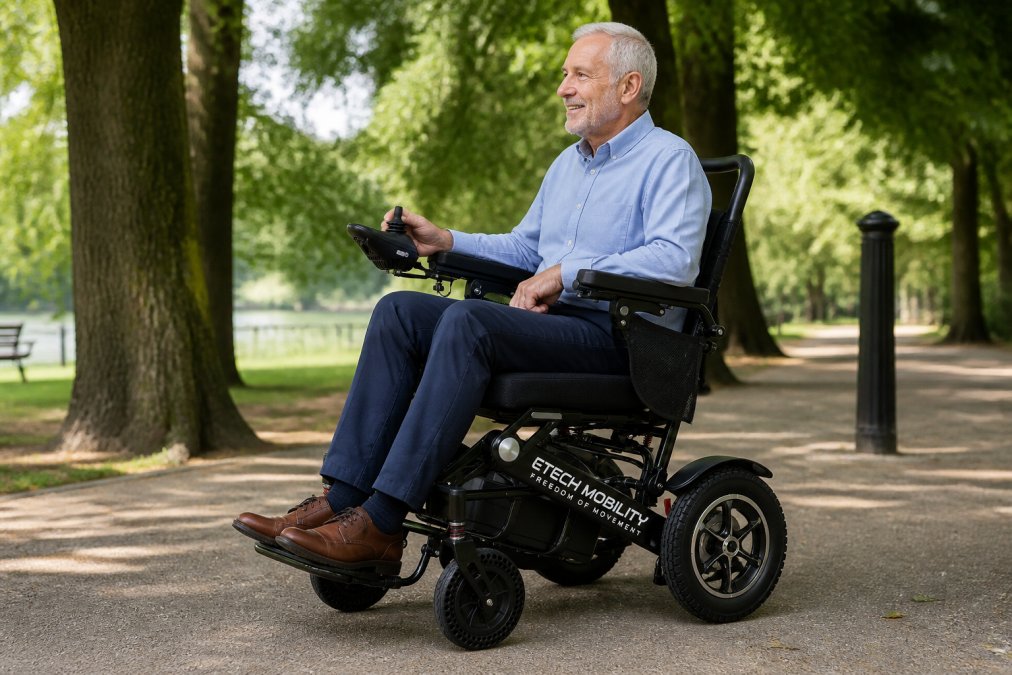
Remote control folding is particularly valuable for people who travel with caregivers. The caregiver can fold the chair without the user needing to operate it, or the user can fold it independently from their seat. This flexibility prevents dependency whilst maintaining the option for assistance when needed.
Joystick sensitivity adjustment is equally important. Standard joysticks require firm, deliberate movements. For arthritis users, sensitivity settings allow operation with minimal finger movement, sometimes just resting your finger on the stick triggers motion. This reduces fatigue and joint stress during longer outings.
A common mistake is assuming all automatic folding powerchairs are equally easy to use. Some require you to hold a button continuously whilst the chair folds, exhausting for people with weak grip. The best models fold with a single press, completing the sequence automatically without ongoing input.
Step-by-Step: How to Fold Your Powerchair Safely with Arthritis
Even with automatic folding, understanding the process protects your chair and your joints. Here's how to fold safely when arthritis affects your strength or mobility.
Step 1: Position the powerchair correctly. Move to a flat, stable surface with adequate space on both sides. Ensure the chair is on level ground, folding on an incline can strain the mechanism and your balance. If you're outdoors, move to the flattest available spot.
Step 2: Check the battery level. Most automatic folding systems require battery power to operate. If your battery is critically low, the fold mechanism may not engage. Aim to fold when battery is above 20% charge.
Step 3: Activate the folding mechanism. Press the button on the remote control or armrest designated for folding. Hold steady and wait, don't press repeatedly or apply additional force. The mechanism will engage and the frame will collapse automatically. This typically takes 10-15 seconds.
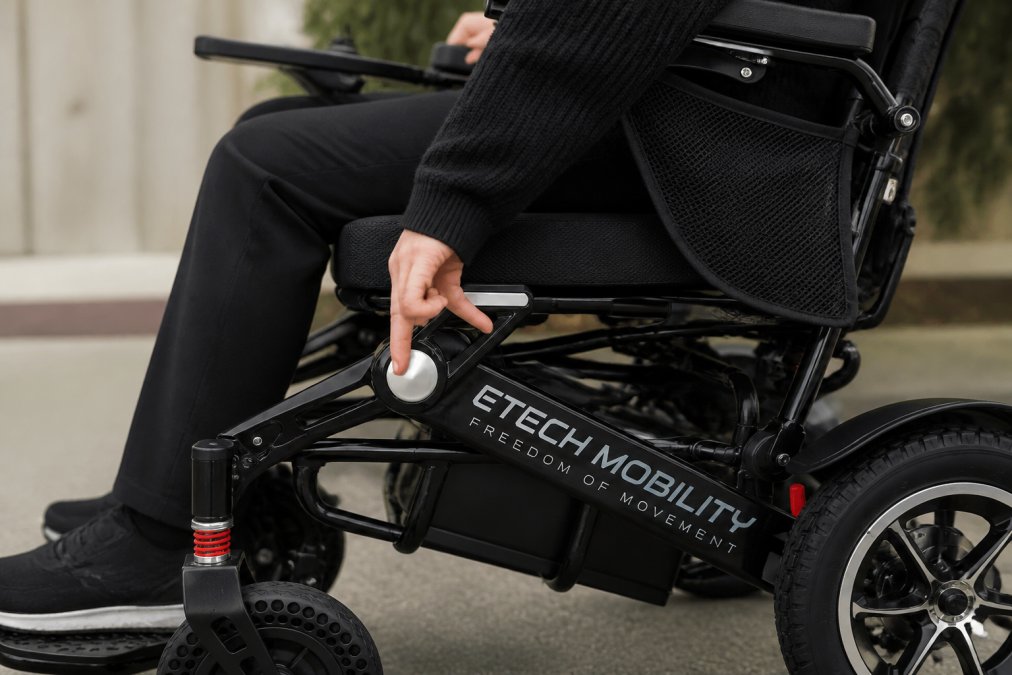
Step 4: Guide the frame as it collapses. Once the mechanism engages, lightly guide the frame with your hands, don't fight it or apply pressure. Your role is to steady it, not power it. If resistance develops, stop immediately and check for obstacles.
Step 5: Secure the folded position. Most powerchairs have a latch or strap that locks the folded frame. Engage this firmly but without excessive force. A properly secured fold prevents the chair from accidentally unfolding during transport.
Step 6: Lift with your legs, not your joints. This is critical for arthritis management. Position your feet shoulder-width apart, bend at the knees and hips, and lift using your leg muscles. Keep the chair close to your body. If it weighs more than 20 kg and you have significant arthritis, ask for assistance, there's no prize for managing alone.
Step 7: Load into your vehicle. Place the folded chair in your boot at an angle if needed to fit. Secure it so it doesn't shift during transport. Never stack heavy items on top of the chair.
Common mistakes include trying to fold the chair whilst seated (impossible and dangerous), forcing the mechanism if it meets resistance (indicates a problem), and lifting with your back or arms rather than your legs. If folding causes pain at any stage, stop and reassess, the mechanism or your approach needs adjustment.
VAT Relief for Mobility Aids and Funding Your Folding Powerchair
The cost of an easiest folding powerchair for arthritis is significant, but several funding pathways exist in the UK that many people overlook.
VAT relief on mobility aids is available for people with disabilities. If you're eligible, VAT (currently 20%) is waived on the purchase price. This reduces the cost of a Freedom Pro AF from £995.50 to approximately £829.58. To claim VAT relief, you must be registered as disabled with your local authority or meet specific criteria. HM Revenue & Customs guidance on VAT relief for disabled people provides the full eligibility criteria and application process.
Motability scheme is worth investigating if you receive certain disability benefits. The scheme provides access to a new car, scooter, or wheelchair every three years through a simple lease arrangement. Eligibility depends on receiving specific benefits like Personal Independence Payment (PIP) or Disability Living Allowance (DLA). Contact Motability directly to explore whether a powerchair suits your needs.
Local authority funding varies by region, but many councils provide grants or loans for mobility equipment through their adult social care services. Request an assessment from your local authority's occupational therapy team. They evaluate your needs and may fund equipment partially or fully depending on your circumstances and local budgets.
Charitable organisations supporting people with arthritis sometimes offer grants for mobility equipment. The Versus Arthritis (formerly Arthritis Care) maintains a directory of funding sources and can advise on eligibility.
Private insurance and occupational health schemes occasionally cover mobility equipment if recommended by a healthcare professional. Check your policy or speak with your employer's occupational health service.
Etech Mobility's approach is to help you navigate these options. Our team can advise on VAT relief eligibility and point you toward funding schemes relevant to your situation. We also offer flexible payment options to make the investment more manageable.
Conclusion
Finding the easiest folding powerchair for arthritis comes down to matching the chair's mechanics to your physical capacity. Automatic folding eliminates the barrier of manual dexterity, lightweight carbon fibre construction reduces daily strain, and ergonomic controls adapt to limited hand strength. The investment is substantial, but funding pathways and VAT relief make it accessible for many.
At Etech Mobility, we specialise in exactly this challenge. Our Freedom Pro AF and Freedom Elite AF models combine automatic folding with lightweight construction and intuitive controls, designed specifically for people managing arthritis whilst maintaining independence. With free UK delivery and personalised guidance to find the right model for your needs, we're here to support your mobility journey. Contact us to discuss your requirements and explore which powerchair suits your lifestyle best.
Frequently Asked Questions
Q: What features make a folding powerchair easiest to use if I have arthritis?
A: Look for automatic folding mechanisms that work at the touch of a button, eliminating the need for manual strength. Ergonomic joystick controllers with soft grip handles reduce strain on arthritic hands. Lightweight frames and compact designs make storage and transport easier. Adjustable armrests and footrests allow you to customise comfort, and shock absorption features reduce vibration that can aggravate joint pain during travel.
Q: Can I get VAT relief when buying a folding powerchair for arthritis?
A: VAT relief for mobility aids may be available if your powerchair is prescribed as a medical device or if you meet specific criteria. Check with HM Revenue and Customs or your healthcare provider about eligibility. Some suppliers can apply VAT relief at point of purchase if you provide the necessary documentation. Contact Etech Mobility directly to discuss your circumstances and what documentation you may need.
Q: What is the lightest folding powerchair available, and will I be able to lift it into my car?
A: Modern folding powerchairs typically weigh between 20-30 kg when folded. Carbon fibre models from Etech Mobility are among the lightest available, designed specifically for easy lifting and storage. However, weight capacity, battery size, and frame material affect final weight. If you have limited upper body strength, automatic folding models or seeking assistance for loading may be more practical than attempting to lift heavier models alone.
Q: How far can I travel on a single charge, and what happens if the battery runs out?
A: Most modern folding powerchairs offer a travel range of 15-25 km per charge, depending on terrain, user weight, and driving style. Battery life varies by model. Plan journeys within your chair's range, and consider carrying a portable charger for longer outings. If the battery does deplete, you can switch to manual operation on some models, or contact your supplier for roadside assistance. Always check your specific model's specifications and battery performance before extended trips.