
Electric Wheelchairs for Small Boots: A Practical Guide
Table of Contents
- Why Boot Space Matters When Choosing an Electric Wheelchair
- How to Measure Your Car Boot for a Powerchair
- Lightweight Folding Electric Wheelchair Dimensions That Fit
- Lifting Technique and Ergonomics for Solo Transport
- Wheelchair Lifts for Cars: Manual and Powered Options
- Portable Electric Wheelchair Dimensions: What Fits Where
- Top Models That Actually Fit Small Boots
- Conclusion
Last Updated: August 22, 2026
Why Boot Space Matters When Choosing an Electric Wheelchair
Finding the right electric wheelchair for small boots is one of the most practical decisions you'll make if you rely on a powerchair for independence. The reality is stark: a chair that doesn't fit your car becomes a chair you won't use. You'll leave it at home, revert to manual mobility, or avoid outings altogether. That defeats the entire purpose of owning a portable device.
Boot space dictates everything. It determines whether you can travel independently, visit friends without logistical stress, or manage essential errands without depending on others. Many users discover this problem too late, after purchasing a chair that looked compact on paper but refuses to fold into their vehicle. At Etech Mobility, we've designed our range of lightweight folding electric wheelchairs specifically for vehicles with limited cargo space.

The relationship between chair dimensions and vehicle capacity isn't intuitive. A chair that weighs less doesn't automatically mean it folds smaller. Frame material, motor placement, and folding mechanism all affect the final dimensions. Carbon fibre construction, for instance, allows chairs to be both lighter and more compact than traditional aluminum designs, but only if engineered correctly.
How to Measure Your Car Boot for a Powerchair
Before shopping for any electric wheelchair, measure your boot accurately. Most people estimate, and most estimates are wrong. You need precise measurements to ensure a folded powerchair will actually fit.
Start by opening your boot fully and clearing it completely. Remove any spare wheel covers, tool kits, or permanently installed storage. You're measuring usable space, not theoretical space.
Measure three dimensions: depth (from the boot opening to the back wall), width (from side to side at the widest point), and height (from the floor to the underside of the boot lid when closed). Use a rigid tape measure, not a fabric one. Measure at multiple points along the depth and width, boots aren't always uniform. Note the smallest width measurement, as that's your actual constraint.
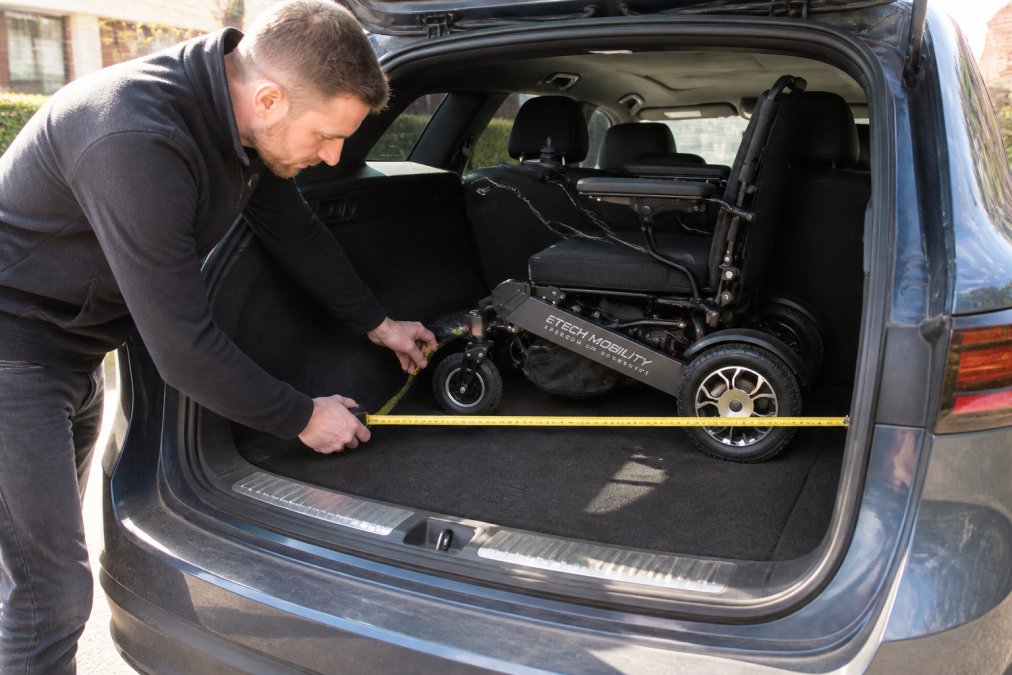
Write these measurements down. Many people measure once, remember "about 60 centimetres" and then wonder why their new chair doesn't fit. Precision matters here.
Next, check whether your boot has wheel arches that protrude inward. These reduce usable width significantly. Measure around them, not across them. Also note if your boot floor is flat or slopes upward toward the back, this affects how a folded chair will sit.
Finally, measure the opening height and width. Some folded chairs are compact in length but tall or wide when folded. Your chair needs to fit through the boot opening, not just fit inside the boot space. A chair that's 65 centimetres long but 85 centimetres tall won't enter a boot with a 75-centimetre opening height, no matter how much space you have inside.
Lightweight Folding Electric Wheelchair Dimensions That Fit
Once you know your boot measurements, you're ready to evaluate chairs. The critical dimension isn't weight, it's folded size. A 15-kilogramme chair that folds to 85 centimetres long is useless if your boot is only 70 centimetres deep.
Lightweight folding electric wheelchairs typically fold to one of three configurations: compact length (under 75 centimetres), ultra-compact (under 65 centimetres), or split-frame designs where the motors detach, reducing the main frame to under 50 centimetres.
Compact length chairs (70-80 centimetres when folded) are the most common. They balance portability with usable seat width and legroom. Most modern cars have boots deep enough for this range. The Etech Mobility Converge 180, for example, folds to a manageable size while maintaining a 180-kilogramme user weight capacity and removable motors that reduce lifting burden.
Ultra-compact designs (under 65 centimetres) are genuinely portable but come with trade-offs. Seat width is often reduced, and legroom can feel cramped on longer journeys. These suits active users making frequent short trips rather than all-day outings.
Split-frame designs are a different approach entirely. The motors detach from the frame, allowing you to lift the main chair frame (often 10-16 kilogrammes) separately from the motors (typically 3-5 kilogrammes each). This is genuinely easier for people with limited upper body strength, though it adds setup time. The Converge 180 uses this approach effectively, the split design reduces individual lift weight significantly, which matters if you have arthritis or shoulder issues.
Width when folded is often overlooked but critical. A chair that's 70 centimetres long but 55 centimetres wide might not fit through a boot opening that's 50 centimetres wide. Always check both folded length and folded width before committing to a model.
Lifting Technique and Ergonomics for Solo Transport
Fitting a chair into your boot is only half the problem. Lifting it there is the other half. Many users can physically manage the weight but injure themselves through poor technique. Others have shoulder or back conditions that make lifting genuinely difficult, regardless of weight.
The standard lifting mistake is bending at the waist with straight legs, then using your back to generate force. This loads your lower back and shoulders with dangerous use. Instead, bend your knees, keep the chair close to your body, and let your legs do the work. booking wheelchair taxis.
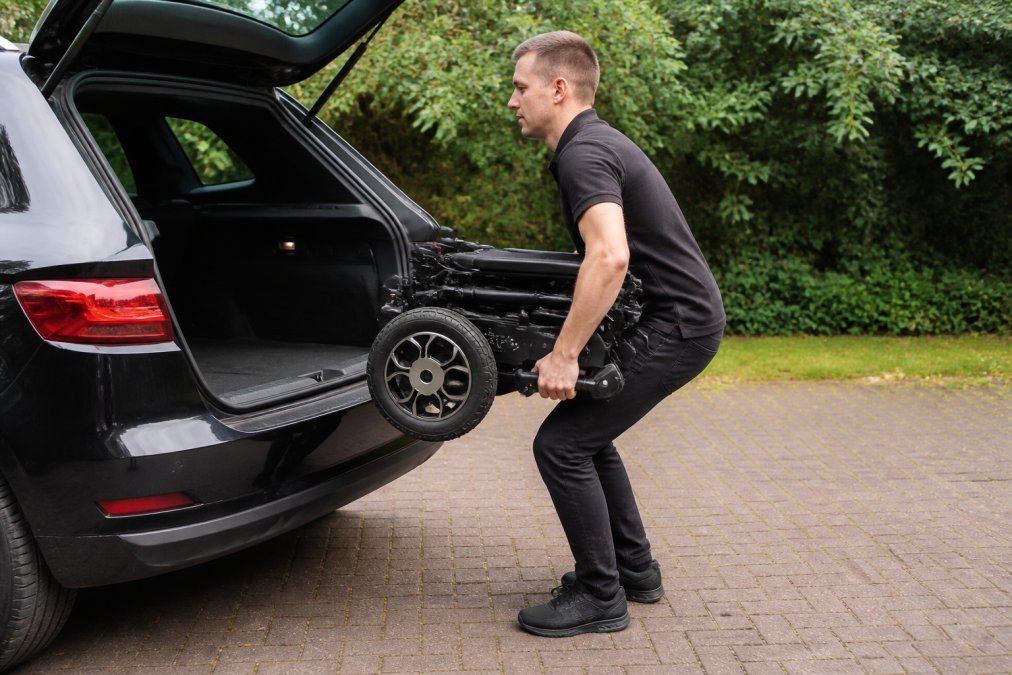
Position yourself facing the boot opening. Hold the chair frame with both hands, keeping it as close to your torso as possible. Bend your knees deeply, your thighs should be nearly parallel to the ground. Drive the lift through your legs, not your arms or back. Your arms are just guides; your legs provide the force.
Pivot your hips as you lift, rotating your entire body toward the boot rather than twisting at the waist. Twisting under load is where back injuries happen. Keep the chair close throughout the entire movement. The moment it drifts away from your body, use multiplies and injury risk increases dramatically.
For people with arthritis or limited shoulder mobility, split-frame designs change everything. Instead of lifting one 20-kilogramme object, you're lifting a 12-kilogramme frame and two 4-kilogramme motors separately. The reduced weight per lift is often the difference between managing independently and needing help every time.
If you have significant upper body weakness, a wheelchair lift is worth considering. Manual lifts cost £400-800 and require installation but eliminate lifting entirely. Powered lifts start around £1,200 and do the work for you. For people with progressive conditions or chronic pain, this investment often pays for itself in reduced injury risk and maintained independence.
Common mistake: rushing the lift. Taking an extra five seconds to position yourself correctly prevents weeks of recovery from a strained shoulder. Slow, controlled lifts with proper technique beat fast, careless ones every time.
Wheelchair Lifts for Cars: Manual and Powered Options
If lifting isn't realistic for you, whether due to age, strength limitations, or chronic conditions, a wheelchair lift transforms everything. You're no longer dependent on finding someone to help you load and unload.
Manual wheelchair lifts use a mechanical arm that pivots down from your boot. You position your folded chair on the platform, then manually crank or lever it up into the boot. These lifts cost £400-800 installed and require no power source. They're reliable and low-maintenance. The trade-off is that you're still doing the physical work, just in a more ergonomic position. If you have limited arm strength, a manual lift might not solve your problem.
Powered lifts are the premium option. They use an electric motor to raise and lower your chair automatically. You position the chair on the platform, press a button, and the lift does the rest. Installation costs £1,200-2,000 depending on your vehicle and the lift model. They require a connection to your car's electrical system, which adds complexity but is manageable for most mechanics.
The decision between manual and powered comes down to your physical capability and budget. Manual lifts work well for people with good arm and shoulder function who simply want to avoid the twisting and bending required for traditional lifting. Powered lifts suit people with significant upper body limitations or those managing progressive conditions where capability may decline over time.
One consideration: both lift types reduce your boot capacity. A powered lift takes up permanent space and adds weight to your vehicle. Manual lifts are more compact but still occupy boot real estate. Factor this into your decision if you regularly transport other items.
Portable Electric Wheelchair Dimensions: What Fits Where
Beyond your car boot, portability extends to your home and social spaces. A chair that fits your boot but doesn't fit through your hallway or bathroom door creates different problems.
Measure your home doorways and hallways. Standard UK doorways are 775 millimetres wide; older properties are often narrower at 700 millimetres (gov.uk). Bathrooms can be tighter still. Your chair needs to navigate these spaces comfortably. Most modern electric wheelchairs have turning radiuses between 600 and 850 millimetres, which affects whether they can rotate in tight spaces like kitchens or bathrooms (peer-reviewed research).
When evaluating portable electric wheelchair dimensions, consider both the footprint (length and width when in use) and the folded size. A chair might be compact when folded but have a wide turning radius, making it difficult to maneuver indoors despite being portable for travel.
The Etech Mobility Firefly, for instance, offers a balance: lightweight enough for practical transport (14.5 kilogrammes), compact when folded, but with a reasonable turning radius for indoor use. The Evora Carbon pushes portability further with a 13-kilogramme weight and ultra-narrow 22-centimetre fold, making it exceptional for travel while maintaining usable indoor maneuverability.

Ground clearance is another practical dimension. If you have thresholds, ramps, or uneven outdoor surfaces, ground clearance matters. Most lightweight folding chairs have 50-75 millimetres of clearance, which handles standard kerbs but struggles with steep ramps or significant obstacles (peer-reviewed research).
Top Models That Actually Fit Small Boots
Not all lightweight folding electric wheelchairs are created equal. Here's what actually works for small boot spaces.
Etech Mobility Converge 180, the top choice for small boots with practical lifting in mind. Folds to a manageable size with removable motors that reduce individual lift weight to 16 kilogrammes for the main frame. The split design is genuinely easier for people with shoulder issues. Price: £1,599.99. Best for: users who need reduced lifting weight and don't mind the extra setup step of detaching motors.
Etech Mobility Evora Carbon, ultra-lightweight at 13 kilogrammes with an extraordinary 22-centimetre fold. This is the most compact option available. Carbon fibre construction keeps weight down without sacrificing durability. Price: £1,249.99. Best for: active users prioritizing portability above all else, frequent travellers, and people with limited upper body strength.
Etech Mobility Firefly, the value option that doesn't compromise. At 14.5 kilogrammes with brushless motors for reliability, it folds compactly and handles daily use without drama. Price: £849.99. Best for: users wanting proven reliability and portability without premium pricing.
Etech Mobility LiteMax 2, entry-level portability at £794.99. At under 15 kilogrammes, it folds to practical dimensions and includes joystick and remote control. Best for: budget-conscious users new to electric wheelchairs who need something genuinely portable.

| Model | Weight | Folded Width | User Capacity | Price |
|---|---|---|---|---|
| Converge 180 | 16kg (main frame) | Compact | 180kg | £1,599.99 |
| Evora Carbon | 13kg | 22cm | 140kg | £1,249.99 |
| Firefly | 14.5kg | Compact | 150kg | £849.99 |
| LiteMax 2 | 15kg | Compact | 130kg | £794.99 |
The choice depends on your specific constraints: boot size, lifting capability, budget, and how much you'll actually use the chair for travel versus daily local mobility.
Choosing an electric wheelchair for small boots isn't about finding the lightest or most compact option in isolation. It's about matching the chair to your actual life: your vehicle's dimensions, your physical capability to lift, your home layout, and how you'll realistically use it. The Etech Mobility range is specifically engineered for UK users facing these practical constraints, with free UK delivery and customer support that understands these challenges firsthand. Contact Etech Mobility to discuss which model fits your specific boot space and lifting requirements, the right chair should enhance your independence, not create new obstacles.
Frequently Asked Questions
How do I measure my car boot for a powerchair?
Measure the boot's length from the back seat to the rear door, width between the wheel arches, and height from the floor to the roof. Note any wheel arches or protruding shapes. Compare your boot dimensions against the folded size of the chair you're considering. Take photos of your measurements to reference when shopping.
Can I lift a lightweight folding electric wheelchair into my car by myself?
Yes, if you choose one under 16 kg. The Converge 180 splits into two 16 kg sections, making it manageable for one person. Lighter models like the Evora Carbon (13 kg) and Firefly (14.5 kg) are easier still. Use proper lifting technique: bend your knees, keep the chair close to your body, and lift with your legs rather than your back. If you have shoulder or upper-back issues, consider a model that separates into smaller pieces or explore powered car lifts.
What is the lightest folding electric wheelchair available?
The Evora Carbon weighs just 13 kg and features a 22 cm ultra-narrow fold, making it one of the lightest full-featured electric wheelchairs. The Firefly is 14.5 kg, and the Converge 180 splits into two 16 kg sections for easier transport. Weight alone doesn't guarantee portability, fold dimensions matter equally for small boots. The Evora Carbon's combination of weight and compact fold makes it ideal for tight spaces.
Do I need a hoist or powered lift to put an electric wheelchair in my car?
Not necessarily. Wheelchairs under 16 kg can usually be lifted manually with proper technique. However, if lifting is painful, you have limited upper-body strength, or your car boot is positioned awkwardly high, a powered car lift or hoist system can make a real difference. Manual wheelchair lifts are also available, they use mechanical leverage rather than electricity. Discuss your specific situation with a mobility advisor to find the right solution for your circumstances.