
Folding Powerchair for Small Cars: 2026 UK Buyer's Guide
Table of Contents
- Why a Folding Powerchair Is the Answer for Small Car Owners
- Measure Your Car Boot Before You Buy
- Lightweight Folding Electric Wheelchairs That Fit Tight Spaces
- Carbon Fibre Powerchair vs Magnesium: Weight and Lifting
- Lifting and Handling: What Your Shoulders Need to Know
- Electric Wheelchair Boot Hoist Requirements: When You Need One
- Battery Range, Charging, and Airline Travel
- Conclusion
- Frequently Asked Questions
Last Updated: September 24, 2026
Why a Folding Powerchair Is the Answer for Small Car Owners
A folding powerchair solves the small-car problem by separating the two jobs a mobility aid has to do: getting you around, and getting you there. Most powerchairs are excellent at the first and hopeless at the second, too heavy to lift, too bulky to fold, and too wide for a boot designed for a weekly shop.
The result is a familiar trap: you buy a capable chair, cannot transport it without help, and it stays at home while your world shrinks to the distance you can travel from your front door. At Etech Mobility, we are dedicated to helping you find the perfect mobility solution for your lifestyle, which is why our lightweight folding electric wheelchairs are built around transportability first.
The numbers behind the problem are stark. The UK's older population is growing, and the Office for National Statistics population estimates show a steady rise in the number of people living with mobility-limiting conditions. Meanwhile, most household cars are getting smaller, not larger.
So this guide starts with your boot, not with the chair.
Below, we cover how to measure your boot opening, which frame materials make lifting realistic, when a hoist becomes necessary, and how battery range and airline rules affect what you can do. By the end you will know which specification fits your car, your shoulders, and your routine.
Measure Your Car Boot Before You Buy
Measure the boot opening first, then the floor, then the depth. The smallest of those three numbers decides which powerchairs are even in the running. Most buyers skip this step and end up choosing between chairs that all fail the same test.
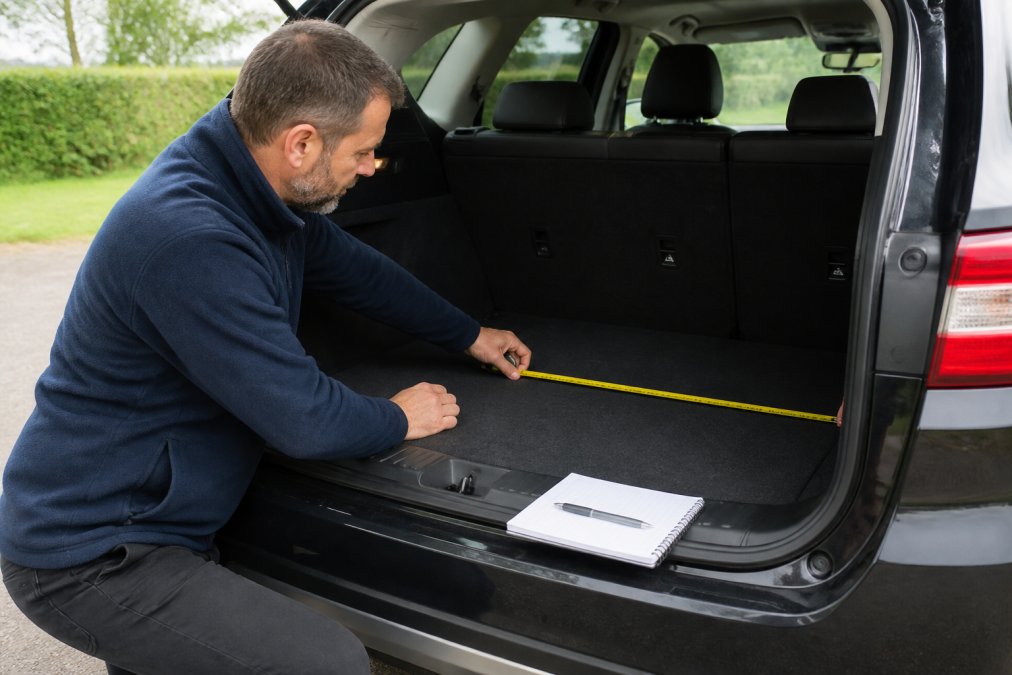
How to Measure Your Boot Opening and Floor
Take three measurements with a retractable tape and write them down before you look at a product page:
- The narrowest point of the opening. Run the tape across the boot lip at its tightest spot, usually between the wheel arches or below the parcel shelf. This is your hard limit.
- The floor width between the wheel arches. Often narrower than you expect on a hatchback.
- The usable depth from the boot lip to the back of the rear seats. This tells you whether a folded chair can sit lengthways or has to go in diagonally.
Then add a working margin: a folded chair needs a few centimetres of clearance to slide in without scraping paint or pinching fingers. If your opening measures 70 cm, treat 65 cm as your maximum.
Height matters less than people think, because folded powerchairs are usually shallow. A chair that folds to 35 cm tall will clear almost any parcel shelf. Width is where small cars bite.
| Measurement | Where to take it | What it decides |
|---|---|---|
| Opening width | Tightest point of the boot lip | Hard maximum for folded width |
| Floor width | Between the wheel arches | Whether the chair sits flat or tilts |
| Depth | Boot lip to rear seat backs | Lengthways or diagonal loading |
| Height | Boot floor to parcel shelf | Whether the shelf must come out |
Lightweight Folding Electric Wheelchairs That Fit Tight Spaces
The best folding powerchair for a tight boot folds narrow rather than merely folding flat. Width eliminates most models, so it is the specification to prioritise above all others.
This is where frame design separates the field. A chair that folds to 22 cm wide slots into spaces a 35 cm fold cannot reach, and that decides whether you load it yourself or wait for help. The Evora Carbon folds to 76 x 22 x 69 cm, the narrowest in Britain at only 22 cm, and weighs 13 kg thanks to a genuine carbon fibre frame. For a small hatchback with a narrow opening, that is the difference between independence and a phone call.

The MagNeo takes a different approach. Its magnesium-alloy frame brings the weight down to 12.3 kg, our lightest chair, and it folds remarkably flat to only 35 cm tall.
Evora Carbon – 13kg Carbon Fibre →
| Model | Weight | Folded size | Price | Best for |
|---|---|---|---|---|
| Evora Carbon | 13 kg | 76 x 22 x 69 cm | £1,249.99 | Narrow boot openings |
| MagNeo | 12.3 kg | 35 cm tall folded | £999.99 | Shallow boots, lightest lift |
| LiteMax 2 | 19.8 kg | 58 cm wide | £794.99 | Stability and longer range |
| Freedom Pro AF | Multi-terrain build | Remote-control fold | £995.50 | Rough ground and slopes |
Carbon Fibre Powerchair vs Magnesium: Weight and Lifting
Carbon fibre wins on strength-to-weight and corrosion resistance; magnesium wins on price per kilogram saved. Both beat aluminium, and both are genuinely liftable by one person. The choice comes down to how much you value the last kilogram and how your shoulders behave on a bad day.
Lifting and Handling: What Your Shoulders Need to Know
Lifting a folded powerchair is a chest-height manoeuvre, not a floor-level deadlift, and that distinction decides whether your shoulders cope. Most loading injuries come from twisting while holding weight away from the body, not from the weight itself.
Three habits make the difference:
- Fold first, lift second. Never lift a partially folded chair. A 13 kg chair that is half open behaves like a 20 kg awkward shape.
- Take the battery out. On the Evora Carbon and MagNeo, the lithium battery is quick-release, so removing it before lifting takes several kilograms out of the equation and gives you a flat, clean grab point.
- Turn your feet, not your spine. Step around to face the boot rather than twisting at the waist with the chair held out in front of you.
Electric Wheelchair Boot Hoist Requirements: When You Need One
A boot hoist is worth considering when the folded weight exceeds what you can lift safely, or when your shoulders, back, or grip make a repeated chest-height lift unwise. Needing one is not a failure; it is a sensible way to keep using a chair you already own.
The decision framework is simple:
- If you can lift the folded chair at chest height without strain, you do not need a hoist.
- If you can lift it but it hurts or you would not want to do it twice a day, a hoist is worth pricing.
- If you cannot lift it at all, a hoist or a lighter chair are the two options, and a lighter chair is usually the cheaper one.
Battery Range, Charging, and Airline Travel
Realistic range depends on rider weight, terrain, temperature, and hills. Published figures describe a best case, so plan around roughly two-thirds of the stated range for everyday confidence.
Conclusion
The gap between a powerchair you use and one that sits in the hallway usually comes down to a tape measure and a set of scales. Measure your boot opening, choose a chair that folds narrower than that number, and pick a weight you can genuinely lift at chest height. Everything else is detail.
Frequently Asked Questions
How do I know if a folding powerchair will fit in my car boot?
Measure your boot's opening width, the internal floor width, and the height from floor to parcel shelf. Then compare those against the chair's folded dimensions. For example, the Evora Carbon folds to 76 x 22 x 69 cm, which fits many small hatchbacks. Always check the folded size listed by the manufacturer, not just the unfolded dimensions, and remember the boot opening is often narrower than the boot floor itself.
Do I need a hoist to put a folding powerchair in a small car?
Not always. If the chair weighs under 15 kg and you can lift it safely, a hoist may be unnecessary. The MagNeo weighs 12.3 kg and the Evora Carbon 13 kg, both light enough for many users to lift without assistance. However, if you have shoulder or back concerns, a boot hoist removes the strain entirely. Your local mobility dealer can assess electric wheelchair boot hoist requirements based on your car and the chair's weight.
What is the lightest folding powerchair available for small car transport?
The MagNeo is the lightest in the Etech Mobility range at 12.3 kg, with a magnesium-alloy frame. The Evora Carbon follows at 13 kg with a genuine carbon fibre frame. Both fold compactly and are designed for easy lifting into a car boot. Lighter chairs generally cost more because of the premium materials, but they make a real difference if you load and unload your chair several times a day.
Are carbon fibre powerchairs worth the extra cost for travel?
Carbon fibre offers a better strength-to-weight ratio than aluminium or steel, so a carbon fibre powerchair is lighter without sacrificing durability. It is also naturally corrosion-resistant. If you frequently lift your chair into a small car or travel by train and plane, the weight saving matters. The Evora Carbon at £1,249.99 weighs 13 kg and folds to just 22 cm wide, making it one of the most compact options for tight boots.