
Folding Powerchair with Long Battery Life: 2026 UK Guide
Table of Contents
- Quick Comparison: Folding Powerchairs Ranked by Battery Range
- What Long Range Really Means on a Folding Powerchair
- Folding Powerchair Battery Range: Tested Figures vs Advertised Claims
- Electric Wheelchair Battery Life: What to Expect Year After Year
- Powerchair Battery Charging and Care: Daily Habits That Protect Range
- How to Choose the Right Folding Powerchair for Your Needs
- Frequently Asked Questions
Last Updated: October 14, 2026
Quick Comparison: Folding Powerchairs Ranked by Battery Range
A folding powerchair with long battery life solves one problem above all others: the fear of being caught short mid-journey.
The honest answer depends on three things: battery capacity in watt-hours, the chair's weight and motor efficiency, and how you ride it. Advertised range figures assume a lighter user, flat ground, mild weather and a steady speed.
Below is how our own range stacks up on paper, using manufacturer specifications.
| Model | Battery | Advertised Range | Charge Time |
|---|---|---|---|
| Horizon 7 | 24V 12Ah (twin-slot) | Up to 24 km per battery | 6-8 hours |
| LiteMax 2 | 24V 12Ah or 20Ah | Up to 24 km or 40 km | 6 or 10 hours |
| Freedom Pro ST | 24V 12Ah (twin-slot) | Up to 24 km | 6 hours |
| Freedom Elite AF | 24V 12Ah (twin removable) | Up to 22 km | 6 hours |
The pattern matters more than the individual numbers. Twin battery slots roughly double your usable range, and that is the single biggest lever you control.

What Long Range Really Means on a Folding Powerchair
Long range on a folding powerchair means a battery large enough to complete your normal day out without charging, plus enough spare capacity to handle cold weather, hills and a heavier load.
Two chairs can both claim "up to 24 km" and behave completely differently. A lighter frame with efficient brushless motors draws less current for the same journey.
Watt-hours tell you more than amp-hours alone. A 24V 12Ah battery holds 288 Wh. A 24V 20Ah battery holds 480 Wh, which is roughly two-thirds more energy in a single unit.

Folding Powerchair Battery Range: Tested Figures vs Advertised Claims
Advertised range is an "up to" estimate, and every reputable manufacturer says so. Our own listings state clearly that range varies with speed, user weight, road surface and outdoor temperature.
That is not a disclaimer to hide behind. It is the honest picture. A 24 km claim assumes favourable conditions. In practice, most riders get somewhere between 60% and 90% of the advertised figure depending on how and where they ride.
What Cuts Your Range Short in Practice
- Cold weather. Lithium-ion batteries lose usable capacity in low temperatures. A winter shopping trip can drain noticeably faster than the same trip in summer.
- Hills and cambers. Climbing draws far more current than flat cruising. A 20% gradient, which our Freedom range handles, is hard work for any battery.
- User weight and load. Heavier riders and loaded baskets increase the energy needed per kilometre.
- Stop-start riding. Constant acceleration in town uses more power than steady cruising on a smooth path.
- Tyre pressure. Soft pneumatic tyres on the Horizon 7 increase rolling resistance. Keep them inflated.
- Speed setting. Running at full speed on the 5-speed selector drains the battery faster than a moderate setting.
Electric Wheelchair Battery Life: What to Expect Year After Year
Electric wheelchair battery life is measured in charge cycles, not calendar years. A lithium-ion battery is generally considered to have reached the end of its useful working life when its usable capacity falls to around 80% of the original figure.
What that means in practice depends on your charging rhythm:
- Charge every other day. At roughly 180 cycles a year, you may see two to three years of strong performance before range noticeably drops.
- Charge daily on long outings. At 300-plus cycles a year, that window shortens to around 18 months to two years.
- Charge only when the battery is low. Fewer, deeper cycles can extend calendar life, but you lose the convenience of always starting full.
A useful rule of thumb: if your advertised 24 km range has fallen to around 19 km or less in the same conditions, the pack is telling you it is nearing replacement.
Replacement Costs and What to Budget
Replacement is straightforward and worth planning for rather than reacting to. Our 24V 12Ah batteries cost £199.99, and the 24V 20Ah extended-range units cost £295.50 to £299.99 depending on the model.

Spread over a typical two-to-three-year lifespan, a 12Ah pack works out at roughly £65 to £100 a year in battery cost.
One thing most buyers miss: buying a second 12Ah battery is often better value than buying one larger battery.
Warranty, Availability and End-of-Life
Before you buy, check three things that determine long-term cost more than the sticker price:
- Warranty cover on the battery. Lithium packs are often covered for a shorter period than the frame and motor, so confirm the battery term separately.
- Replacement availability. A battery you cannot source in two years' time turns a working chair into a paperweight. Ask whether the exact pack will still be stocked.
- Disposal. Lithium batteries should not go in household waste. Most councils accept them at household waste recycling centres, and many retailers will take an old pack back when you buy a replacement.
NHS guidance on mobility aids and equipment
Powerchair Battery Charging and Care: Daily Habits That Protect Range
Charging habits decide how long your battery lasts, and the reason is chemistry. Lithium-ion cells age fastest when they sit at very high or very low charge, and when they are charged or discharged at temperature extremes. Every habit below is really about keeping the pack in its comfortable middle ground.
Horizon 7 – Multi-Terrain Folding Electric Wheelchair with Expandable →
Our chairs charge in 6 hours with a 12Ah battery and 10 hours with a 20Ah unit. On-board charging means you plug the chair in directly.
A few habits that genuinely extend battery life, and why they work:
- Charge before the battery is completely flat, ideally around 20-30% remaining. Deep discharges stress the cells; shallow top-ups are gentler.
- Avoid charging in a cold garage or shed during winter. Charging a cold pack can reduce the charge it accepts and accelerate wear. Let it reach room temperature first.
- If storing the chair for weeks, leave the battery around half-charged and top it up monthly. A pack left flat for months can lose capacity permanently.
- Keep the charging port clean and dry. Moisture in the port is a common cause of charging faults.
- Use the charger supplied with the chair, not a generic substitute. The wrong voltage or current profile can damage the pack and may void the warranty.
Airline Rules and Travel Batteries
Airline acceptance depends on the battery's watt-hour rating, not the chair. Watt-hours are calculated by multiplying voltage by amp-hours: a 24V 12Ah battery is 288 Wh, and a 24V 20Ah battery is 480 Wh.
Most airlines accept lithium batteries up to 300 Wh without special approval, which is why the 288 Wh 12Ah pack is generally treated as airline friendly. Our 20Ah batteries are 480 Wh and are explicitly not airline friendly because they exceed the maximum allowable capacity. If you fly regularly, the 12Ah battery is the one to travel with.
In practice, that means:
- Tell the airline at the time of booking, not at the gate, that you are travelling with a mobility aid and a lithium battery.
- Expect the battery to travel in the cabin where possible, or to be removed and carried separately if the chair goes in the hold.
- Carry the specification sheet or a label showing the watt-hour figure, so staff can verify it quickly.
- Confirm the current rules with your airline before booking, as carriers apply their own limits on top of the general guidance.
What Actually Cuts Your Range in the Real World
Advertised range is an "up to" estimate, and every reputable manufacturer says so. Our own listings state clearly that range varies with speed, user weight, road surface and outdoor temperature. In practice, most riders get somewhere between 60% and 90% of the advertised figure depending on how and where they ride.
The factors that matter most, in rough order of impact:
- Cold weather. Lithium-ion batteries lose usable capacity in low temperatures. A winter shopping trip can drain noticeably faster than the same trip in summer.
- Hills and cambers. Climbing draws far more current than flat cruising. A 20% gradient, which our Freedom range handles, is hard work for any battery.
- User weight and load. Heavier riders and loaded baskets increase the energy needed per kilometre.
- Stop-start riding. Constant acceleration in town uses more power than steady cruising on a smooth path.
- Tyre pressure. Soft pneumatic tyres on the Horizon 7 increase rolling resistance. Keep them inflated.
- Speed setting. Running at full speed on the 5-speed selector drains the battery faster than a moderate setting.
UK Civil Aviation Authority guidance on travelling with mobility aids
How to Choose the Right Folding Powerchair for Your Needs
Choose by matching battery capacity and chair weight to your actual routine, not to the biggest number on the page. A rider who does short local trips does not need a 20Ah battery.
Work through these questions in order:
- How far is your typical day out? Under 8 km, a 12Ah battery is plenty. Over 15 km, look at a 20Ah unit or twin slots.
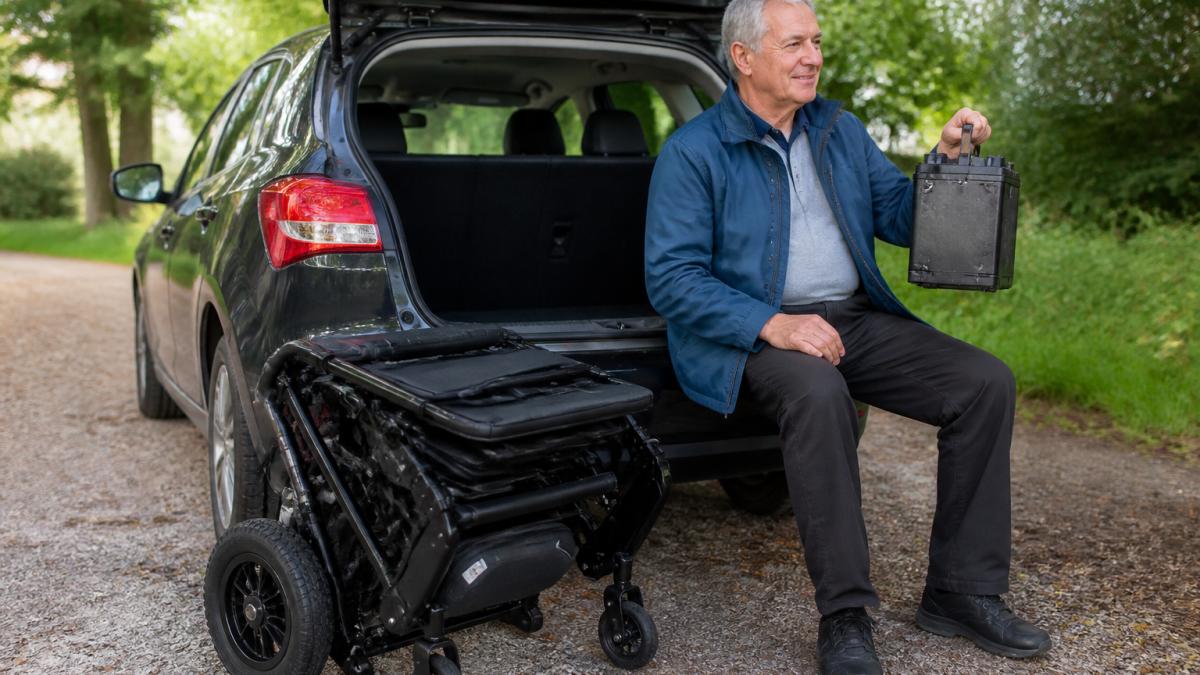
- How much do you need to lift? Our LiteMax 2 weighs 19.8 kg, the lightest in our range. The Freedom Pro ST is 26 kg without the battery. Removing the battery first cuts the lift considerably.
- Will you fly with it? Then you need a 12Ah battery. The 20Ah units are not airline friendly.
- Do you need a wider seat? The wide-seat Freedom Pro ST offers 52 cm between the armrests, useful if you layer up in winter.
- Do you want automatic folding? The Freedom Elite AF folds and unfolds by remote control, which helps if bending to fold a chair is difficult.
For most riders who want genuine long-range capability without a heavy chair, we recommend the LiteMax 2 with the 20Ah battery option.
GOV.UK guidance on VAT relief for mobility aids
Choosing a folding powerchair with long battery life comes down to matching capacity to your real routine, then protecting that battery with sensible charging habits.
Frequently Asked Questions
How far can a folding powerchair travel on one charge?
It depends on the battery fitted. A 24V 12Ah lithium battery gives up to 15 miles on the Horizon 7, the Freedom Pro ST and the Freedom Elite AF. The LiteMax 2 offers a 20Ah option rated up to 25 miles. Twin-battery models roughly double that. Treat every figure as an "up to" estimate: weight, hills, temperature and speed all reduce real range.
How long should a powerchair battery last before replacement?
Lithium-ion batteries in folding powerchairs typically hold useful capacity for several years of regular use, then gradually lose range. Replacement batteries are straightforward to buy: a 24V 12Ah unit costs £199.99, and a 24V 20Ah long-range battery costs £295.50 to £299.99 depending on the model. Check compatibility with your chair's mounting plate before ordering, as fittings changed across versions.
What reduces a powerchair's battery range in real use?
Heavier users, steep gradients, grass or gravel surfaces, cold weather and higher speeds all draw more power. A chair rated at 15 miles might cover 10 to 12 miles on a hilly route in winter. If your regular journeys are close to the limit, a twin-battery model or a 20Ah battery gives you a safer margin rather than relying on the advertised figure.
Can you take a folding powerchair on a plane?
Only if the battery is within the airline's lithium battery limit, which is usually expressed in watt-hours. Several 24V 12Ah batteries here are airline friendly at 288 Wh, while the 24V 20Ah units at 480 Wh are not, because they exceed the maximum allowable capacity. Always confirm the current rules with your airline before travel, as policies vary.
How long does charging take, and can you charge the battery off the chair?
A 24V 12Ah battery reaches full charge in about 6 hours; the 20Ah version takes around 10 hours. On most models the battery is removable, so you can charge it on or off the chair. That matters if you store the powerchair in a car boot and carry the battery indoors to charge, avoiding a second lift.