
Folding Powerchair for Narrow Doorways: A Selection Guide
Table of Contents
- Understanding Folding Powerchairs for Narrow Doorways
- Measuring Home Doorways for Mobility Aids
- Key Specifications: Turning Circle of Electric Wheelchairs
- Lightweight Folding Electric Wheelchair Benefits
- Top Folding Powerchairs for Narrow Spaces
- Navigating Thresholds and Carpet Transitions Indoors
- Choosing the Right Model: Step-by-Step Selection
- Frequently Asked Questions
Last Updated: September 3, 2026
Understanding Folding Powerchairs for Narrow Doorways
A folding powerchair for narrow house doorways is an electric wheelchair engineered to pass through tight domestic spaces whilst maintaining independence and manoeuvrability. If your home has doorways under 80cm wide, narrow hallways, or limited storage space, a folding powerchair becomes essential. The challenge isn't just fitting through a doorway once, but doing so repeatedly and reliably without physical strain. A powerchair that folds to 22cm wide versus 40cm wide fundamentally changes what's possible in a narrow house.

This guide covers measurement techniques, key specifications that determine fit, and real-world navigation strategies for thresholds and carpet transitions. By the end, you'll understand which models work and why, and how to verify fit before purchase.
Measuring Home Doorways for Mobility Aids
The standard doorway width in homes built before 1990 is typically 75-80cm. Newer builds often have 85-90cm openings. What matters is the clear opening width, which excludes door frames, hinges, and trim.
Use a tape measure and check three points: top, middle, and bottom of the frame. Record the smallest measurement, that's your true constraint. If a doorway is 78cm wide, a folding powerchair needs to fold to 77cm or narrower to pass comfortably.
Beyond the doorway, measure your hallways and note any corners or turns. A 90cm doorway becomes useless if the hallway beyond is only 85cm wide. Document threshold heights; most folding powerchairs have ground clearance between 8-12cm, which handles standard thresholds. Measure carpet transitions too, as raised lips can create unexpected obstacles.
NHS guidance on home adaptations and accessibility provides a useful reference framework for understanding how doorway width interacts with mobility aid selection.
Key Specifications: Turning Circle of Electric Wheelchairs
The turning circle determines whether a powerchair can rotate in place or requires multi-point manoeuvring in tight spaces. This matters far more than most buyers realise, especially in homes with narrow hallways.
Turning radius is measured from the wheelchair's centre to the outer edge of the wheel during a 360-degree rotation. A powerchair with a 1.2-metre turning radius needs a circular space 2.4 metres in diameter to spin completely. In an 85cm hallway, that's impossible; you'll use multi-point turns instead.
Most folding powerchairs designed for narrow spaces have turning radii between 1.0-1.3 metres. Some models offer "zero-turn" or "tight-turn" options using differential motor control, allowing rotation in a smaller footprint. Joystick sensitivity settings also affect turning behaviour; a sensitive joystick allows micro-adjustments in tight corners.
Ground clearance affects threshold handling. Higher clearance (10-12cm) helps with raised thresholds but increases turning radius slightly. Lower clearance (8-9cm) reduces turning radius but requires careful approach to thresholds.
Lightweight Folding Electric Wheelchair Benefits
The weight of a folding powerchair determines whether you can lift it, transport it, and store it independently. A typical full-size powerchair weighs 120-150kg. Folding powerchairs designed for portability range from 12-18kg, a transformative difference.
A 13kg powerchair can be lifted by most adults without mechanical assistance. You can store it in a car boot without a vehicle lift, travel on public transport, and visit friends' homes without worrying about accessibility infrastructure. Most airlines accept powerchairs under 50kg as checked baggage, and UK train services allow folding chairs in designated spaces (gov.uk).
Lightweight design reduces fatigue during transport. Lifting a 45kg chair repeatedly causes shoulder and back strain. A 13kg chair is manageable even for users with arthritis. Many users find that independent folding and stowing restores autonomy that heavier chairs undermine.
Battery weight contributes significantly to overall mass. Lithium-ion batteries are lighter than lead-acid alternatives but more expensive. Lightweight models using lithium-ion technology reduce weight whilst maintaining range. Storage becomes practical with lightweight models; a 13kg chair folds compactly and can be stored in a hallway cupboard, under a bed, or in a car.
Top Folding Powerchairs for Narrow Spaces
Evora Carbon: Ultra-Narrow 22cm Fold
The Evora Carbon folds to just 22cm wide, narrow enough to pass through most doorways without removing the door. Full carbon fibre frame construction weighs just 13kg. At £1,249.99, the investment pays dividends if doorway width is your primary constraint. navigating narrow staircases.
Carbon fibre construction provides durability without weight. Users report noticeably smoother rides compared to aluminium alternatives. Battery range is 15km per charge. The removable 24V lithium-ion battery is airline-friendly. Charging takes approximately 4-5 hours from empty.
The Evora Carbon suits users for whom doorway width is the primary barrier. If you have doorways under 80cm and limited hallway width, the ultra-narrow fold becomes essential.
MagNeo: Lightest Option at 12.3kg
The MagNeo weighs just 12.3kg, the lightest electric wheelchair in the Etech Mobility range. Magnesium-alloy frame is lighter than aluminium yet retains strength and durability. At £999.99, it offers significant weight advantage at lower cost than the Evora Carbon. The trade-off is fold width; the MagNeo folds to 35cm, which still fits through most doorways but requires slightly more clearance.

Magnesium-alloy construction is more corrosion-resistant than aluminium, reducing maintenance and extending lifespan. Quick-release airline-friendly batteries are a major advantage for users who travel. Battery range is 12km per charge.
The MagNeo suits users for whom weight and portability are primary concerns. If you frequently lift the chair into a car boot, travel on public transport, or visit homes without accessible storage, the 12.3kg weight becomes transformative. (Source: guidance from the Disabled Living Foundation)
Firefly: Balanced Performance and Weight
The Firefly weighs 14.5kg and folds to approximately 38cm wide, positioning it between the MagNeo and Evora Carbon. At £849.99, it offers value for users who want lightweight portability without premium prices.
The Firefly's appeal lies in balance. It's light enough to lift and transport, narrow enough to fit through most doorways, and affordable. Premium brushless motors provide smooth, quiet operation. The 2-second fold mechanism is fast, encouraging day trips and social outings. Battery range is 14km per charge.
The Firefly suits active older adults and users who want lightweight portability without premium cost.
LiteMax 2: Indoor-Outdoor Hybrid Capability
The LiteMax 2 weighs approximately 15kg and is engineered for both indoor and outdoor use. Larger wheels and suspension handle uneven terrain, gravel paths, and outdoor surfaces. At £794.99, it's the most affordable option in the Etech Mobility range.
The LiteMax 2's advantage emerges when you need both indoor manoeuvrability and outdoor capability. Users who want a single powerchair for shopping trips, park visits, and home use find the hybrid design eliminates the need for separate chairs. Joystick and remote control options provide flexibility. Battery range is 15km per charge.
The LiteMax 2 suits users who want a versatile powerchair handling both indoor narrow spaces and outdoor terrain.
Navigating Thresholds and Carpet Transitions Indoors
Thresholds and carpet transitions create unexpected obstacles. Standard thresholds are 12-15mm high. Most folding powerchairs have ground clearance of 8-12cm, which easily clears standard thresholds. Approach angle matters more than threshold height. Approaching at a shallow angle reduces the effective height barrier significantly.
Carpet transitions are trickier. Where carpet meets hard flooring, the edge creates a raised lip. A 5mm lip can catch the front caster. Approaching at 30-45 degrees allows larger main wheels to climb the lip whilst the caster navigates underneath.
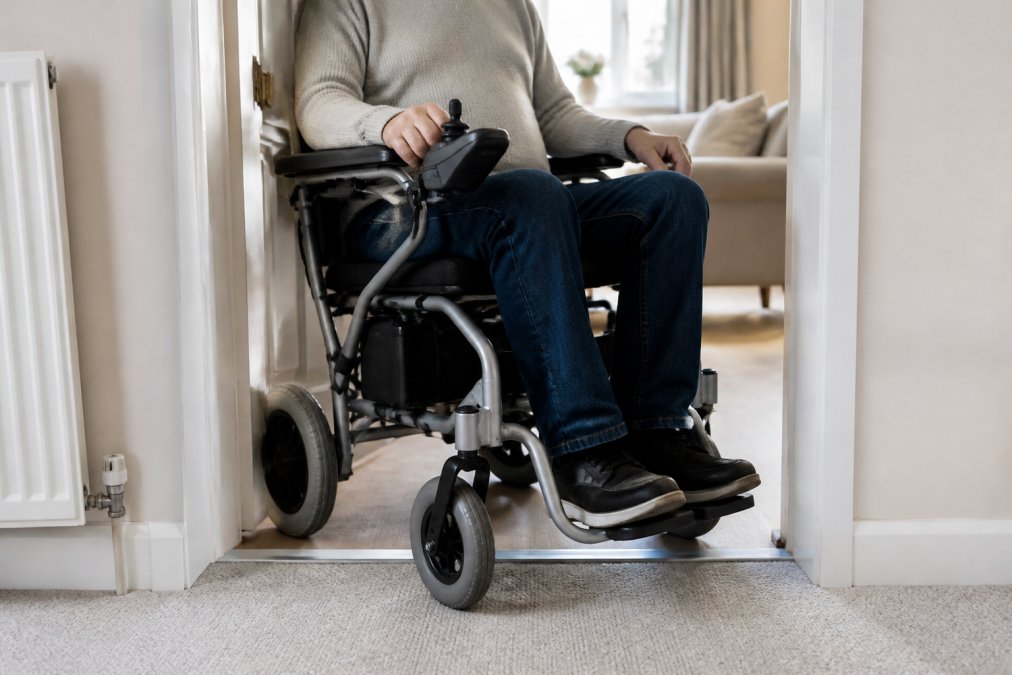
Furniture layout optimisation eliminates threshold problems entirely. Creating alternative routes through your home reduces daily frustration. Threshold ramps are a practical solution for raised thresholds exceeding ground clearance. Temporary ramps (2-3 metres long) create a gentle slope any folding powerchair can navigate. According to ACPIN guidance on accessible housing, threshold ramps are considered standard accessibility modifications and may qualify for funding.
Carpet maintenance affects wheel movement. Worn carpet at doorways creates uneven surfaces that catch wheels. Regular vacuuming reduces this problem. Low-profile threshold seals, rubber strips smoothing the transition, cost under £20 and eliminate most catching.
Choosing the Right Model: Step-by-Step Selection
Step 1: Measure your doorways and hallways. Record the smallest doorway width, hallway widths, and threshold heights. If your smallest doorway is 78cm, you need a powerchair folding to 77cm or narrower.
Step 2: Identify your weight constraint. Can you lift 12kg? 15kg? 20kg? Weight becomes critical if you have arthritis or limited upper-body strength.
Step 3: Determine your range requirement. Daily shopping is usually 3-5km. Social visits might be 10-15km. If you rarely leave home, 12km range is sufficient.
Step 4: Assess indoor versus outdoor use. Do you need to handle grass, gravel, or uneven terrain? The LiteMax 2 excels outdoors; the Evora Carbon and MagNeo are primarily for indoor use.

Step 5: Set your budget. Folding powerchairs range from £794.99 to £1,249.99. The LiteMax 2 offers value for versatile use. The Firefly balances cost and performance. The MagNeo prioritises weight. The Evora Carbon prioritises fold width.
Step 6: Test if possible. Ask the supplier about trial periods or demonstration models. Testing in your actual home reveals whether specifications match reality.
Step 7: Verify after-sales support. Ask about warranty, repair timelines, and battery replacement costs. A powerchair that breaks down and takes weeks to repair becomes a barrier to independence.
| Specification | Evora Carbon | MagNeo | Firefly | LiteMax 2 |
|---|---|---|---|---|
| Weight | 13kg | 12.3kg | 14.5kg | 15kg |
| Fold Width | 22cm | 35cm | 38cm | 40cm |
| Battery Range | 15km | 12km | 14km | 15km |
| Price | £1,249.99 | £999.99 | £849.99 | £794.99 |
| Best For | Ultra-narrow doorways | Maximum portability | Balanced performance | Outdoor hybrid use |
| Ground Clearance | 10cm | 9cm | 10cm | 11cm |
Selecting a folding powerchair for narrow house doorways transforms daily independence. The right model fits through your doorways, weighs little enough to lift, and provides the range you need. Etech Mobility's range offers solutions across different priorities, from the ultra-narrow Evora Carbon to the versatile LiteMax 2. Contact Etech Mobility to discuss your specific doorway constraints and home layout. Their personalised guidance and exceptional customer support ensure you find the right solution, with free UK delivery included.
Frequently Asked Questions
What is the narrowest folding powerchair available?
The Evora Carbon folds to just 22cm wide, which is the narrowest in Britain. When folded, this width lets you store it in tight spaces and navigate confined areas. For comparison, standard doorways are typically 77cm wide, so even folded powerchairs fit easily through most domestic doorways. If your hallways are particularly narrow, check the overall width of the unfolded chair as well, this determines whether you can manoeuvre through the space during daily use.
How do I measure my home doorways for a folding powerchair?
Measure the clear width of each doorway opening with a tape measure, from frame to frame. Note the height as well, though most powerchairs pass under standard 2.04m door frames. Measure your narrowest hallway width too, as this affects manoeuvrability more than doorway width alone. Record these measurements and compare them against the powerchair's overall width specification when unfolded. Also check for thresholds or steps that might affect ground clearance.
What turning circle of electric wheelchairs do I need for indoor navigation?
A tight turning circle matters more indoors than overall width. Most folding powerchairs need 1.2 to 1.5 metres to complete a full 360-degree turn. Measure your hallways and rooms to see if this space is available. Joystick sensitivity adjustments on many models let you tighten turns further. If your home has very tight corners, practice in a showroom or ask the supplier about test-driving before purchase to confirm the powerchair fits your layout.
Will I be able to lift a folding powerchair myself if I have shoulder arthritis?
Weight is critical if you have joint pain. The lightest models, like the MagNeo at 12.3kg and Evora Carbon at 13kg, are significantly easier to lift than standard powerchairs. However, the folding motion itself can still cause discomfort. Ask the supplier for a demonstration of the folding mechanism, and consider whether assistance from a carer might be needed regularly. Some models fold with one hand, which reduces strain. Always discuss your specific condition with your healthcare provider before purchase.