
Folding Powerchair Weight Capacity Guide 2026
Table of Contents
- Understanding Weight Capacity vs Frame Weight in a Folding Powerchair
- Categories of Heavy Duty Folding Electric Wheelchairs
- How to Determine Your Required Weight Capacity
- Powerchair Battery Range and User Weight: What Changes
- Frame Material, Folding Mechanisms and Real-World Transportability
- Safety, Stability and Regulatory Compliance for High-Capacity Models
- Frequently Asked Questions
Last Updated: September 11, 2026
Understanding Weight Capacity vs Frame Weight in a Folding Powerchair
A folding powerchair's weight capacity and its frame weight are two entirely separate numbers, and confusing them is the most common mistake buyers make. Capacity is the maximum load the chair is engineered to carry. Frame weight is how much the chair itself weighs. This guide from Etech Mobility explains both, along with the motor, battery and safety factors that decide whether a chair genuinely suits you.
The distinction matters because a chair rated to 150kg is not automatically heavier than one rated to 120kg. Modern materials have broken that link. A reinforced frame built from carbon fibre can carry far more than a steel frame while weighing considerably less, which changes what you can realistically lift into a car boot.
Weight capacity is the maximum occupant weight, plus any luggage or shopping, that a powerchair is designed to carry safely. Frame weight is the mass of the chair itself, excluding the battery on some models. Total unit weight, the two combined, is the figure that determines whether you or a carer can lift the chair into a vehicle.
Why Total Unit Weight Matters for Transport
Transportability is decided by total unit weight and how that weight is divided. A 30kg chair that splits into two 15kg sections is easier to manage than a 20kg chair that lifts as one piece, particularly if you have shoulder or back limitations.
Look for a folding mechanism that separates the heaviest component, usually the motors and rear axle, from the main frame. On the Converge 180, the rear motor section detaches so the heaviest lift is around 16kg rather than the full unit weight. That single design decision often decides whether a chair goes in the boot or stays in the hallway.

Categories of Heavy Duty Folding Electric Wheelchairs
Heavy duty folding electric wheelchairs fall into three broad bands based on user weight limit: standard, heavy-duty and bariatric. Each band changes the frame, motor and seat specification, not just the sticker on the box.
| Category | Typical User Weight Limit | Seat Width | Frame Approach | Best For |
|---|---|---|---|---|
| Standard | Up to around 120kg | 40-45cm | Light alloy, single motor | Everyday indoor and short outdoor use |
| Heavy-duty | Around 120-160kg | 45-50cm | Reinforced alloy or carbon fibre | Daily outdoor use, travel, mixed terrain |
| Bariatric | 160kg and above | 50cm+ | Aerospace-grade reinforced frame | Larger users needing stability and comfort |
Standard, Heavy-Duty and Bariatric Specifications Compared
The jump between categories is not just about capacity. Higher-rated chairs use wider seats, stronger motor torque, larger wheels for ground clearance, and more strong folding mechanisms. A bariatric model such as the Enterprise 200 carries a 200kg load rating on a 53cm seat, with 350W brushless motors providing the torque needed to move that load up inclines. The Medicines and Healthcare products Regulatory Agency (MHRA) oversees medical device safety in the UK.

Weight distribution changes across categories too. On a wider seat, the occupant's mass sits further from the centre line, so the frame needs greater torsional rigidity to stay stable during turns. That is why reinforced frames use thicker wall sections or different materials rather than simply more metal.
How to Determine Your Required Weight Capacity
Your required weight capacity is your body weight plus a realistic allowance for anything the chair will carry, with a safety margin on top. Weigh yourself as you would be seated, then add shopping, a bag or medical equipment you routinely travel with.
A common mistake is buying exactly to your current weight. Body weight fluctuates, and a chair running at its maximum load limit every day will wear faster and feel less stable. Choosing a model rated above your needs gives the frame and motor headroom, which extends service life and improves handling.
Occupant Weight, Seat Width and Weight Distribution
Seat width affects how your weight is distributed across the frame. A seat that is too narrow concentrates pressure and makes transfers harder; too wide and you lose lateral support, which matters on cambered pavements and ramps. As a rule, you want roughly 2-3cm of clearance on each side when seated. Industry benchmarks suggest this provides adequate support without restricting movement.
Weight distribution also changes with posture. If you lean forward to reach a door handle or lean back on a reclining seat, the load shifts toward the front castors or rear axle. Chairs with a wider wheelbase and a lower centre of gravity handle that shift more predictably.
Powerchair Battery Range and User Weight: What Changes
Powerchair battery range and user weight are directly linked: the heavier the load, the more energy the motor draws to move it. A chair that manages a long range with a lighter occupant will cover less ground with a heavier one, all else being equal. What most guides never explain is why, and what that means for the battery over the years you own the chair.
The Physics of Carrying More Weight
Range is a function of the energy stored in the battery divided by the energy the motor consumes per kilometre. Adding occupant weight increases rolling resistance at the tyres, increases the torque the motor must produce on every incline, and increases the current drawn during acceleration. On the flat, the penalty is modest. On a ramp, it is severe: climbing a 1-in-12 slope with an extra 40kg of occupant weight can draw noticeably more current than the same chair carrying a lighter user on level ground.
Several variables compound this. Incline is the biggest drain, followed by rough ground, frequent stopping and starting, and cold weather, which temporarily reduces lithium battery performance. A heavier occupant climbing a ramp draws noticeably more current than the same chair on the flat.
Long-Term Battery Degradation Under Maximum Load
This is the part almost no guide covers. Lithium cells degrade with every charge cycle, and the rate of degradation depends partly on how hard they are worked. A chair that is routinely run close to its maximum weight capacity draws higher currents more often, which generates more heat inside the pack and accelerates capacity loss. Over two to three years of daily use at high load, it is common for a pack to deliver a meaningfully shorter range than it did when new, even if the manufacturer's headline figure never changes. ENERGY.GOV reports on battery development.
A common pattern practitioners see is that a chair used well within its weight limit holds its range better over its service life than an identical chair run at the limit every day. That is one more reason to buy a category above your actual weight rather than matching it exactly.
Practical Steps to Protect Range
- Treat the manufacturer's range figure as a best-case estimate under ideal conditions: light load, level ground, mild temperature, new battery.
- Plan routes with a comfortable margin, and charge fully before long outings.
- Avoid running the pack to full discharge; partial top-up charges are gentler on lithium cells than deep cycles.
- Store and charge within the temperature range in the manufacturer's guidance; cold charging is particularly hard on lithium packs.
- Consider a model with a removable or side-slot battery so you can carry a spare. Etech Mobility's Voyager 185 uses side-slot batteries, which makes swapping or charging simpler for heavier users.
Frame Material, Folding Mechanisms and Real-World Transportability
Frame material determines the trade-off between strength and lifting weight. Carbon fibre offers the best weight-to-power ratio, carrying high loads at low frame weight. Aerospace-grade aluminium sits in the middle, and steel is strong but heavy.

Folding mechanisms vary just as much. A single central hinge is quick but usually heavier to lift as one unit. A split design that separates the motor assembly from the frame takes an extra step but reduces the heaviest single lift considerably. For anyone with arthritis in the shoulders or a small car boot, that extra step is worth taking.
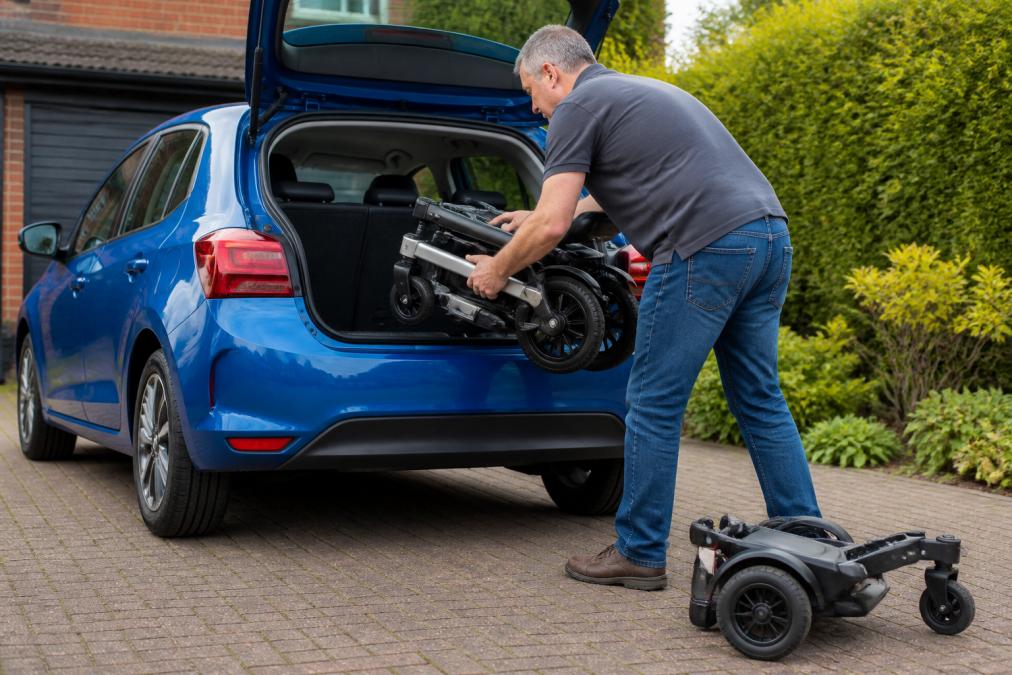
The Atlas HD Carbon illustrates the point: a 150kg load rating on a chair weighing 16.2kg, built from carbon fibre. That combination of maximum load and low total unit weight is what makes real-world transportability possible rather than theoretical.
Safety, Stability and Regulatory Compliance for High-Capacity Models
Safety on a high-capacity chair comes down to stability, braking and compliance with recognised standards. A mobility aid sold in the UK should meet applicable safety standards for its class, and reputable suppliers will confirm this on request. Ask any supplier directly which standards a model is tested to before you buy.
Stability and the Centre of Gravity
Stability depends on wheelbase, seat height and centre of gravity. Wider track and larger rear wheels improve it, particularly on slopes and uneven paving. The critical point most guides skip is that centre of gravity shifts with load. A heavier occupant raises the combined centre of gravity and, on a wider bariatric seat, moves it further from the chair's centre line. That is why a high-capacity chair needs greater torsional rigidity in the frame and a lower, wider stance than a standard model, not simply thicker tubing.
In practice this means:
- Avoid turning sharply on a slope or camber; the lateral load shift is greatest there.
- Keep the heaviest carried items low and centred, not hung on the back of the seat.
- Check that the anti-tip wheels are fitted and set correctly, especially on bariatric models.
- Motor torque matters on inclines, and electromagnetic brakes should hold the chair when you release the controls, including on a ramp.
Standards and Compliance
Mobility equipment sold in the UK is expected to meet applicable British and European standards for its class, and reputable suppliers will state which standards a model has been tested to. Ask directly, and ask for it in writing. If a supplier cannot tell you which standards a chair is tested to, treat that as a warning sign rather than a detail to chase later.
Funding, Assessment and Medical Necessity
On the insurance side, funding routes for a powerchair often depend on an assessment of your mobility needs, so speak to your GP, an occupational therapist or a mobility assessor about eligibility before committing. In practice, the pathway usually runs through one of a few routes: a referral via your GP or an occupational therapist to your local authority's equipment service, a wheelchair service assessment, or a self-funded purchase where you claim back through a mobility scheme if you are eligible. Each route has its own criteria, waiting times and contribution rules.
Because criteria and amounts change, check the official source for current figures rather than relying on secondhand numbers from forums or retailer pages. A mobility assessor or your GP's practice can point you to the current published guidance.
If you are weighing up whether you need a powerchair or a lightweight manual chair, the deciding factors are propulsion type, the distances you travel and whether you can self-propel comfortably. A powerchair suits longer outdoor trips and progressive conditions; a manual chair suits shorter, assisted journeys. Etech Mobility offers free delivery and can talk you through which fits your routine.
Frequently Asked Questions
Is there a weight limit for electric wheelchairs?
Yes. Every folding powerchair carries a maximum load set by the manufacturer, and it covers the occupant plus anything carried in a bag on the frame. Typical folding models sit between 100kg and 150kg, while heavy-duty options reach 180kg to 200kg. Exceeding the stated limit stresses the frame, motor and brakes, so always match the chair's occupant weight rating to your own weight with a margin to spare.
How does user weight affect the battery range of a folding powerchair?
A heavier occupant or a heavier chair draws more current from the same lithium battery, so range per charge drops. Hills, kerbs and cold weather reduce it further. If you weigh close to the chair's maximum load, expect a shorter real-world distance than the quoted figure and plan charging points on longer outings. Models with brushless motors and higher torque cope better with that extra load.
Are carbon fibre powerchairs suitable for higher weight capacities?
Carbon fibre frames are not automatically low-capacity. The Atlas HD Carbon is rated to 150kg while weighing 16.2kg, so it stays liftable for a carer even at that rating. Above 150kg, aluminium frames such as the Enterprise 200 are the more common choice. The deciding factor is the manufacturer's stated maximum load and the reinforced frame design behind it, not the material alone.
Why is exceeding the manufacturer's weight limit dangerous for a powerchair?
Overloading pushes the frame, seat, castors and braking system past the load they were tested for. The chair can become unstable on slopes or kerbs, stopping distances lengthen, and welds or folding joints can crack over time. Repeated overload also shortens motor and battery life. If your weight sits above a chair's rating, choose a higher-capacity model rather than relying on it to cope.