
How to Fold a Portable Mobility Scooter: Step-by-Step
Table of Contents
- Before You Start: Preparing Your Portable Mobility Scooter to Fold
- Folding Mobility Scooter Instructions: The Standard Sequence
- Manual Folding vs Automatic Folding: Which Mechanism You Have
- Why Won't My Mobility Scooter Fold? Common Causes and Fixes
- How to Unfold a Folding Mobility Scooter Safely
- How to Disassemble a Mobility Scooter for Transport and Storage
- Lifting, Loading and Battery Rules for Travel
- Frequently Asked Questions
Last Updated: October 17, 2026
Before You Start: Preparing Your Portable Mobility Scooter to Fold
Knowing how to fold a portable mobility scooter takes seconds once you know the sequence, but the preparation beforehand is what separates a smooth fold from a strained back. At Etech Mobility, we walk customers through this routine every week, and the same handful of steps prevents most problems.
Before you touch the folding mechanism, do three things:
- Switch the scooter off and remove the key if it has one.
- Check the battery level so you know whether it needs charging before storage.
- Clear the area around the scooter so nothing blocks the seat or tiller.
Safety Checks to Run First
A quick safety check protects both you and the scooter. Many folding mobility scooter problems start with a missed step here.

- Make sure the scooter sits on flat, level ground.
- Check that the tiller and seat are locked in their riding positions.
- Look for anything loose, such as a bag hanging from the handlebars.
Folding Mobility Scooter Instructions: The Standard Sequence
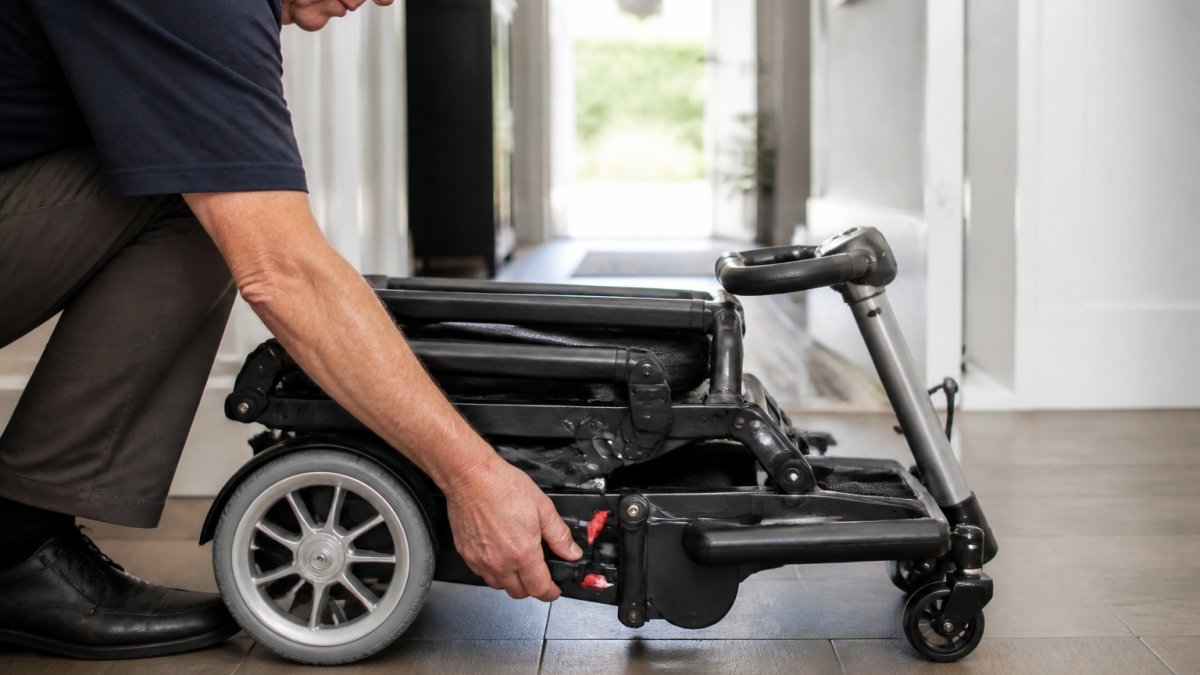
The standard sequence for how to fold a portable mobility scooter moves from the top down: seat first, then footrest and latch, then the frame sections, then the tiller.
Step 1: Fold the Seat Backrest Down
Push the backrest forward until it lies flat against the seat base. Most models click into place here. If yours has a lever or strap, release it first, then lower the backrest gently rather than letting it drop.
Step 2: Collapse the Footrest and Release the Folding Latch
Flip the footplate up so it sits flush against the front section. Then find the folding latch or release lever, usually near the base of the seat post or under the front deck. Pull or press it fully and hold it while you move to the next step.
Step 3: Bring the Front and Rear Sections Together
With the latch released, lift the front section and swing it back towards the rear section. The two halves meet in the middle. Keep your hands clear of the hinge points as they close.
Step 4: Fold the Tiller and Lock It Into Place
Loosen the tiller adjustment, tilt the handlebars down towards the folded frame, and tighten or clip it into its folded position. The scooter should now stand compact and stable, ready to lift or store.
Manual Folding vs Automatic Folding: Which Mechanism You Have
Manual folding relies on levers, latches and your own hands. Automatic folding uses a button or remote control to move the frame for you, which suits anyone with limited grip or shoulder strength.

| Feature | Manual Folding | Automatic Folding |
|---|---|---|
| How it works | Release lever and push sections together | Button or remote moves the frame |
| Effort needed | Moderate hand and arm strength | Minimal |
| Folding time | Around 20-30 seconds | Around 10-15 seconds |
| Best for | Confident, mobile users | Users with arthritis or limited strength |
| Battery use | None | Small draw from the battery |
If you are unsure which type you own, check whether the frame has a visible latch or a motorised hinge.
Why Won't My Mobility Scooter Fold? Common Causes and Fixes
A scooter that will not fold almost always has one of five problems: a stuck latch, an obstruction in the hinge, a seat or tiller still locked in the riding position, a flat battery on an automatic model, or a mechanism that needs a specific sequence your manual describes. Work through the fixes below in order, and stop the moment something feels forced.
1. The latch will not release
Latch designs vary by model. Common types include a pull-lever under the seat post, a push-button on the front deck, a spring-loaded catch at the hinge, and a twist collar on the tiller. Identify which type your scooter uses before applying force.
- Pull-lever: pull the lever fully until it clicks, then hold it while you swing the front section back. If it moves only partway, the cable may be stretched or the lever may need adjusting.
- Push-button: press firmly and listen for the release. A button that feels spongy usually means grit in the housing.
- Spring catch: lift the catch clear of its notch before moving the frame. Do not lever it with a tool.
2. Something is trapped in the hinge
Grit, mud, a trapped strap, a hanging bag or a coat caught in the folding joint will stop the frame closing. Clear the area around the hinge, wipe the joint, and try again. If the scooter has been stored outdoors or used on wet ground, a soft brush around the hinge points removes the grit that jams the mechanism.
3. The seat or tiller is still in the riding position
A backrest that is still upright, a seat that is locked in place, or a tiller that has not been loosened will block the fold on most models. Lower the backrest first, then loosen the tiller, then release the frame latch. Following the wrong order is a very common reason a scooter appears jammed.
4. The battery is flat on an automatic model
Automatic folding scooters need charge to move the frame. If the button or remote does nothing, check the battery level before assuming a fault. Most automatic models have a manual override lever or release pin so you can fold the scooter by hand when the battery is flat, locate it before you need it, and keep the manual with the scooter.
5. The mechanism needs a model-specific sequence
This is the fix most guides skip. Folding mechanisms are not standardised. Two scooters that look similar can have completely different latch positions, release directions and folding orders. Before forcing anything:
- Find the model name and number on the frame plate or under the seat.
- Look up the manufacturer's manual for that exact model, most are available as a PDF on the manufacturer's website.
- Follow the sequence in the manual, not a generic online guide.
If you cannot find the manual, contact the supplier you bought the scooter from and ask for the folding instructions for your model. A two-minute call is cheaper than a replacement hinge.
Never force a stuck mechanism. Pressure bends hinges, cracks frames and stretches release cables. If the latch will not release after a few careful attempts, stop and have the scooter checked by a service technician.
Before you fold, take a photo of the scooter in its unfolded state and another of the latch in its released position. If you get stuck later, the photos show you exactly how it should look.
Ultra-Lightweight Folding Motorised Electric Wheelchair | Etech Mobility →
How to Unfold a Folding Mobility Scooter Safely
Unfolding follows the same steps in reverse. Place the scooter on level ground, release the tiller, swing the front and rear sections apart until the latch clicks, lower the footplate, then raise the backrest until it locks.
Test it before you sit down:
- Push down on the seat to confirm it is locked.
- Check the tiller for wobble.
- Confirm the footplate sits flat.
If any part feels loose, the latch has not engaged. Re-fold and try again.
How to Disassemble a Mobility Scooter for Transport and Storage
Many folding scooters also come apart for tighter storage. Disassembly usually means removing the battery, then separating the seat and front section from the frame.
- Remove and charge the battery separately.
- Lift off the seat if your model allows it.
- Separate the front and rear sections where the frame splits.
Reassembly is the reverse. Check every connection before riding.
Lifting, Loading and Battery Rules for Travel
Folding the scooter is only half the job. Getting it into a car boot, storing it safely and travelling with the battery are where most owners need the most practical help, and where most guides stop short.
Check the folded dimensions before you lift
Folded size varies widely between models. Before lifting, check your manual for the folded length, width, height and weight.
Measure your boot opening and floor before you buy or travel. A scooter that folds small enough on paper can still be awkward if the boot lip is high or the opening is narrow.
Lift safely
- Bend your knees and keep your back straight.
- Grip the frame at its balance point, usually the centre of the folded frame, not the tiller or seat.
- Keep the heaviest part close to your body.
Secure it in the boot
A folded scooter can slide and tip during braking. Place it against the back of the rear seats, use the boot's luggage hooks or a strap to hold it steady, and keep the tiller and any loose parts tucked in. Never leave the scooter loose behind the rear seats where it could move forward in a sudden stop.
Battery rules for travel
Battery rules depend on the battery type and the carrier, so always check before you travel.
- Lithium batteries are usually removable on folding scooters. Many airlines require lithium batteries to be carried in the cabin rather than the hold, and carriers set their own limits on battery size and watt-hours. Check your airline's rules and the manufacturer's guidance before flying.
- Lead-acid batteries are heavier and are often carried in the hold, but carrier rules still apply.
- Removable batteries should be charged off the scooter where the model allows it, and stored according to the manufacturer's instructions.
For general guidance on carrying lithium batteries, see government guidance on carrying lithium batteries.
Storage between trips
Store the folded scooter somewhere dry and flat, away from damp and direct heat.
Our lightweight folding models, such as the Etech Mobility LiteMax 2, are built for exactly this job. At 19.8 kg with a 58 cm width, the LiteMax 2 folds down for storage and lifts easily into a car boot.

Frequently Asked Questions
Why won't my mobility scooter fold?
Most folding problems come down to one of four things: the tiller is not fully upright, the seat is still locked in its riding position, the battery is not switched off, or the folding latch is stuck. On automatic models, a flat battery stops the motor from folding the frame. Check the manual for your model, confirm the release lever moves freely, and never force the frame. If it still will not fold, contact the supplier rather than applying extra pressure.
Do all portable mobility scooters fold the same way?
No. Manual folding scooters usually rely on a release lever or latch near the seat post, then the front and rear sections swing together. Automatic folding models use a power button or remote control to move the frame. Tiller and footrest designs also vary between models. Always follow the folding mobility scooter instructions supplied with your own scooter rather than copying a video for a different model.
How do you unfold a portable mobility scooter?
To unfold a folding mobility scooter, place it on level ground, release the folding latch, and pull the front and rear sections apart until the frame locks into place. Raise the tiller until it clicks, lift the seat backrest, and lower the footrest. Switch the battery on, check the brakes and tyres, then test the scooter at low speed before setting off. Listen for the lock engaging; a half-locked frame is a stability risk.
Can you take a folding mobility scooter on a bus or train?
Folding scooters are generally easier to take on public transport because they collapse into a compact shape, but rules vary by operator and by vehicle. Many bus and train companies ask that the scooter is folded and stowed out of the aisle, and some require advance notice. Check the specific operator's conditions before travelling, and confirm the folded weight and dimensions against their limits.
Folding a portable mobility scooter should feel simple, not like a workout. If lifting or folding still feels like a struggle, the scooter may be heavier than your needs require. At Etech Mobility, we offer lightweight folding designs, free delivery, and personal guidance to match you with the right model. Get in touch with our team and we will help you find a scooter that folds easily and fits your car, your home and your travels.