
How to Lift a Powerchair Into Your Car
Table of Contents
- Why Lifting Your Powerchair Safely Matters
- Assessing Your Powerchair and Vehicle Before Lifting
- Step-by-Step: How to Lift Powerchair Into Car Manually
- Lightweight Folding Electric Wheelchairs for Easier Transport
- Wheelchair Lifts for Cars: Mechanical and Electric Alternatives
- Transporting Mobility Aids Safely: Common Mistakes to Avoid
- Conclusion
Last Updated: August 30, 2026
Why Lifting Your Powerchair Safely Matters
Getting your powerchair into a car safely protects your independence and prevents injury. Many people rely on their powerchair to maintain their lifestyle, and when transport becomes difficult, it often means staying home instead.
A powerchair isn't light, and improper lifting technique can lead to back strain, shoulder injuries, or equipment damage. The right approach makes all the difference.
This guide covers manual techniques, mechanical alternatives, and practical tips to protect both yourself and your equipment, whether you're managing this alone or with a carer.
Assessing Your Powerchair and Vehicle Before Lifting
Before attempting to load your powerchair, you need accurate information about what you're working with.
Check your powerchair's weight and dimensions
Your powerchair's weight is the single most important factor in determining how you'll transport it. Find the weight specification in your user manual or contact the manufacturer. Most standard powerchairs weigh between 40-60 kg, but lightweight folding electric wheelchairs can weigh as little as 15-25 kg (peer-reviewed research). This difference is significant and changes whether you can realistically lift it alone.
Beyond weight, measure the dimensions of your folded powerchair. Width, length, and height all matter when fitting it through your car boot opening and positioning it inside.

Measure your car boot height and opening
Measure three things:
- Boot opening height: From the ground to the top of the opening when fully open
- Boot floor to roof height: The vertical space inside where your powerchair will sit
- Boot opening width: The narrowest point the powerchair must pass through
These measurements tell you whether you can load at waist height (easier on your back) or whether you'll need to lift higher. If your boot opening is particularly high or narrow, this information helps you decide whether a ramp or hoist might be more practical than manual lifting.
Step-by-Step: How to Lift Powerchair Into Car Manually
Manual lifting works well for lightweight powerchairs, particularly if you're reasonably mobile and have good upper body strength. The technique matters far more than raw strength.
Prepare your powerchair for lifting
Remove the footrest if detachable. Take off any bags, cushions, or accessories. If your powerchair has a removable battery, consider removing it separately, this can reduce the load by several kilograms and is often safer.
Check that the powerchair is in a stable position. Engage any parking brakes if your model has them. Ensure the seat is upright and locked. Position your car with the boot opening facing you and fully open, backing the powerchair up to the boot so you're not carrying it further than necessary.
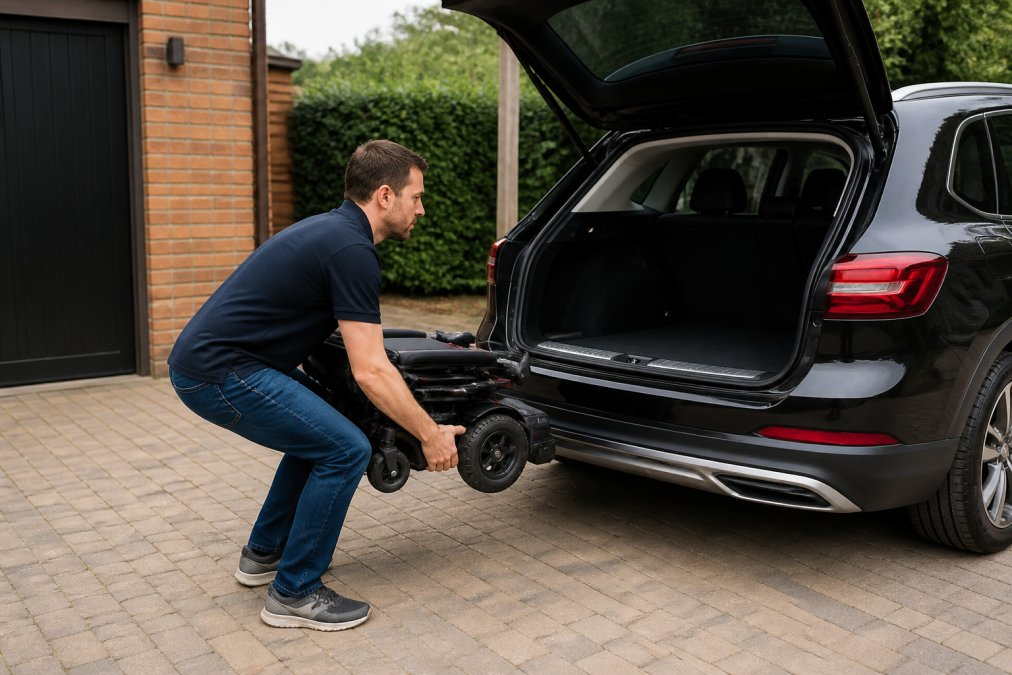
Position yourself and lift with proper technique
Stand directly in front of the powerchair with your feet shoulder-width apart. One foot should be slightly forward for balance. Keep your back straight, this is non-negotiable.
Bend at your knees and hips, not your waist (guidance on safe patient handling). Your knees should be bent to roughly 90 degrees. Grip the powerchair frame firmly, avoiding armrests or seat which can collapse. Look for sturdy frame points or handles designed for lifting.
Engage your core muscles by tightening your abdominal muscles before you lift. Then, using your leg muscles, push through your heels to stand up while holding the powerchair. Your legs do the work, not your back. Lift in a smooth, controlled motion without jerking or twisting. If the powerchair feels unstable, put it down and reposition rather than struggling with an unsafe hold.
Once at boot height, guide it in smoothly, tilting slightly if needed to fit through the opening.
Secure your powerchair in the boot
Once inside, your powerchair needs to stay there safely. Use tie-down straps or securing mechanisms to anchor it. Many car boots have anchor points designed for this purpose. Position the powerchair so it won't tip or roll. If it folds, ensure it's fully folded and locked in that position.
Never leave the powerchair loose or partially secured. The risk of damage isn't worth the few seconds saved by skipping this step.
Lightweight Folding Electric Wheelchairs for Easier Transport
If manual lifting is becoming difficult, consider whether your current powerchair is right for your transport needs.
Lightweight folding electric wheelchairs are specifically designed for users who need to transport their chair regularly. A typical lightweight model weighs 20-30 kg compared to 50+ kg for standard powerchairs (peer-reviewed research). This difference transforms the experience, what feels like a strain with a heavy chair becomes manageable with a lightweight one.
Carbon fibre construction is the key to this weight reduction. Carbon fibre frames are stronger than steel at a fraction of the weight. Etech Mobility's premium carbon fibre range offers models that are genuinely simple to store and easy to lift for travel.
Beyond weight, these chairs typically fold compactly, taking up roughly the space of a large suitcase. The trade-off is typically cost, but if you're regularly lifting your powerchair, the cost difference often pays for itself in reduced injury risk and increased independence.
Wheelchair Lifts for Cars: Mechanical and Electric Alternatives
If manual lifting isn't realistic for you, mechanical and electric lifting solutions exist. For many users, they're what makes independent transport possible.
Portable car boot hoists
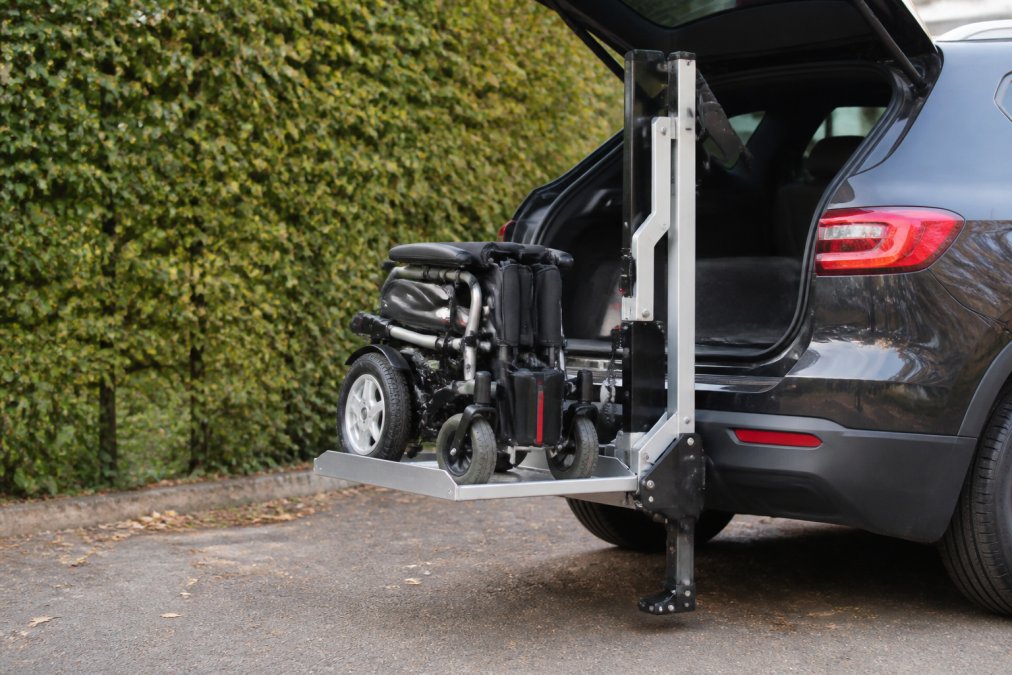
A portable car boot hoist is an electric lifting device that raises your powerchair from ground level to boot height at the push of a button. Unlike fixed in-car hoists that require permanent installation, a portable hoist can be moved between vehicles or stored when not needed.
The Portable Car Boot Hoist by Etech Mobility eliminates the need for manual lifting entirely. You position your powerchair on the lifting platform, press the button, and the hoist raises it smoothly into your boot. This is particularly valuable if you have limited upper body strength, arthritis in your shoulders, or want to avoid repetitive strain.
Portable hoists typically cost between £300-500, which is often less than a fixed installation.
Telescopic and foldable ramp options
Ramps work on a different principle, instead of lifting, they provide a gradual incline that allows you to roll or push your powerchair into the boot.
Telescopic ramps are adjustable in length, working with different boot heights. A ramp from Etech Mobility can handle most vehicles. They're lightweight aluminium with non-slip surfaces and raised sides to prevent the powerchair from rolling sideways.
Foldable suitcase ramps work similarly but fold down into a compact package for storage. They're useful not just for car boots but also for steps, kerbs, and door thresholds.

Ramps cost less than hoists, typically £90-150, but they require you to be able to push your powerchair. They work well if your powerchair has good battery range and you have sufficient arm strength to push it up an incline.
| Solution | Cost | Best For | Key Advantage |
|---|---|---|---|
| Manual lifting | £0 | Lightweight chairs, good upper body strength | No equipment needed |
| Portable hoist | £300-500 | Limited strength, heavier chairs | Fully automatic, no physical effort |
| Telescopic ramp | £90-120 | Moderate strength, adjustable boot height | Lightweight, affordable, versatile |
| Foldable ramp | £150+ | Regular multi-purpose access | Compact storage, handles various obstacles |
Transporting Mobility Aids Safely: Common Mistakes to Avoid
Most transport-related injuries and damage happen because of preventable mistakes.
Lifting with your back instead of your legs. Your back muscles aren't designed for heavy lifting; your leg muscles are far more powerful. Bending at the waist instead of the knees places strain on discs and muscles that can't handle it, leading to chronic back pain over time.
Attempting to lift alone when help is available. If a carer or friend is present, use them. Two people lifting with proper technique is safer and faster than one person struggling.
Not securing the powerchair properly in the boot. A powerchair that shifts during braking or cornering can damage itself, damage your car, or become a hazard. Tie-down straps are inexpensive, use them every time.
Ignoring weight limits. If you're using a ramp or hoist, these have maximum weight capacities. Exceeding them damages the equipment and creates safety risks.
Attempting transport when fatigued or injured. If your back is already sore or you're tired, this is when injuries happen. Rest or ask for help.
Not maintaining your equipment. Ramps and hoists need occasional maintenance. Check that moving parts work smoothly and that everything is clean and functional.
Conclusion
Transporting your powerchair safely depends on understanding your equipment's weight and dimensions, using proper lifting technique if you're lifting manually, and choosing the right equipment solution for your strength and vehicle. For many users, the practical answer isn't struggling with a heavy powerchair, it's choosing a lightweight model or investing in mechanical assistance.
At Etech Mobility, we specialise in lightweight folding electric wheelchairs designed specifically for users who need to transport their chair regularly. Our premium carbon fibre range offers models that are genuinely simple to store and easy to lift for travel. If transport is currently limiting your independence, exploring a lighter powerchair or one of our lifting solutions could change how you move through your day. Get started with Etech Mobility and discover a mobility solution that works with your lifestyle, not against it.
Frequently Asked Questions
Q: What is the safest way to lift a powerchair into a car boot?
A: The safest method depends on your strength and your powerchair's weight. Always start by removing the battery and any detachable parts to reduce weight. Bend at your knees, keep your back straight, and lift with your legs rather than your back. Position the powerchair at the correct angle to align with the boot's opening, then slide it in smoothly rather than lifting vertically. If you experience shoulder or back pain, consider a portable car boot hoist or telescopic ramp instead of manual lifting.
Q: Can lightweight folding electric wheelchairs reduce the strain of lifting?
A: Yes, significantly. Lightweight folding electric wheelchairs are specifically designed for travel and transport. Models using premium carbon fibre construction can weigh as little as 20-30 kg when the battery is removed, making manual lifting much more manageable. The folding mechanism also reduces the overall dimensions, allowing easier positioning into the boot. Many users find that switching to a lightweight folding model eliminates the need for mechanical lifting aids altogether.
Q: What weight capacity should I look for in a wheelchair lift for cars?
A: Most portable car boot hoists are rated for 100-150 kg, which covers most powerchairs. Check your powerchair's total weight including the battery, then ensure any lift you choose exceeds that figure by at least 10-20 kg for safe operation. The Portable Car Boot Hoist by Etech Mobility, for example, handles typical powerchair weights efficiently. Always verify the hoist's weight rating matches your specific powerchair model before purchase.
Q: Are there alternatives if I cannot manually lift my powerchair into the car?
A: Yes, several alternatives exist. Portable electric hoists like the Portable Car Boot Hoist by Etech Mobility eliminate manual lifting entirely, just position your powerchair and press a button. Telescopic ramps allow you to roll the powerchair up into the boot rather than lifting it. Foldable suitcase-style ramps offer compact storage while providing a gentle incline. Choose based on your car's boot height, your physical ability, and your storage space available.