
How to Transport a Mobility Scooter by Car
Table of Contents
- How to Get a Mobility Scooter In and Out of a Car
- Choosing the Right Mobility Scooter Loading Ramp for Your Car
- Using a Mobility Scooter Car Boot Hoist
- How to Secure a Mobility Scooter in a Car
- Folding, Dismantling and Lifting Your Scooter Safely
- Vehicle and Scooter Fit Checklist
- Battery Transport and Safety Precautions
- Conclusion
- Frequently Asked Questions
Last Updated: October 12, 2026
How to Get a Mobility Scooter In and Out of a Car
Transporting a mobility scooter by car hinges on three key factors: your scooter's weight, your car's boot space, and your own lifting capability.
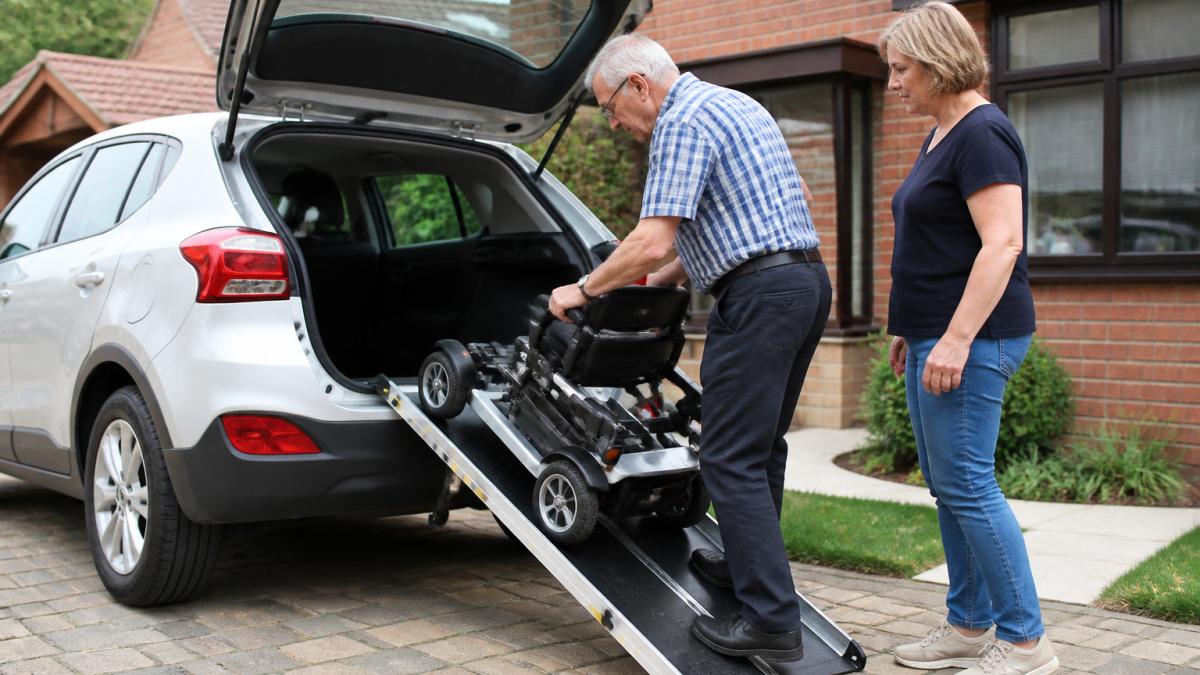
Learning how to safely transport a mobility scooter by car begins with accurate measurements and weights. Weigh your scooter. Measure your car's boot opening.
Most scooters can be split into parts, and the heaviest section, typically the battery and rear assembly, will dictate your chosen method.
There are five primary ways to move a scooter by car:
- Folding or dismantling it and lifting it in
- Driving it up a portable ramp into the boot
- Using a car boot hoist
Below, we detail each method, along with advice on safe loading, securing, and unloading.

Step-by-Step Loading Procedure
The safest method will vary depending on your specific scooter, but the general sequence remains consistent for most.
- Park on flat, level ground. Never attempt to load on a slope.
- Switch the scooter off and remove the key.
- Fold the tiller down or remove it entirely if it detaches.
- If the battery is removable, take it out and set it aside.
- If your scooter dismantles, split it into its lightest sections.
- Lift each section into the boot, placing the heaviest part in first.
- Alternatively, if using a ramp, position it correctly and slowly drive the scooter up.
Safe Unloading and Common Mistakes
Unloading is often where accidents occur. This is frequently due to rushing the process or adopting awkward lifting postures.
Common mistakes we observe include:
- Lifting with a twisted back instead of using a squatting motion.
- Leaving the battery in, adding unnecessary weight.
- Loading on an incline, leading to the scooter rolling.
Take your time: position the scooter on flat ground, then reassemble it fully before switching it on.
Choosing the Right Mobility Scooter Loading Ramp for Your Car
A mobility scooter loading ramp for a car allows you to roll the scooter into the boot rather than lifting it, significantly reducing the physical effort required.
Ramps are available in several types:
- Telescopic channel ramps can be adjusted for length and are compact for storage. Our Telescopic Channel Ramps extend from 88 cm to 150 cm and have a weight capacity of up to 270 kg.
- Foldable suitcase ramps fold in half and often feature a carry handle. Our 6ft Foldable Suitcase Ramp weighs 14.5 kg and also supports up to 270 kg.
Two primary factors determine the most suitable ramp for your needs: the height you need to ascend and the desired ramp angle. A gentler angle enhances safety and reduces the risk of tipping or losing grip.


| Ramp Type | Length | Load Limit | Best For |
|---|---|---|---|
| Telescopic channel | 88-150 cm | 270 kg | Steps and low car boots |
| Foldable suitcase | 6 ft | 270 kg | Kerbs, vans, higher car boots |
Consult the GOV.UK guidance on buying mobility equipment for general safety advice before making a purchase.
Using a Mobility Scooter Car Boot Hoist
A mobility scooter car boot hoist automates the process of lifting the scooter into your car's boot at the touch of a button.
This is an ideal solution for individuals who find safe lifting challenging or whose scooters are too heavy to manage by hand.
Our Portable Car Boot Hoist offers a flexible alternative to permanently installed in-car hoists.
While fixed hoists are permanently fitted to a single vehicle, a portable hoist can be transferred between vehicles, which is beneficial if you use more than one car.
How to Secure a Mobility Scooter in a Car
Securing a mobility scooter in a car is essential to prevent it from moving during transit.
It's crucial to distinguish between transporting a scooter as cargo and travelling while seated on it, as these carry different risk profiles.
- As cargo: The scooter is folded, dismantled, or mounted on a carrier and restrained to prevent independent movement within the vehicle.
- While seated on it: This implies using the scooter as a passenger seat within a moving vehicle. A mobility scooter is not designed as a vehicle seat, lacks crash-testing to that standard, has no head restraint, no tested seat belt anchorage, and no structural crumple behaviour. Most manufacturers explicitly state that a scooter must not be occupied while the vehicle is in motion.
If you need to travel while seated, this requires an adapted or wheelchair-accessible vehicle equipped with a tested tie-down and occupant restraint system, not merely a boot hoist or carrier.
Restraining the scooter as cargo
For scooters transported inside the boot or cabin:
- Position the scooter in its travel configuration: folded, dismantled, or with the tiller locked.
- Apply the parking brake and engage any freewheel lock if your scooter is equipped with one.
- Attach tie-down straps to solid frame points. The chassis, axle mounts, and main frame tubes are load-bearing. The tiller, basket, seat post, and plastic shrouds are not.
- Use a minimum of two straps pulling in opposing directions to prevent the scooter from sliding forward under braking or sideways during turns.
- Tighten each strap until firm, but avoid overtightening to the point of crushing the frame. Re-check strap tension after the first few miles.
- If your boot configuration allows, use wheel chocks or a locking bar for added security.
For rear carriers or hitch-mounted platforms, use the supplied straps and brackets, adhering to the manufacturer's torque and routing guidelines. Do not substitute household ratchet straps unless explicitly approved by the manufacturer.
Portable Car Boot Hoist for Mobility Scooter & Wheelchairs | Etech Mobility →
What not to rely on
- The scooter's parking brake: This is designed to hold the scooter when parked on a slope, not to withstand crash-level deceleration.
- The boot lid or tailgate: These are not designed as restraint mechanisms.
- A single strap: A single strap allows for rotation and sliding.
Checking the load before you drive
Before commencing any journey, verify that the straps are tight, the parking brake is engaged, the battery is secured or removed, and that nothing obstructs your view.
If your car has a towbar-mounted carrier, also confirm the carrier's locking mechanism and the towbar's nose weight limit before setting off. The DVSA guidance on vehicle loads and towing provides detailed information on load limits and towbar ratings.
Folding, Dismantling and Lifting Your Scooter Safely
Folding and dismantling a scooter reduces its size and weight, often making the difference between being able to lift it yourself or requiring assistance.
Most scooters feature a folding tiller and split at the frame. Some also have removable seats and batteries.
A common error is lifting a folded scooter by the seat or basket, as these are not load-bearing components. Always lift from the frame.
If lifting remains a challenge, a lightweight folding powerchair can be a helpful alternative. Our Etech Mobility LiteMax 2 weighs 19.8 kg, folds compactly for storage, and is available with a choice of 12Ah or 20Ah battery.
The weight of the lightest section you need to lift dictates your method. If the heaviest component is still too much to manage, switch to a ramp or hoist to avoid potential injury.
Vehicle and Scooter Fit Checklist
Before deciding on a transportation method, confirm that your scooter and car are compatible.
- Measure your boot opening height and width.
- Measure your boot floor depth.
- Weigh your scooter and its heaviest section.
If the folded scooter does not fit, a ramp or an external carrier is the next logical step. Do not attempt to force it.
The DVSA guidance on vehicle loads and towing explains the principles of load limits and towbar ratings.
Battery Transport and Safety Precautions
Batteries require specific attention during transport. Most mobility scooter batteries are either sealed lead-acid or lithium-ion, each with distinct handling requirements.
The most effective practice is to strictly follow the scooter and battery manufacturers' instructions for your specific model. These instructions supersede any general advice, including this section, as they are tailored to your exact battery chemistry, casing, and charging system.
Removable versus fixed batteries
If your battery is removable, always take it out before lifting or loading the scooter. This significantly reduces the weight and allows you to carry it separately and upright.
If the battery is fixed, plan your transport method around the scooter's full weight. In such cases, a ramp or hoist is typically the most practical choice.
Handling a removable battery
- Keep the battery in an upright position. Laying a lead-acid battery on its side could lead to electrolyte leakage if the casing is compromised.
- Carry the battery by its handle or casing, avoiding the cables or terminals.
- Protect the terminals. Loose metal objects, keys, tools, or buckles touching both terminals simultaneously can cause a short circuit, leading to heat and, in rare instances, a fire. Fit terminal caps if provided, or wrap the terminals in insulating tape for transport.
Temperature and charging
- Avoid leaving a battery in a hot car for extended periods. Boot temperatures in direct summer sun can rise considerably above ambient levels, and prolonged heat exposure shortens battery life. For lithium cells, it also increases the risk of a thermal event.
- Do not charge a battery in a sealed boot or a closed, unventilated space. Charge it indoors in a well-ventilated area, away from flammable materials.
- Allow a battery to return to room temperature before charging if it has been stored in a cold car overnight.
Lithium-specific points
Lithium batteries offer a higher energy density for their weight, making them suitable for portable hoists and lightweight scooters. However, they require careful handling:
- Use only the charger supplied or approved for that specific battery.
- Do not charge a lithium battery if it appears swollen, dented, wet, or shows any signs of damage.
- Avoid leaving a lithium battery charging unattended overnight in a confined space if the manufacturer advises against it.
- If a lithium battery is dropped or subjected to impact, inspect it thoroughly before attempting to charge it.
Before every trip
- Inspect the terminals for corrosion, looseness, or damage.
- Check the casing for cracks, swelling, or leaks.
- Confirm the battery is securely fastened in its compartment, or removed and stowed upright if you are carrying it separately.
- If the battery is damaged, swollen, or leaking, do not use it. Seek advice from a qualified technician.
Conclusion
Transporting a mobility scooter in and out of a car should be a safe and manageable process, free from injury or damage to the equipment. Match your chosen method to your scooter's weight, your car's available space, and your personal strength.
If lifting presents a significant challenge, Etech Mobility offers solutions. Our lightweight folding powerchairs are engineered for ease of lifting and straightforward storage.
Begin your journey with Etech Mobility and discover the mobility solution that perfectly complements your car and your lifestyle.
Frequently Asked Questions
Can you carry a mobility scooter in a car boot?
Yes, if the scooter folds or dismantles and your boot is large enough. Measure your boot opening and internal floor space first, then check the scooter's folded dimensions and heaviest component weight. Most boot-friendly scooters break into pieces under 20 kg each. A telescopic channel ramp or a portable boot hoist makes loading far easier than lifting by hand, particularly if you have shoulder or back problems.
How do you secure a mobility scooter inside a car?
Once loaded, apply the scooter's parking brake and remove the key. Use ratchet straps or cam buckle tie-downs rated to at least the scooter's weight, anchored to fixed lashing points in the boot. Strap across the frame, not the tiller or basket. If you use a boot hoist, its integral securing straps hold the scooter in place. Check the straps are tight before every journey and re-tension after the first few miles.
What are the new rules for mobility scooters?
Mobility scooter rules depend on their class and intended use. Different classes have varying regulations regarding where they can be used and whether they require registration or other documentation. Always check the DVLA's current guidance, as requirements can change.
Can a mobility scooter be transported on a car boot hoist?
Yes, provided the scooter's weight and dimensions suit the hoist. A portable car boot hoist such as the Etech Mobility model lifts up to 50 kg and fits most car boots. It raises your scooter to boot level at the push of a button, so you avoid heavy lifting entirely. Check your scooter's total weight and folded size against the hoist's capacity before buying, and confirm your boot opening is wide enough.