
How to Transport Power Wheelchairs in Vehicles
Table of Contents
- What You'll Need Before You Transport a Power Wheelchair
- How to Lift an Electric Wheelchair into a Car
- Power Wheelchair Car Boot Space: What Actually Fits
- Wheelchair Vehicle Hoist Options and How to Use One
- How to Secure a Wheelchair in a Vehicle
- Troubleshooting Common Transport Problems
- Matching Your Chair to the Right Transport Method
- Frequently Asked Questions
Last Updated: October 5, 2026
What You'll Need Before You Transport a Power Wheelchair
Transporting a power wheelchair safely starts with three numbers: the chair's weight, its folded dimensions, and your vehicle's boot opening. Get those wrong and the loading attempt fails before it begins. (Source: NHS guidance on safe lifting and handling)
The good news is that modern folding designs have made the job far easier than it used to be. Below, we'll show you exactly how to measure your chair, match it to your car, and pick the right method for how to transport power wheelchairs in vehicles without straining your back.
A common mistake is buying a carrier or hoist before measuring anything. Do it the other way round.
Measuring Your Chair and Checking Vehicle Compatibility
Start with a tape measure and a set of bathroom scales. Weigh yourself holding the chair, then subtract your own weight. That figure decides everything that follows.
Write down four measurements:
- Folded length, width and height in centimetres
- Total weight in kilograms, including batteries
- Heaviest single part if the chair splits into sections
- Boot opening height on your car, measured at the lowest point
Then check your car's handbook for the maximum boot load. Most hatchbacks and estates handle a folded chair without trouble. Smaller city cars often do not.
For a full breakdown of safe lifting technique, see NHS guidance on safe lifting and handling.
How to Lift an Electric Wheelchair into a Car
The safest method is to split the chair into its lightest parts, lift each one separately, and keep the heaviest section close to your body.
Here is the sequence we recommend:
- Fold the backrest down and remove the footplates
- Detach the rear motor section if your model allows it
- Lift the lighter frame section first
- Slide it into the boot, wheels facing you
- Add the motor section and batteries last
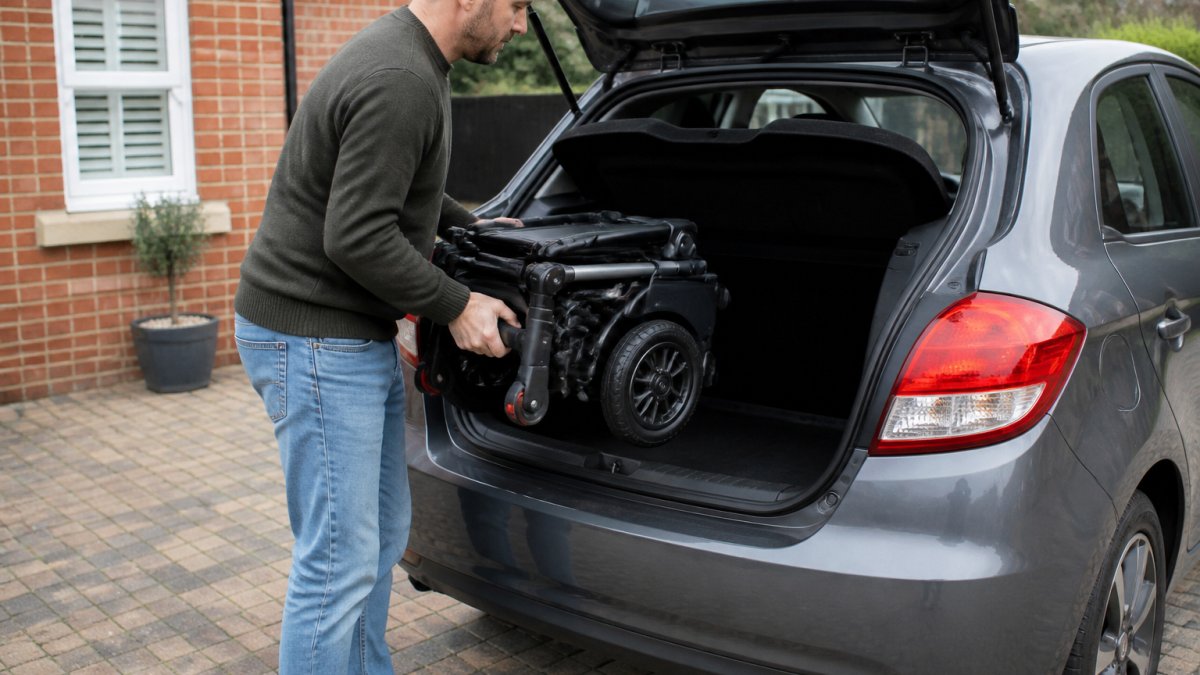
A split-frame design changes this job completely. The Converge 180, for example, separates into a 16kg main lifting weight, which one person can manage without help.

Two-Person Lifts and Safe Transfer Techniques
With two people, one takes the front and one takes the rear. Agree on the count before you lift, and lower the chair onto the boot lip rather than reaching over it.
For getting the user into the car, a sliding board works well. A standing transfer suits people who can bear weight briefly. Ask an occupational therapist which method fits your situation before you try it alone.
Power Wheelchair Car Boot Space: What Actually Fits
A folded powerchair typically needs a boot opening at least 60cm wide and 50cm tall, plus enough depth to slide the frame in flat. Measure your opening, not the whole boot.
Here is how the main vehicle types compare:
| Vehicle type | Boot opening | Fits a folded powerchair? | Best for |
|---|---|---|---|
| Small hatchback | Narrow, high lip | Only split-frame models | Solo travel, short trips |
| Estate car | Wide, low lip | Most folding chairs | Daily use, two people |
| SUV | Wide, high lip | Most chairs, lifting harder | Longer journeys |
| Minibus or MPV | Very wide, flat floor | Any chair, plus a ramp | Wheelchair users staying seated |
Estate cars are a good option for many people. The low lip can make loading easier, and the flat floor lets the chair slide rather than lift.

Wheelchair Vehicle Hoist Options and How to Use One
A wheelchair vehicle hoist does the lifting for you. It attaches to the boot and raises the chair to boot level at the push of a button, so you never take the full weight.

The Portable Car Boot Hoist from Etech Mobility is a flexible option at £399.99. It lifts up to 50kg, runs from its own detachable battery, and stores in the boot or across the rear seats. Secure straps hold the chair, and locking wheels keep the unit steady.
Setting one up takes four steps:
- Position the hoist in the boot and lock the wheels
- Attach the lifting straps to the chair frame
- Raise the chair with the hand controller
- Swing it into the boot and secure it
Ramps and Tail Lifts as Alternatives
A ramp suits anyone who wants to roll the chair in rather than lift it. Our 6ft Foldable Suitcase Ramp (£149.99) handles kerbs, steps and van loading, folds in half, and carries up to 270kg. The Telescopic Channel Ramps (£89.99) work well for car boots and store in a carry bag.
Tail lifts are an option that suits minibuses and anyone who needs to stay seated during transport.
Portable Car Boot Hoist for Mobility Scooter & Wheelchairs | Etech Mobility →
How to Secure a Wheelchair in a Vehicle
Securing a wheelchair means four-point tie-down straps anchored to the vehicle floor, plus a separate seat belt for the occupant. Never rely on the chair's brakes alone; they are parking brakes, not transport restraints, and they will not hold the chair in a sudden stop.
The correct approach depends on whether the chair is occupied or empty. These are two different considerations.
Securing an Unoccupied Power Wheelchair in the Boot
For a folded or partly disassembled chair in the boot, the goal is to stop it sliding and to stop the heaviest component, usually the motor and battery section, from becoming a projectile.
- Place the heaviest section as low and as far forward in the boot as possible, against the rear seat back.
- Run two straps across the frame, one over the top and one through the wheel or frame gap, anchored to the vehicle's own lashing points rather than to plastic trim.
- Tighten until there is no slack, then check again after five minutes of driving, as straps settle.
- Put loose parts (footplates, armrests, joystick) in a bag and tuck it beside the frame, not on top.
A non-slip mat under the frame makes a real difference. So does removing the batteries where the model allows, because a 10-15kg battery block is the single heaviest loose item in most folding powerchairs. Reducing the overall weight of your equipment not only eases the loading process but also contributes to maintaining mobile healthcare vehicles by minimizing unnecessary strain on the interior floor and suspension systems.
Securing a Wheelchair User Travelling Seated
This is the method the Department for Transport guidance on wheelchair safety in vehicles addresses, and it is not the same as strapping a chair into a boot.
For an occupied wheelchair, you need two separate systems:
- A wheelchair tie-down and occupant restraint system (WTORS), four straps, two at the front and two at the rear, anchored to the vehicle floor or to a tested anchorage point. The straps should pull the chair down and slightly forward, at roughly 45 degrees, so the chair is pressed into the floor rather than lifted.
- A separate three-point occupant restraint, a seat belt routed over the shoulder and across the lap, anchored to the vehicle, not to the wheelchair. The wheelchair's own belt is not a substitute.
A common pattern is to attach the rear straps to the chair's main frame, not to the footrests, armrests or wheels. If the chair has designated tie-down points marked by the manufacturer, use those.
Checks Before Every Trip
Run through this list each time, because straps loosen and anchor points wear:
- Straps are tight, with no slack, and not twisted
- Anchor points are rated for the load and bolted to metal, not trim
- The chair cannot roll, tip or rotate
- The occupant belt sits on the collarbone and hips, not the stomach or neck
- Nothing blocks the boot catch, the door seals or the seat release
- The chair's own battery is isolated where the model allows
If you are transporting a wheelchair user regularly, ask the vehicle converter or the chair supplier to confirm the anchorage points meet the relevant restraint standard. This is not a job to improvise.
Troubleshooting Common Transport Problems
Transport problems can often be attributed to the chair's weight, the boot's size, or the lifting method used.
Work through these fixes:
- Chair won't fit: remove wheels, footplates and armrests, then try again
- Too heavy to lift alone: use a hoist or a split-frame chair
- Shoulder or back pain: switch to a ramp or hoist rather than lifting
- Chair slides in the boot: add tie-down straps and a non-slip mat
- Battery drains in storage: charge it before and after travel
If lifting still causes pain, that is a signal to change method, not to push through. Our team can help you talk through which option suits your car and your strength.
Matching Your Chair to the Right Transport Method
The most suitable method for how to transport power wheelchairs in vehicles is the one that fits your chair, your car and your body. Getting the measurements right is a key first step.
If you lift alone, a split-frame chair plus a boot hoist removes almost all the strain. If you travel with a companion, a ramp may be all you need. And if you stay seated during travel, a minibus with a tail lift is the safest route.
Etech Mobility specialises in lightweight folding electric wheelchairs built for exactly this problem. Our carbon fibre range is simple to store and easy to lift, we offer free delivery, and our team will help you match a chair to your vehicle before you buy.
Frequently Asked Questions
What is the best way to transport a power wheelchair?
The best method depends on your chair's weight and your vehicle. For chairs under 50 kg, a portable car boot hoist lifts the chair to boot level at the push of a button. For lighter folding models, manual lifting into the boot works well. If you cannot lift at all, a ramp or tail lift lets you wheel the chair in. Always secure the chair with straps or a tie-down system so it cannot move during travel.
Can a power wheelchair be transported in a standard car?
Yes, if the chair folds or splits into lighter sections and your boot is large enough. Check your boot opening height and depth against the chair's folded dimensions before travelling. A split-frame model that separates into a 16 kg section is easier to lift into a hatchback or estate car than a one-piece chair. Measure both the chair and the boot, and allow a few centimetres of clearance.
How should a power wheelchair be secured inside a vehicle?
Use approved straps or a tie-down system anchored to the vehicle's secure points, and apply the chair's brakes or engage the parking mode. If the user stays seated in the chair during travel, the chair itself must be anchored to the vehicle floor and the user restrained with a seat belt. Loose items such as cushions, footplates and bags should be stored separately so they cannot become projectiles.
Can you travel with a power wheelchair in a car boot?
Yes, provided the folded chair fits within your boot's dimensions and you can lift it safely, or you use a hoist or ramp to load it. Remove or fold down anything that increases the chair's bulk, such as footplates and armrests, and check the battery is switched off. A boot hoist with a 50 kg lifting capacity suits many powerchairs and removes the need for heavy lifting entirely.
Lifting a heavy chair into a small boot is the single biggest reason people stop going out. It does not have to be that way. Etech Mobility builds lightweight folding electric wheelchairs with a split-frame design, a 16kg main lifting weight, and simple storage, so travel stops being a struggle. Get started with Etech Mobility and find the chair that fits your car and your life.