
Lightweight Folding Electric Wheelchair Benefits
Table of Contents
- Why Lightweight Folding Electric Wheelchairs Matter
- Portability and Travel Convenience
- Storage and Transport Made Simple
- Electric Wheelchair Battery Range and Performance
- Independence and Everyday Mobility
- VAT Relief for Mobility Aids and Funding Options
- Durability, Comfort, and Safety Features
- Conclusion
Last Updated: August 21, 2026
Why Lightweight Folding Electric Wheelchairs Matter
A lightweight folding electric wheelchair offers independence without the burden of weight. For people managing mobility challenges, the difference between a powerchair that weighs 15kg and one that weighs 35kg isn't just comfort, it's the difference between spontaneous outings and planning logistics around transport. At Etech Mobility, we've spent years helping customers understand that the benefits of a lightweight folding electric wheelchair go far beyond convenience. They reshape daily life.

The core challenge most people face is simple: traditional electric wheelchairs deliver power and range, but they're heavy enough to require a vehicle lift or a second person to load. A lightweight folding design solves this without sacrificing the features that matter, battery range, motor power, and reliability. This is why the market has shifted dramatically toward compact, foldable models over the past few years.
What makes this shift significant is that it's driven by real user feedback, not marketing trends. People with chronic mobility conditions, active seniors, and caregivers all report the same insight: a powerchair you can actually transport becomes a powerchair you'll actually use. That distinction matters more than specifications.
Portability and Travel Convenience
The ability to fold a powerchair and fit it into a car boot transforms what's possible in a day. Most compact models fold to roughly the size of a large suitcase, making them airline-approved for cabin baggage on many carriers (iata.org). This opens travel options that standard electric wheelchairs simply don't allow.
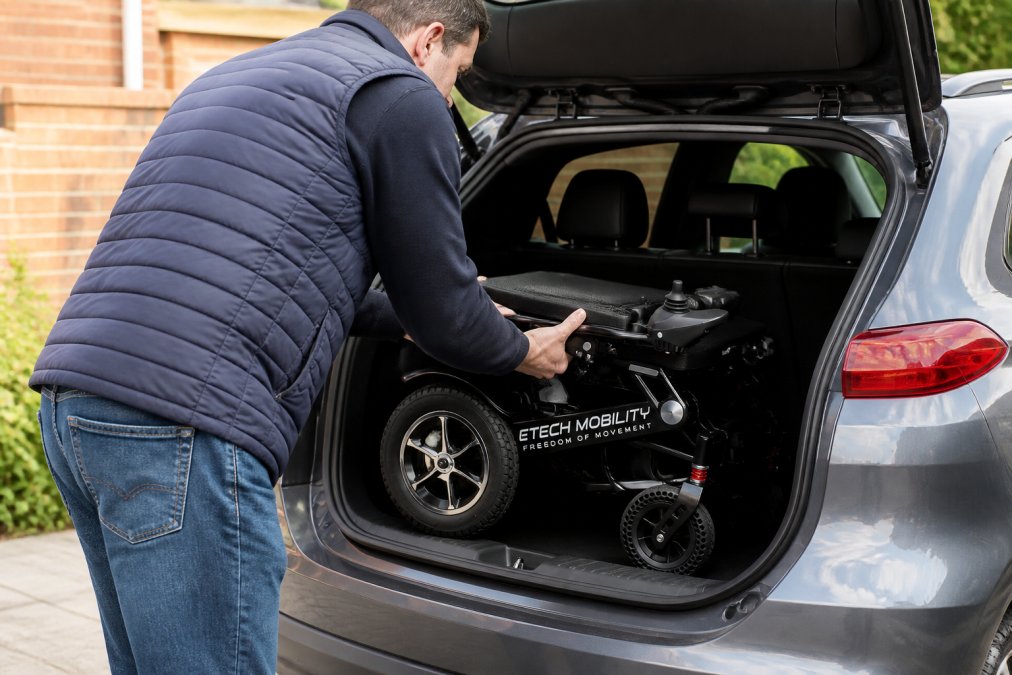
Portability isn't just about fitting into vehicles, it's about independence. When you can load your own chair without help, you're not dependent on someone else's schedule or strength. For people with arthritis or limited upper body strength, this matters enormously. A chair that weighs 14kg versus 30kg is the difference between managing solo and needing assistance every time you travel.
The travel convenience extends beyond car transport. A lightweight folding electric wheelchair is genuinely portable on public transport. You can board a coach or train without requiring staff assistance or advance notice. You can visit friends whose homes don't have accessible parking nearby. These small freedoms compound into a fundamentally different quality of life.
Battery placement and quick-release systems matter here. Some models feature detachable batteries that reduce the weight of the chair itself during folding, making the whole package easier to handle. Others have batteries that stay mounted but are positioned low in the frame, keeping the centre of gravity stable when carrying.
Storage and Transport Made Simple
Storage constraints drive many purchasing decisions. A standard electric wheelchair requires dedicated space, a garage corner, a utility room, or permanent positioning in a hallway. A lightweight folding model stores upright in a cupboard, under a bed, or in the corner of a living room. For people in smaller homes or flats, this is transformative.
The mechanics of folding matter more than the marketing suggests. A chair that requires you to release multiple latches, fold the frame, then detach and fold the footrest takes three minutes and multiple steps. A chair with a single-action fold mechanism takes ten seconds. When you're managing pain, fatigue, or arthritis, that difference determines whether you'll actually fold the chair or leave it out permanently.
Transport by others becomes feasible with a lightweight model. A caregiver or family member can load the chair into a vehicle without risk of back injury. This removes a genuine barrier for many people, the guilt of asking someone to lift a heavy powerchair, or the practical problem of having no one strong enough to help.
Some models feature carry handles specifically designed for two-person transport, with weight distribution that prevents the chair from feeling awkward or unbalanced. Others are light enough that a single person of average strength can manage it. This specification matters more than most guides acknowledge.
Electric Wheelchair Battery Range and Performance
Battery range determines whether a lightweight folding electric wheelchair is practical for your actual life. A 10-mile range sounds reasonable until you're halfway through a shopping trip and watching the battery percentage drop. Real-world range is typically 20-30% lower than manufacturer claims, depending on terrain, speed, and how heavily you're using the motor.
Most lightweight models use lithium-ion batteries, which offer better range-to-weight ratio than older lead-acid systems. A 24V lithium battery in a compact frame typically delivers 15-25 miles per charge, depending on the specific model and your weight (peer-reviewed research). For daily errands and social visits, this is usually sufficient. For longer outings, you need to plan charging or carry a spare battery.
Battery longevity is where many users encounter problems. A lithium-ion battery degrades with every charge cycle. After 500-1000 full charge cycles (roughly 2-3 years of regular use), capacity drops noticeably (peer-reviewed research). After 2000 cycles, you're looking at 60-70% of original range. This is normal, but it's worth factoring into your long-term cost calculations.
Charging time varies significantly. Some models charge fully in 4-6 hours; others need 8-10 hours. If you're using the chair daily, overnight charging is essential. A chair that takes 10 hours to charge limits your flexibility more than one that charges in 4 hours, especially if you're making multiple trips in a day.
The joystick control system affects how efficiently you use battery power. A sensitive joystick that responds to small movements lets you modulate speed smoothly, preserving battery life. A stiff or overly responsive joystick encourages full-speed operation, draining the battery faster. This is a usability feature that directly impacts range.
Independence and Everyday Mobility
This is where the benefits become personal. A lightweight folding electric wheelchair isn't just equipment, it's the difference between dependence and autonomy. An older adult who can independently visit the shops, attend social groups, or run errands without asking for a lift experiences a fundamentally different quality of life than someone who can't.
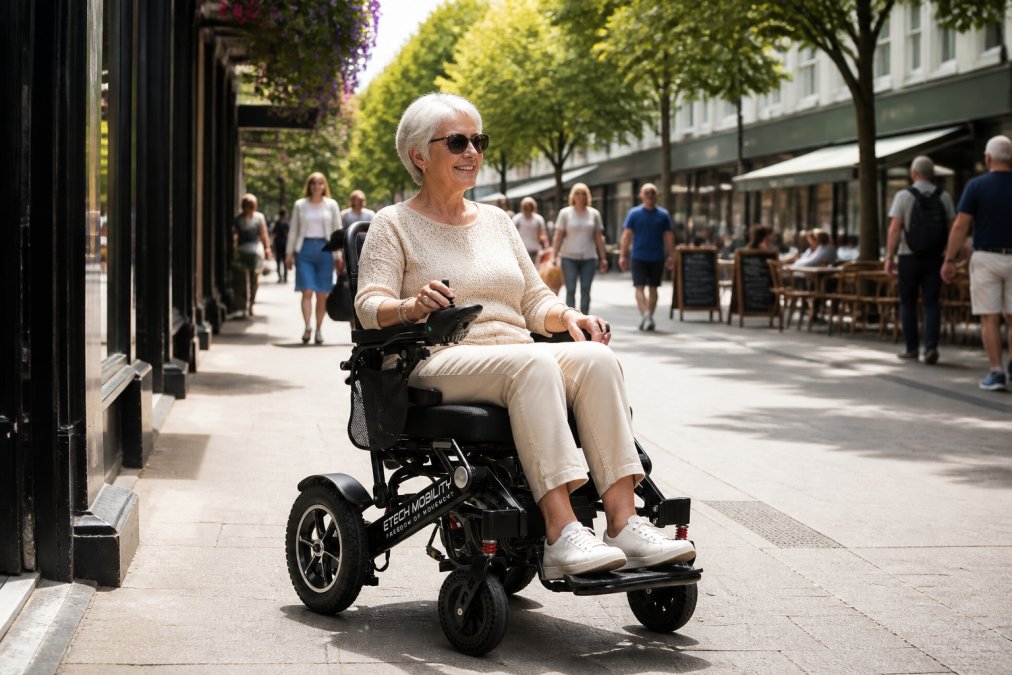
For people with progressive conditions like MS or motor neurone disease, an electric powerchair extends the window of independence. Manual wheelchairs become impractical as strength declines; a powered chair maintains mobility when pushing would be impossible. A lightweight model means that when your condition progresses to the point where you need a carer, the chair itself doesn't become another burden they have to manage.
The psychological impact is substantial. Users consistently report that having reliable, independent mobility reduces anxiety and depression. The ability to control your own movement, make spontaneous decisions about where to go, and participate in social activities without being dependent on others' schedules affects mental health as much as physical capability.
For younger adults with chronic conditions, a lightweight folding electric wheelchair enables participation in work and education. You can commute independently, attend meetings, and navigate campus or office buildings without relying on accessible transport or assistance. This shifts the conversation from "what can you do despite your disability" to "what do you want to do, and how can equipment support that."
The turning radius and manoeuvrability matter more than specifications suggest. A chair with a tight turning circle navigates shops, cafes, and domestic spaces more easily. A chair that requires wide turns becomes impractical in real environments. Test this in actual spaces before purchasing, a showroom doesn't replicate the reality of narrow aisles or doorways.
VAT Relief for Mobility Aids and Funding Options
In the UK, mobility aids including electric wheelchairs can qualify for VAT relief, reducing the effective cost by 20%. To qualify, the chair must be for personal use by someone with a disability. The relief applies to the purchase price and any accessories specifically designed for the wheelchair.
Claiming VAT relief requires providing evidence of disability. This typically means a letter from your GP, occupational therapist, or consultant confirming your medical condition and need for mobility equipment. Different suppliers handle the documentation differently, some manage the process for you; others require you to provide the paperwork.
Several funding routes exist beyond personal purchase. The NHS can provide mobility equipment through your local wheelchair service, though waiting times vary and the selection is typically limited to standard models. Your local authority may offer grants for home adaptations that include mobility equipment. Charities specific to your condition often have funding schemes or can direct you to relevant support.
Personal Independence Payment (PIP) can be used to purchase mobility equipment, though the process is indirect, the payment goes to you, and you decide how to spend it. Some people use PIP to fund a private purchase rather than waiting for NHS provision. Employment and Support Allowance doesn't typically cover equipment, but Access to Work grants may if you're employed.
Insurance companies sometimes cover mobility equipment as part of health or disability insurance, though this varies widely. Check your policy or contact your provider directly. Some private healthcare plans include equipment provision.
The cost-benefit calculation is worth doing properly. A lightweight folding electric wheelchair from Etech Mobility ranges from around £795 to £1,250 depending on the model. After VAT relief, the effective cost is lower. Against that, consider the cost of alternatives, taxis for every outing, or the cost to family members of providing transport. For most people, the independence gained justifies the investment.
Durability, Comfort, and Safety Features
A lightweight chair is only valuable if it lasts. The materials matter enormously here. Carbon fibre frames offer the best strength-to-weight ratio but cost significantly more. Aluminium alloy frames are lighter than steel, durable, and more affordable. Steel frames are heavier but extremely strong if durability is your primary concern.
The motors determine reliability more than the frame. Brushless motors are more durable and require less maintenance than brushed alternatives. They're also more efficient, extending battery range. Most modern lightweight models use brushless systems, but it's worth confirming.
Comfort features affect how much you'll actually use the chair. Ergonomic seating with proper lumbar support prevents back pain during longer journeys. Adjustable armrests accommodate different body shapes and allow you to position arms for comfort or to facilitate transfers. A well-designed seat distributes weight evenly, reducing pressure sores risk for users who spend extended periods seated.
Safety features include electromagnetic brakes that engage automatically if power is lost, anti-tip wheels that prevent tipping on slopes, and ground clearance sufficient to navigate kerbs and uneven surfaces. A chair with good ground clearance handles real-world terrain; one with minimal clearance gets stuck on every raised edge.
The joystick control should be intuitive and responsive. Some users prefer a proportional joystick that delivers speed based on how far you push it; others prefer a simple on-off switch. Accessibility matters, if you have limited hand function, you need a joystick designed for minimal force input.
Weather resistance is often overlooked. A chair used outdoors needs sealed electronics and corrosion-resistant materials. Water ingress into the motor or battery system causes failure. Quality models use sealed connectors and drainage systems to manage moisture.
Etech Mobility's premium carbon fibre range exemplifies these durability principles. The ultra-lightweight construction doesn't compromise on strength, carbon fibre has a higher strength-to-weight ratio than aluminium. The brushless motor system is sealed and maintenance-free. The ergonomic seating is adjustable, and the electromagnetic braking system engages automatically, providing safety without requiring constant user input.
A lightweight folding electric wheelchair isn't a luxury, it's a practical solution to a genuine problem. The benefits compound over time: better health outcomes from increased activity, reduced caregiver burden, lower transport costs, and fundamentally greater independence. If you're considering whether this type of chair is right for you, the question isn't whether you can afford it. It's whether you can afford not to have reliable, portable mobility that you control.
At Etech Mobility, we understand that choosing the right mobility aid is personal. Our team can guide you through the options, discuss funding routes including VAT relief, and help you find a lightweight folding electric wheelchair that matches your actual lifestyle, not just your specifications. We offer free UK delivery and support to ensure your new chair works for you from day one. Contact us to discuss which model suits your needs, or explore our range including the Etech Mobility LiteMax 2 at £794.99, the Firefly at £849.99, and the premium Evora Carbon at £1,249.99.


Frequently Asked Questions
What are the main advantages of choosing a lightweight folding electric wheelchair?
Lightweight folding electric wheelchairs offer independence without the physical strain of manual operation. Their compact design fits into car boots and narrow spaces, making travel and daily storage practical. The foldable frame reduces effort when lifting, and powered movement reduces fatigue during longer outings. Most models weigh between 13-15 kg, making them manageable for users and caregivers alike.
How far can I travel on a single charge with an electric wheelchair battery range?
Battery range varies by model and conditions. Most lightweight folding electric wheelchairs achieve 10-20 miles per charge, though terrain, user weight, and weather affect actual distance. Models like the Etech Mobility LiteMax 2 and Firefly are designed for daily errands and social visits. Always check the manufacturer's specifications and plan routes with charging access nearby for longer journeys.
Are there VAT relief schemes available for electric wheelchairs in the UK?
Yes. Mobility aids, including electric wheelchairs, may qualify for VAT relief under specific conditions. Eligibility depends on your medical condition and circumstances. Contact your local authority or visit the HMRC website for current criteria. Many suppliers, including Etech Mobility, can advise on whether your purchase qualifies for relief when you enquire.
Will I be able to lift a lightweight folding electric wheelchair myself if I have arthritis or reduced upper body strength?
Ultra-lightweight models (13-15 kg) are significantly easier to manage than standard powerchairs (30+ kg). However, folding and lifting depend on your individual strength and mobility. Look for models with quick-release batteries (which separate for lighter handling) and practice the folding motion before purchase. Discuss your specific concerns with the supplier to ensure the model suits your physical capability.