
Long Range Electric Wheelchair Reviews 2026
Table of Contents
- What to Look for in a Long Range Electric Wheelchair
- Lightweight Folding Electric Wheelchairs: Who They Suit Best
- Horizon 7 Long Range Electric Wheelchair: Full Review
- Electric Wheelchair Battery Life Tips to Maximise Your Range
- Wheelchair Lifts for Cars: Getting Your Powerchair In and Out
- Airline Travel, Insurance and Funding Eligibility
- Long-Term Ownership Costs and After-Sales Support
- Conclusion
Last Updated: August 17, 2026
Choosing the right long range electric wheelchair is consequential and confusing. Manufacturer range claims vary wildly from real-world performance, funding routes are poorly signposted, and the sheer number of folding powerchairs on the market makes comparison exhausting. This guide covers battery specifications, terrain capability, airline compliance, and long-term ownership costs. You'll find a full review of the Horizon 7, practical battery tips, and honest answers to common questions before buying.

The single biggest gap in most long range electric wheelchair reviews: they repeat manufacturer range figures without questioning them. Real-world range is routinely lower than stated maximums.
What to Look for in a Long Range Electric Wheelchair
Buying a powerchair is not like buying a laptop. The wrong choice can leave you stranded, in pain, or unable to travel. These three areas separate a genuinely capable long range electric wheelchair from one that looks good on a spec sheet.
Battery Range: Manufacturer Claims vs. Real-World Performance
Manufacturer range figures are best-case estimates, tested on flat surfaces at low speed with a light rider. Real-world range drops noticeably once you factor in hills, heavier user weight, cold weather, and battery age.
Lithium-ion batteries lose capacity in temperatures below 10°C. According to Battery University's guide to lithium-ion degradation, keeping a lithium-ion battery between 20% and 80% charge significantly extends its working life. If a chair claims 15 miles per battery, plan outings around 10-12 miles and you'll rarely be caught short. For genuine long-range capability, look for twin-battery systems or models with quick-release batteries you can swap mid-day.
Weight Capacity, Frame Material and Durability
Weight capacity is the maximum user weight a powerchair is certified to carry safely. Always check this figure against your actual weight with clothing and items you carry.
Aluminium alloy frames offer a good balance of rigidity and weight in mid-range folding powerchairs. Carbon fibre frames, available in premium models, are significantly lighter and equally strong, making them better for users who need to lift or transport their chair frequently. Durability depends on build quality, weld integrity, and how the frame handles repeated folding. Check warranty terms: a one-year warranty is standard, but after-sales support matters equally.
Safety Features, Braking and Certifications
A long range electric wheelchair should carry UKCA certification and comply with BS EN 12184:2022, the British Standard for electrically powered wheelchairs. These certifications confirm independent testing for performance, safety, and electromagnetic compatibility.
Braking systems on folding powerchairs are typically electromagnetic, holding the chair on slopes when you release the joystick. Most mid-range chairs handle around 10-12 degrees, covering the majority of everyday ramps and kerb cuts. Safety features include anti-tip protection, a speed limiter for indoor maneuverability, and a joystick controller with a clear display showing battery life and speed mode.
Lightweight Folding Electric Wheelchairs: Who They Suit Best
A foldable design collapses to around half its unfolded depth and can be lifted into a car boot, stored in a cupboard, or checked as luggage. The trade-off is that folding frames are generally less suitable for very rough terrain than rigid-frame powerchairs, and weight capacity is usually lower.
Who benefits most from a lightweight folding powerchair:
- Users who travel regularly by car, taxi, or public transport and need a chair that fits in a standard boot
- People with limited upper-body strength or arthritis who need a chair they can fold and lift themselves
- Active seniors who want outdoor independence but also need the chair to work indoors in tighter spaces
- Carers managing transport for a loved one and needing a genuinely portable solution
A compact frame means a smaller battery compartment, typically shorter range per charge. Models with twin-battery slots address this directly, offering portability without sacrificing distance.
| Feature | Best For | Trade-Off |
|---|---|---|
| Lightweight frame (under 25 kg) | Car travel, frequent transport | Lower max weight capacity |
| Twin-battery slot | Long outings, all-day use | Slightly heavier when both fitted |
| Pneumatic rear wheels | Outdoor comfort, rough paths | Puncture risk vs. solid tyres |
| Compact folded size | Small car boots, storage | Less legroom when unfolded |
| Solid front tyres | Low-maintenance indoor use | Less shock absorption on kerbs |
Horizon 7 Long Range Electric Wheelchair: Full Review
The Horizon 7 is Etech Mobility's most capable all-round folding powerchair, priced at £759.99. It features 300W dual brushless motors, pneumatic rear wheels of approximately 30 cm, and a full suspension system covering front, side and rear, a specification rarely seen at this price point.
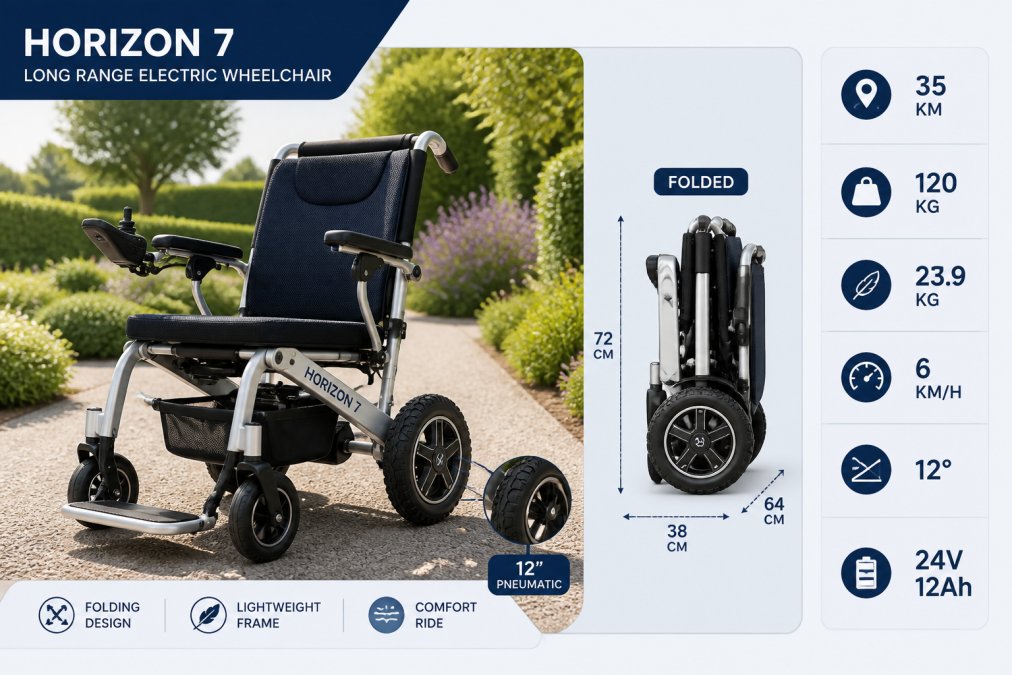
The chair is CE, UKCA, and BS EN 12184:2022 certified, supports a maximum user weight of 120 kg, and comes with a one-year warranty. The joystick controller is user-friendly, mounts on either side, and includes a clear display for battery life and speed.
All-Terrain Performance and Suspension
The Horizon 7's all-round suspension system separates it from most folding powerchairs in this price range, smoothing out cobblestones, compacted gravel, grass, and ramps. The approximately 30 cm pneumatic rear wheels provide genuine shock absorption on uneven ground, while the solid front tyres of around 20 cm keep maintenance simple. The maximum gradient of 11 degrees covers the vast majority of everyday slopes, including dropped kerbs, car park ramps, and moderate inclines. The 4 mph maximum speed complies with Class 2 mobility aid regulations, appropriate for pavements and shared paths.
Expandable Twin-Battery System: Pros and Cons
The Horizon 7 ships with a single 24V 12Ah lithium-ion battery, rated at up to 15 miles per charge. The twin-slot battery design allows you to add a second battery, roughly doubling your range to around 30 miles, though real-world mileage varies with user weight, terrain, and temperature.
Pros of the twin-battery system:
- Start with the standard battery and add a second only when you need it, spreading the cost
- Quick-release battery design allows charging on or off the chair
- Airline-friendly battery capacity on the standard 12Ah pack (under 300Wh), important for international travel
- Genuine flexibility: use one battery for local errands, two for full-day outings
Cons to be aware of:
- The second battery is purchased separately, adding to total outlay
- Charge time of 6-8 hours per battery means overnight charging is practical for both batteries
- The 20Ah extended-range batteries available for other Etech Mobility models exceed airline-friendly watt-hour limits
Comfort, Seating and Indoor Maneuverability
The Horizon 7's seat is 45 cm wide and 45 cm deep, with ergonomic seating supported by all-round suspension. The seat cushion, armrests, and footrests are included. Indoors, the chair's 63 cm unfolded width fits through most standard UK doorways (typically 76 cm). The folded dimensions of 60 x 37 x 75 cm mean it fits in most car boots and can stand upright in a hallway or cupboard.

Electric Wheelchair Battery Life Tips to Maximise Your Range
Battery life is the most common concern among powerchair users. These tips apply to any lithium-ion battery powerchair.
Charge consistently, not obsessively. Charge after each use rather than waiting for the battery to run low. Lithium-ion batteries do not suffer from memory effect, so partial charges are fine. Avoid full discharge. Running a lithium-ion battery to zero regularly accelerates capacity loss. Aim to recharge when the display shows around 20% remaining.
Store at partial charge. If you are not using the chair for more than a week, store the battery at roughly 50% charge rather than fully charged or fully empty. Keep it warm. Cold weather reduces available capacity temporarily. If your range feels shorter in winter, that is normal and should recover as temperatures rise.
Match speed to terrain. Running at maximum speed on rough ground drains the battery faster than steady, moderate-speed travel on flat surfaces. Plan for real-world range. If your battery is rated at 15 miles, plan outings of no more than 10-12 miles until you have established your actual range in your typical conditions.
Replacement lithium-ion batteries are available for all Etech Mobility models, ranging from the 24V 10Ah LitePro battery at £195.50 to the extended-range 24V 20Ah options from £249.99. Having a spare battery is the most reliable way to extend your operational range without buying a new chair.
Wheelchair Lifts for Cars: Getting Your Powerchair In and Out
Transporting a powerchair is one of the most practical challenges users face and is worth thinking through carefully before you buy.
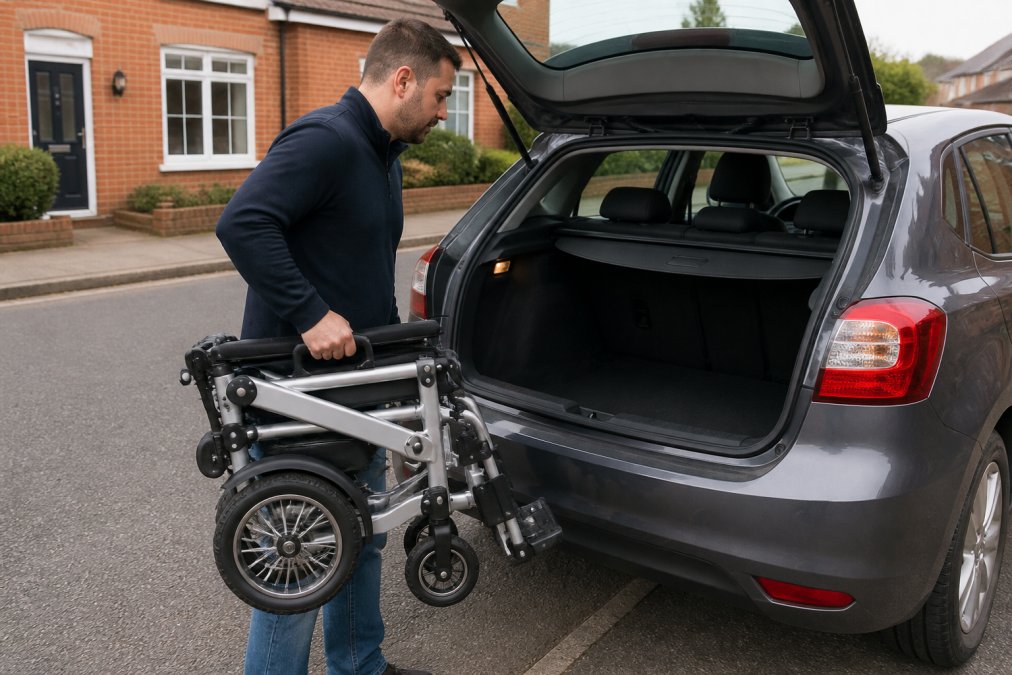
For most users with a folding powerchair, options fall into three categories:
Self-loading into the boot. A folding powerchair weighing under 25 kg can be lifted into a standard hatchback or estate boot by many users or carers. The Horizon 7 weighs 23 kg without its battery, which is manageable for most carers and some users. Remove the battery first, and the lift becomes significantly easier.
Hoist or lift systems. Aftermarket car hoists attach to a towbar and lift the folded chair into the boot or onto a platform carrier. [EXTERNAL_LINK: The Disabled Living Foundation's guide to vehicle adaptations | dlf.org.uk] covers the range of hoist and lift options available and how to access assessment services.
Wheelchair-accessible vehicles. For powerchair users who remain seated during travel, a purpose-adapted vehicle with a ramp and tie-down system is the appropriate solution.
If you cannot comfortably lift 23 kg from floor height to boot height, plan for a hoist or enlist regular help.
Airline Travel, Insurance and Funding Eligibility
These areas are often skipped in long range electric wheelchair reviews. They matter enormously to the people buying these chairs.
Airline travel. Airlines regulate lithium-ion batteries by watt-hour capacity. Most carriers permit batteries up to 300Wh in the cabin as mobility aid batteries, subject to prior approval. The standard 24V 12Ah batteries used in Etech Mobility's folding range (288Wh) fall within this limit and are airline-friendly. The 20Ah extended-range batteries (480Wh) exceed the standard limit. Always notify the airline in advance and carry documentation for your battery. The Civil Aviation Authority guidance on travelling with mobility aids sets out the rules that apply to flights departing from the UK.
VAT relief. Disabled people in the UK are entitled to buy mobility aids including electric wheelchairs without paying VAT, provided they meet the eligibility criteria under the Value Added Tax Act 1994. Always verify current eligibility criteria with HMRC or a qualified adviser rather than relying on a retailer's summary.
NHS and funding routes. The NHS provides powered wheelchairs through wheelchair services for users with a clinical need, assessed by an occupational therapist or physiotherapist. Eligibility and waiting times vary by area. Charitable grants through organisations such as the Motability scheme or local disability charities can also contribute to the cost of a powerchair. Check with your local wheelchair service and GP for the routes available to you.
Insurance. Powerchairs used on public roads as Class 2 mobility aids do not require motor insurance, but specialist mobility aid insurance covering accidental damage, theft, and breakdown is worth considering for a chair at this price point.
Long-Term Ownership Costs and After-Sales Support
The purchase price is only part of the story. A powerchair that costs £759.99 upfront but requires expensive repairs or is unsupported after six months is a poor investment.
Battery replacement is the most predictable long-term cost. Lithium-ion batteries degrade over time, and most users will want a replacement battery within three to five years of regular use. Etech Mobility's replacement batteries are priced between £195.50 and £299.99 depending on capacity and model.
Tyre maintenance. Pneumatic rear tyres can puncture. Keep a puncture repair kit or spare inner tube accessible, and check tyre pressure periodically. Solid front tyres require no maintenance. Servicing. Most powerchair maintenance is user-manageable: cleaning, tyre pressure checks, battery care, and occasional tightening of bolts. More significant repairs require a qualified technician.
After-sales support. Etech Mobility is trusted by thousands of customers across the UK, with a commitment to genuine customer support reflected in independently verified reviews. Before buying any powerchair, check reviews and confirm that the supplier can supply spare parts for the model you are buying.
| Cost Category | Typical Timing | Approximate Cost |
|---|---|---|
| Replacement battery (12Ah) | Every 3-5 years | From £195.50 |
| Extended-range battery (20Ah) | Optional upgrade | From £249.99 |
| Tyre repair / replacement | As needed | Low (DIY possible) |
| Specialist servicing | As needed | Varies by provider |
| Mobility aid insurance | Annual | Varies by cover level |
A well-maintained folding powerchair from a reputable supplier is a durable, cost-effective mobility solution. The risks come from buying on price alone from suppliers who cannot support the product after the sale.
Finding a long range electric wheelchair that genuinely fits your life takes more than reading a spec sheet. Etech Mobility's range of lightweight folding powerchairs, including the Horizon 7 at £759.99 with its twin-battery system and full all-round suspension, is designed for real-world independence, not just impressive numbers on a page. With free UK delivery, UKCA-certified quality, and a customer support team that actually answers, it is a genuinely different buying experience. Contact Etech Mobility to discuss which model suits your needs, your terrain, and your travel plans.
Frequently Asked Questions
What factors affect the actual battery range of an electric wheelchair?
Manufacturer range figures are measured under controlled conditions, so real-world results are typically lower. The main variables are user weight, terrain type, gradient, ambient temperature and travelling speed. Cold weather reduces lithium-ion battery output noticeably. Riding on grass or gravel draws more power than smooth pavements. A chair rated at up to 15 miles on flat ground may deliver 10-12 miles in everyday mixed conditions. Carrying a spare or upgrade battery is the most reliable way to extend your range.
Are long-range electric wheelchairs suitable for air travel?
Many long range electric wheelchair models use lithium-ion batteries, and airlines follow Civil Aviation Authority guidance on watt-hour limits for mobility aid batteries carried in the cabin or hold. Batteries at or below 300 Wh are generally accepted; those above 300 Wh require prior airline approval and may be refused. The Horizon 7's standard 24V 12Ah battery (288 Wh) is airline-friendly, but the 20Ah upgrade batteries (480 Wh) exceed this threshold. Always confirm with your airline before travelling.
What are the main disadvantages of choosing a heavy-duty long-range powerchair?
Heavier powerchairs offer greater stability and battery capacity but create practical challenges. They are harder to lift into a car boot without assistance or a specialist lift, may not fit through narrower doorways, and can be difficult to transport on public transport. A heavy-duty frame also tends to mean a longer folding process. For users who travel frequently or have limited upper-body strength, a lightweight folding electric wheelchair with an upgradeable battery often strikes a better balance.
How often should I charge my long-range electric wheelchair battery?
Charge the lithium-ion battery after each day of use, even if it is not fully depleted. Allowing the battery to run completely flat repeatedly shortens its overall charging cycle life. Avoid leaving it on charge for days at a time once full. Store the battery at roughly 50-80% charge if the chair will not be used for an extended period, and keep it somewhere dry and away from extreme cold. Following these habits helps maintain capacity over the battery's lifespan.
Can I get funding help to buy a long-range electric wheelchair?
Several routes exist. The NHS can provide a powerchair through its Wheelchair Service if clinical criteria are met, though waiting times and available models vary by integrated care board. The Motability Scheme allows eligible recipients of certain disability benefits to exchange part of their allowance for a mobility aid. Disabled Facilities Grants, administered by local councils, may cover adaptations including mobility equipment. Eligibility rules and amounts change, so check directly with your local wheelchair service, Motability or your council for current details.