
Portable Powerchair for Airline Travel: 2026 Guide
Table of Contents
- What Makes a Powerchair Airline Friendly?
- CAA Mobility Aid Regulations: What You Need to Know
- Lithium Battery Flight Safety: Watt-Hour Limits and Rules
- Airline Notification for Mobility Equipment: When and How
- How to Prepare a Powerchair for Air Travel: Step-by-Step
- Choosing a Portable Powerchair: Comparison and Pricing
- Insurance, Damage Protection and Rental vs Purchase
- Frequently Asked Questions
Last Updated: September 27, 2026
What Makes a Powerchair Airline Friendly?
A portable powerchair for airline travel is a folding electric wheelchair whose weight, folded dimensions and battery configuration meet the carriage rules set by airlines and airports. Three specifications decide whether yours travels smoothly or gets refused at check-in.
Weight, Fold Size and Battery Type
Weight matters because you, a companion or ground staff will lift the chair at least twice per trip. A magnesium or carbon fibre frame keeps that lift manageable; our lightest model, the MagNeo, weighs 12.3 kg and folds to just 35 cm tall.

CAA Mobility Aid Regulations: What You Need to Know
The Civil Aviation Authority (CAA) is the body that licenses UK airlines and sets the consumer-protection framework they operate within, but it does not publish a single rulebook listing which powerchairs may fly. Instead, the CAA requires airlines to publish their own conditions of carriage for mobility aids, and those conditions are what actually govern your journey. This is the point most guides miss: there is no such thing as a universally 'airline approved' powerchair, there is only a chair that meets the specific conditions of the specific carrier you have booked.
What the framework actually requires of airlines
Under the CAA's consumer framework and the UK's accessibility obligations for air travel, airlines operating to and from the UK must:
- Carry mobility equipment for passengers who need it, subject to their published conditions
- Provide assistance at the airport and to and from the aircraft
- Give clear, accessible information about how to book carriage of a mobility aid
- Handle mobility equipment with reasonable care, with liability for damage or loss
Why 'airline approved' is a misleading phrase
A chair marketed as 'airline approved' has usually been designed to sit inside the most common limits, a removable lithium battery under 100 Wh, a folded size that fits a hold, and a weight one person can lift. That is a useful shorthand, but it is not a guarantee. A carrier can still refuse carriage if its own conditions are stricter, if the aircraft is small, or if the battery documentation is incomplete.
International versus domestic carriage
A common source of confusion is the difference between a domestic flight within the UK and an international flight. On a domestic service, the CAA framework and the airline's UK conditions apply throughout. On an international service, the rules of the destination country and, for flights outside the UK, the requirements of that region's aviation authority also come into play. A chair that is straightforward to carry on a UK domestic flight may attract additional scrutiny on a flight to another region, where the battery rules and the documentation expectations are set by a different authority.
The three questions that resolve almost every case
- What notice does this carrier require? Some ask for 48 hours, some for more, and some accept notification at booking.
- Must the battery be removed and carried in the cabin? This varies by carrier and by battery rating.
- Where will the chair be stowed and returned? This determines your arrival-day experience more than any other single factor.
Get answers to those three in writing, and the regulatory picture collapses into something manageable. For the current CAA guidance on carrying mobility aids and batteries, check the UK Civil Aviation Authority guidance on batteries and confirm the detail with your airline.
Lithium Battery Flight Safety: Watt-Hour Limits and Rules
Lithium battery flight safety centres on the watt-hour (Wh) rating printed on the battery label. Spare and removable lithium batteries are generally capped at 100 Wh for straightforward carriage, with higher ratings requiring airline approval and, in some cases, limits on how many you may carry.
Airline Notification for Mobility Equipment: When and How
Notify your airline as soon as you have a booking, and treat 48 hours as a sensible minimum rather than a target. Many carriers ask for advance notice so they can record the chair's dimensions, weight and battery type, and arrange assistance at both ends of the journey. Coordinating these logistics alongside the complexities of traveling with medication ensures that your health needs remain as prioritized as your mobility equipment throughout the duration of your trip.
How to do it:
MagNeo – 12.3kg Ultra-Lightweight →
- Call the airline's accessibility or special assistance line
- Provide the chair's make, weight, folded dimensions and battery watt-hour rating
- Ask whether the battery must be removed and carried in the cabin
- Request assistance to and from the gate
- Confirm the details in writing by email
How to Prepare a Powerchair for Air Travel: Step-by-Step
Preparation starts at home, not at the terminal. Charge the battery fully, clean the chair, and gather the paperwork before you leave. The steps below cover the practical sequence.
- Charge the battery fully and confirm it holds charge.
- Label the chair with your name and contact details.
- Photograph the battery rating and keep the safety documentation with your travel papers.
- Practise folding the chair until you can do it without help.
- Remove the battery if your airline requires it, and carry it in the cabin.
- Attach a manual override note so staff know how to move the chair if needed.
At the Airport: Check-In and Gate Logistics
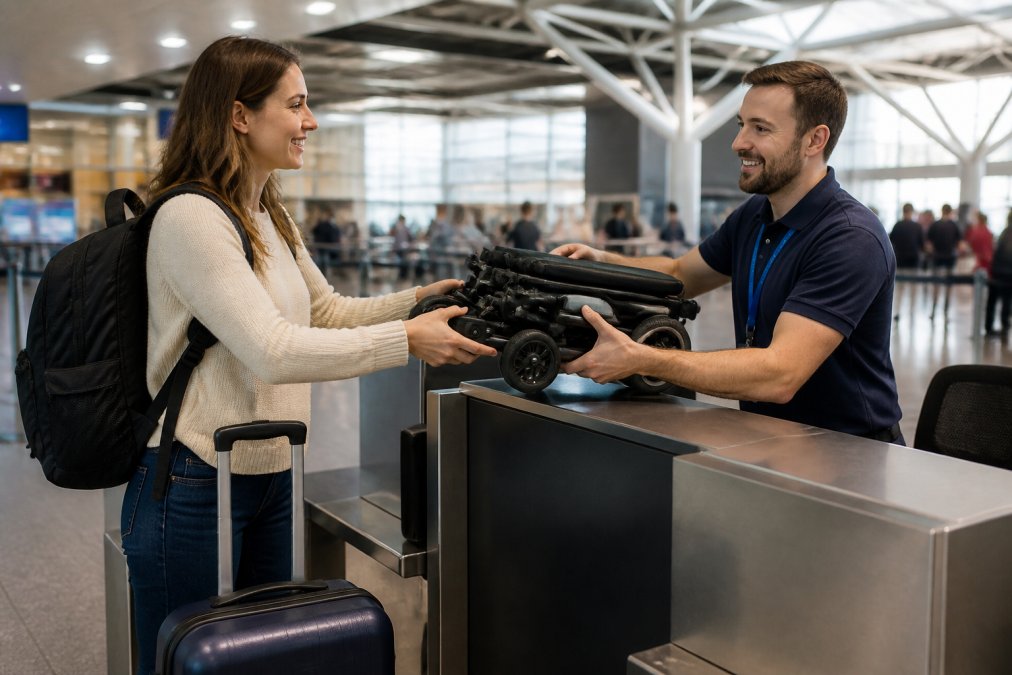
Arrive early and go straight to the assistance desk rather than the standard check-in queue. Staff will usually tag the chair, confirm the battery arrangement, and tell you whether it travels to the gate with you or goes into the hold at check-in.
Choosing a Portable Powerchair: Comparison and Pricing
The right chair balances lifting weight, folded size, battery configuration and capacity against your budget. Each of our travel-friendly models uses a quick-release airline-friendly battery and a folding frame, so the differences come down to weight, fold and capacity.
| Model | Weight | Folded Size | Capacity | Price |
|---|---|---|---|---|
| MagNeo | 12.3 kg | 35 cm tall folded | 120 kg | £999.99 |
| Evora Carbon | 13 kg | 76 × 22 × 69 cm | 120 kg | £1,249.99 |
| Vector Carbon | 13.8 kg | Folding | 120 kg | £1,349.99 |
| Atlas HD Carbon | 16.2 kg | Folding | 150 kg | £1,395.99 |
| Vantage Carbon | 13.8 kg | Folding | 120 kg | £1,395.99 |
Insurance, Damage Protection and Rental vs Purchase
Travel insurance and airline liability are two separate things, and neither is automatic. Airlines are generally liable for mobility equipment they carry, but the cover is often capped, so check the limit before you fly and consider specialist travel insurance that names your chair.

Frequently Asked Questions
Can you take a powerchair on an airline?
Yes, most airlines carry powerchairs as checked mobility equipment. You will need to notify the airline in advance, provide the battery's watt-hour rating and confirm whether the battery is removable. The CAA sets the framework for carrying mobility aids, but each airline applies its own procedures, so always check directly with your carrier before booking. A portable powerchair with a quick-release lithium battery, like the MagNeo at 12.3 kg, is easier to check in and handle.
What are the CAA mobility aid regulations for flying with a wheelchair?
The Civil Aviation Authority requires that mobility aids with lithium batteries meet specific watt-hour limits and be declared to the airline before travel. Batteries must be protected against short circuit, and if removable, they should be carried separately in the cabin where possible. Airlines must also provide assistance moving you and your chair through the airport. Always confirm current requirements with your airline and the CAA before flying, as rules can change.
Can you take a lithium battery wheelchair on a plane?
Yes, if the battery meets the watt-hour limits set for lithium batteries carried on aircraft. Most airline-friendly powerchairs use 24V lithium batteries within these limits. The battery should be removable so it can be taken into the cabin if the airline requires it. Lithium battery flight safety rules also require the terminals to be protected and the battery to be declared at check-in. Confirm your specific battery's rating with the manufacturer.
Which portable powerchair is best for air travel?
The best portable powerchair for airline travel is one that is lightweight, folds compactly and has a removable airline-friendly battery. The Evora Carbon weighs 13 kg and folds to just 22 cm wide, making it easy to lift and store. The MagNeo is our lightest at 12.3 kg with dual quick-release batteries. Both are certified to BS EN 12184:2022 and designed for indoor and smooth outdoor use, ideal for airports and hotels.
How do I prepare a powerchair for air travel?
Start by notifying your airline at least 48 hours before departure and confirming the battery watt-hour rating. Remove the battery if it is quick-release and carry it in the cabin. Fold the chair, secure any loose parts and label it clearly with your contact details. Take photographs before check-in in case of damage. Arrive early and ask for assistance at the special assistance desk. Keep your battery safety documentation with you throughout the journey.
What happens if my powerchair is damaged during a flight?
If your powerchair is damaged during handling, report it to the airline immediately at the arrival airport before leaving the baggage area. Airlines are liable for damage to mobility equipment under international carriage rules, but you must file a claim within the stated timeframe. Photograph the damage and keep your check-in receipt. Travel insurance can provide additional cover. Always inspect your chair as soon as it is returned to you at the gate or baggage reclaim.
Airline travel with a powerchair is manageable once the weight, folded size and battery rating line up. That is where Etech Mobility can help: our lightweight folding range, including the 12.3 kg MagNeo and the ultra-narrow Evora Carbon, is built for easy lifting and simple storage, with free delivery and guidance to match you to the right chair. Get started with Etech Mobility and travel with a chair you can lift, fold and trust.