
Powerchair Range on Single Charge: What to Expect
Table of Contents
- Understanding Powerchair Range on a Single Charge
- Factors Affecting Electric Wheelchair Range
- Lithium vs Lead-Acid Powerchair Batteries
- How to Extend Powerchair Battery Life and Range
- Real-World Powerchair Range: What You Can Expect
- Battery Degradation Over Time
- Conclusion
Last Updated: August 20, 2026
Understanding Powerchair Range on a Single Charge
When you're deciding whether a powerchair is right for you, one question matters most: how far will it actually take me on a single battery charge? The answer to powerchair range on single battery charge isn't a simple number, it depends on your battery type, how you drive, the terrain, and conditions you encounter. Most users can expect between 10 and 30 miles per charge with standard lithium-ion batteries, though some high-capacity systems extend well beyond that.
At Etech Mobility, we help customers understand what realistic range means for their lifestyle. Whether you're planning daily shopping trips, social visits, or longer outings, knowing your powerchair's actual range prevents the anxiety of being stranded. This guide covers the technical factors that determine range, practical strategies to extend it, and what real-world performance looks like across different scenarios.
Factors Affecting Electric Wheelchair Range
Your powerchair's range isn't fixed, it's a moving target influenced by at least five major variables. Understanding each one helps you predict what you'll actually get from your battery and plan accordingly.
Battery Capacity and Amp-Hours
Battery capacity, measured in amp-hours (Ah), is the primary determinant of range. A 10Ah battery stores half the energy of a 20Ah battery, and that translates directly to distance. Most folding powerchairs use 24V systems with batteries ranging from 10Ah to 20Ah. The Etech Mobility Extra Range 24V 20Ah Lithium-ion Battery delivers approximately 20-25 miles of range under typical conditions, whilst a 10Ah equivalent might manage 10-12 miles.

Voltage also matters. A 24V system is standard, but some heavier-duty models use 36V or 48V configurations. Higher voltage systems typically offer better efficiency and longer range, though they're less common in lightweight folding models designed for portability.
Battery chemistry affects range too. Lithium-ion batteries provide more consistent power throughout the discharge cycle compared to lead-acid alternatives. With lithium, you maintain usable power until the battery is nearly empty. Lead-acid batteries lose efficiency as they discharge, meaning the last 20% of stored energy delivers noticeably less distance.
Terrain, Incline and Rolling Resistance
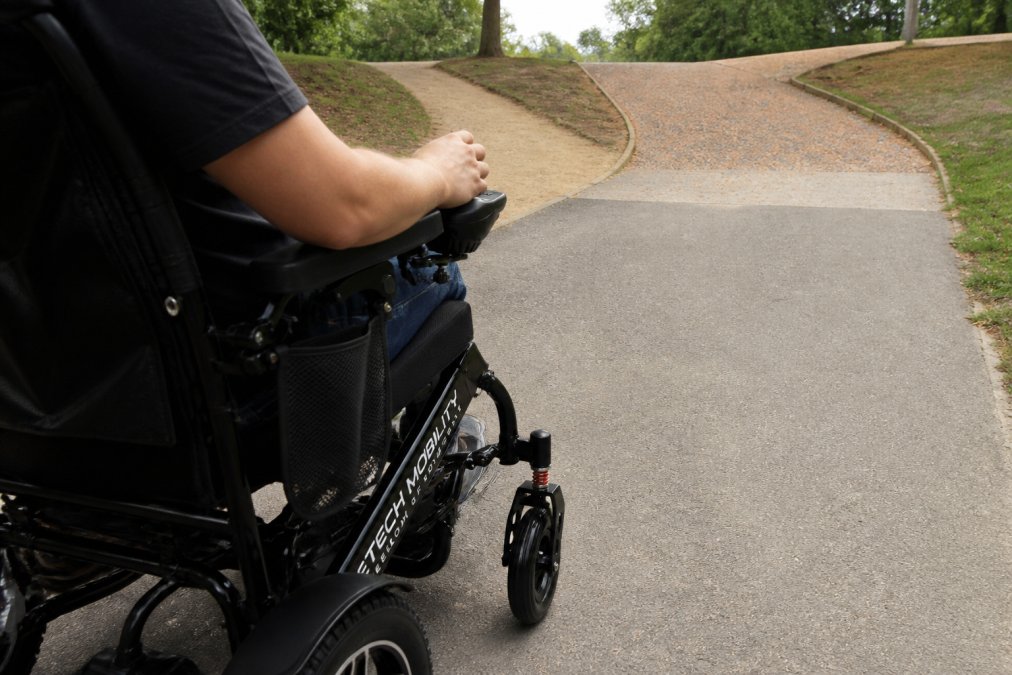
Flat, smooth surfaces are a powerchair battery's best friend. On a paved, level path, your motor works at minimum efficiency, it's fighting only rolling resistance from the tyres against the ground. Switch to grass, gravel, or sand, and energy consumption jumps immediately. Rough terrain creates friction that demands more power from the motor.
Incline is where battery drain accelerates most dramatically. Climbing a 5-degree hill consumes roughly 40% more energy than level ground. A 10-degree incline can double your power consumption. This is why a powerchair that delivers 20 miles on flat terrain might manage only 12-15 miles in hilly areas. Your motor must work harder against gravity, and that effort drains the battery faster.
Rolling resistance depends on tyre pressure and condition. Under-inflated tyres create more friction, they deform slightly as they roll, wasting energy. Properly inflated tyres roll more efficiently. Similarly, worn or damaged tyres increase rolling resistance, reducing range by 10-15% compared to new ones.
User Weight and Motor Efficiency
A powerchair motor must overcome both the chair's own weight and the user's weight to move forward. A 60kg user places less demand on the motor than a 100kg user, the difference is substantial over distance. Heavier users typically see 15-25% shorter range on the same battery because the motor works harder throughout the journey.
Motor efficiency also relates to how the powerchair is designed. Lightweight folding models like those in the Etech Mobility range are engineered to minimise motor strain. The carbon fibre construction reduces the chair's own weight, meaning the motor spends less energy moving the frame itself and more energy moving you.
Weight distribution matters too. A user sitting evenly in the chair creates balanced load on the motor. Leaning heavily to one side or shifting weight repeatedly increases motor effort slightly. It's a small factor compared to terrain or battery capacity, but it contributes to overall efficiency.
Environmental Temperature and Battery Performance
Cold weather is a battery's enemy. Lithium-ion batteries perform poorly in freezing conditions, chemical reactions inside the battery slow down, reducing available power. In temperatures below 5°C, you might see 20-30% reduction in range. Below freezing, the drop can exceed 40%.
Hot weather presents the opposite problem. Temperatures above 30°C cause batteries to degrade faster and can reduce immediate range by 10-15% due to increased internal resistance. Extreme heat also accelerates long-term battery degradation.
Most powerchair users operate in moderate conditions, but seasonal variation is real. Winter journeys will be shorter than summer ones on the same battery. If you live in a colder climate or travel during winter months, plan for reduced range and consider carrying a spare battery for longer trips.

Lithium vs Lead-Acid Powerchair Batteries
The choice between lithium-ion and lead-acid batteries fundamentally affects your powerchair's range, weight, and long-term cost.
Lithium-ion batteries deliver consistent power throughout discharge. You get usable range until the battery is nearly depleted. A 20Ah lithium-ion battery provides reliable performance across its entire charge cycle. These batteries are lighter, critical for folding powerchairs designed for portability, and they last longer, typically 3-5 years of regular use versus 1-2 years for lead-acid.
Lead-acid batteries lose efficiency as they discharge. Early in the charge cycle, they deliver full power. By the time they're 50% depleted, voltage drops and the motor works less efficiently. This means practical range is shorter than the raw amp-hour rating suggests. Lead-acid batteries are also significantly heavier, making them less suitable for lightweight folding models. However, they cost less upfront.
For most users, especially those prioritising portability and reliability, lithium-ion is the better choice despite higher initial cost. The range consistency and weight savings make a real difference in daily use. The Etech Mobility lithium-ion batteries are designed specifically for this purpose, they're engineered to maximise range whilst keeping the overall powerchair weight manageable.
How to Extend Powerchair Battery Life and Range
Your battery's range isn't fixed at purchase. How you charge, drive, and maintain your powerchair directly affects how far each charge takes you.
Daily Charging Habits and Maintenance
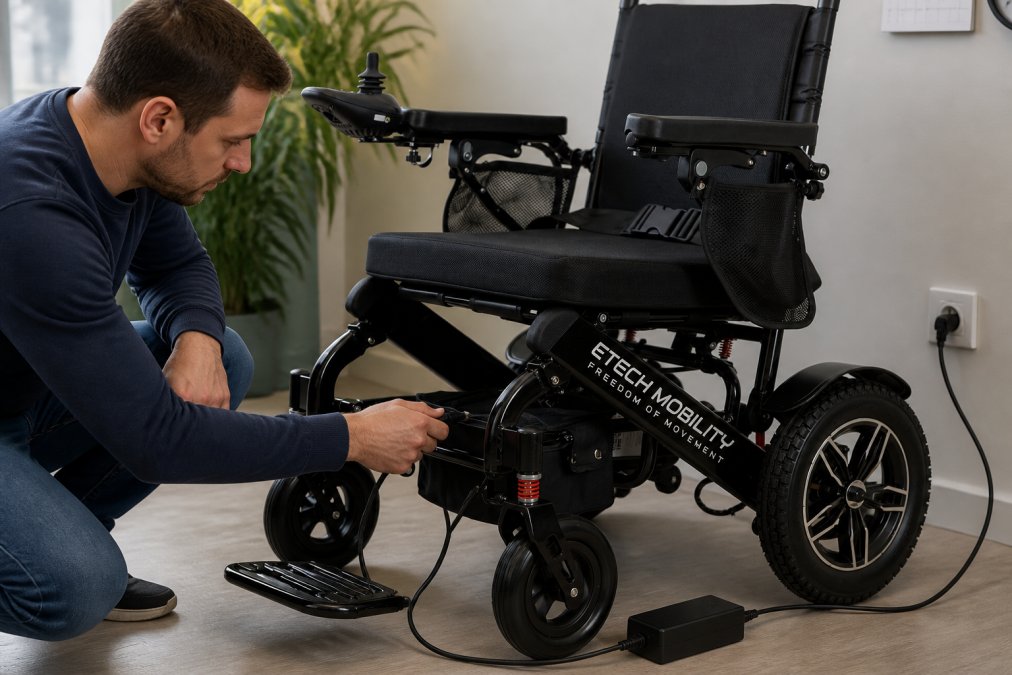
Charge your powerchair every night, even if you didn't fully deplete the battery. This habit keeps the battery in optimal condition. Lithium-ion batteries perform best when they stay within a 20-80% charge window regularly. Letting them drop to near-empty repeatedly, then fully charging them, accelerates degradation.
Most modern powerchair chargers are smart, they stop charging once the battery is full, preventing overcharging damage. Still, don't leave the charger connected for days at a time. Charge overnight, then disconnect. This simple habit extends battery lifespan by 6-12 months.
Keep battery terminals clean and dry. Corrosion on connectors reduces electrical efficiency and can reduce range by 5-10%. If you notice white or blue-green deposits on terminals, clean them gently with a dry cloth or a small brush.
Store your powerchair in a temperature-controlled environment when not in use. Extreme heat or cold during storage degrades battery chemistry faster than moderate conditions. If you won't use your powerchair for several weeks, store it with the battery at 50% charge rather than fully charged or completely depleted.
Throttle Control and Driving Techniques
How you use the throttle directly affects range. Running at maximum speed drains the battery faster than cruising at moderate speeds. Accelerating aggressively from a standstill demands peak power from the motor. Smooth, gradual acceleration is more efficient.
Plan your route to minimise stops and starts. Each time you accelerate from a standstill, the motor draws significant current. A route with fewer intersections and stops uses less energy than one requiring constant acceleration. On longer journeys, maintain a steady speed rather than alternating between fast and slow.
Avoid unnecessary weight in the powerchair. If you carry bags or cargo, keep them as light as possible and positioned low and centred. Extra weight increases the load the motor must move, reducing range proportionally.
On hills, accept slower speeds. Climbing at half speed uses significantly less energy than pushing the motor hard uphill. The journey takes longer, but you'll travel further on the same charge. Descending hills, use gentle braking rather than coasting at high speed, this prevents motor strain and reduces wear.
Tyre Pressure and Weight Distribution
Check tyre pressure monthly. Under-inflated tyres create rolling resistance that drains your battery faster. Properly inflated tyres (check your powerchair's manual for the correct PSI) roll more smoothly and extend range by 10-15%.
Inspect tyres for damage or excessive wear. Worn treads increase friction. Damaged tyres that are bulging or cracked should be replaced, they're not just inefficient, they're a safety hazard.
Weight distribution affects motor efficiency subtly but measurably. Sit centred in the chair rather than favouring one side. Distribute any cargo you carry evenly. Unbalanced weight forces the motor to work harder, reducing range slightly.
Real-World Powerchair Range: What You Can Expect
Theory meets reality when you're actually using your powerchair. Real-world range depends on how you combine all the factors above.
On flat, paved surfaces with moderate speed and good weather, a 20Ah lithium-ion battery typically delivers 20-25 miles. This is the "best case" scenario. Most users report this range on calm days with familiar routes and no unexpected hills.
In typical mixed conditions, some hills, variable speed, moderate weather, expect 15-20 miles from a 20Ah battery. This accounts for the fact that most real journeys involve some terrain variation and occasional acceleration.
In challenging conditions, hilly terrain, frequent stops and starts, cold weather, or high-speed driving, range drops to 10-15 miles. Users in mountainous areas or those who drive aggressively typically experience this shorter range.
For a 10Ah battery, reduce these figures by roughly 50%. A 10Ah system delivers 10-12 miles in ideal conditions, 8-10 miles in mixed conditions, and 5-8 miles in challenging conditions.
The Horizon 7 Multi-Terrain Folding Electric Wheelchair from Etech Mobility, for example, offers expandable twin-battery range, meaning you can carry a second battery to extend your total travel distance significantly. This flexibility is valuable for users who take longer trips or live in hilly areas.

:::bestfor Users who make frequent trips beyond 15 miles should consider dual-battery systems or higher-capacity batteries. The extra weight is minimal, and the peace of mind is substantial.
Battery Degradation Over Time
New batteries deliver maximum range. Over time, all batteries lose capacity, it's inevitable chemistry, not a defect.
Lithium-ion batteries typically retain 80-85% of their original capacity after 500 full charge cycles (roughly 2 years of daily use). After 1,000 cycles, they're usually around 70% capacity. This degradation is gradual, you won't wake up one day with a dead battery. Instead, you'll notice range decreasing slowly over months.
Lead-acid batteries degrade faster, losing noticeable capacity within 12-18 months of regular use. By 2 years, they're often 50-60% of original capacity.
You can slow degradation by following the charging and storage practices outlined above. Keeping batteries at moderate temperatures, avoiding complete discharge cycles, and charging regularly extends their useful lifespan by 6-12 months.
When a battery reaches 60-70% of original capacity, it's time to consider replacement. At this point, range becomes unreliable for planning journeys. Replacement batteries are available from Etech Mobility, the Extended Range 24V 20Ah Lithium-ion Battery for the V2 Enterprise 200 and similar options ensure you maintain your powerchair's performance without replacing the entire chair.
Understanding your powerchair's range transforms how you use it. You'll stop worrying about running out of power mid-journey and start planning trips confidently. Battery capacity, terrain, driving style, and maintenance all play roles, and you control most of them. Whether you're managing a 10-mile radius or stretching toward 25 miles per charge, the principles remain the same: know your limits, plan accordingly, and maintain your battery properly.
At Etech Mobility, we've built our lightweight folding powerchairs with range in mind. Our lithium-ion battery options, including the 24V 20Ah systems available for multiple models, are engineered to deliver consistent, reliable distance without the weight penalty of older lead-acid technology. When you're ready to explore how our range of powerchairs can support your independence, contact us, we'll help you find the right combination of battery capacity and chair design for your lifestyle.
Frequently Asked Questions
What is the average range of an electric powerchair on a single charge?
Most powerchairs travel between 15 and 40 kilometres on a full charge, depending on battery capacity (measured in amp-hours), user weight, terrain and driving style. A 20Ah lithium-ion battery typically provides longer range than a lead-acid equivalent. Real-world distance varies significantly: flat, smooth surfaces yield maximum range, while hills, rough terrain and heavier users reduce it substantially. Always check your specific model's specifications and test the actual distance in your typical environment before relying on a powerchair for longer journeys.
How does user weight affect powerchair battery range?
Heavier users consume more power because the motor works harder to move the additional weight. A user weighing 100 kg will drain the battery faster than someone weighing 70 kg on the same powerchair and terrain. Motor efficiency decreases as load increases, meaning your range can drop by 20-40% depending on how far above the chair's recommended weight capacity you are. Always check your powerchair's maximum weight capacity and realistic range estimates for your weight to avoid being caught short during outings.
What is the difference between lithium-ion and lead-acid batteries for powerchairs?
Lithium-ion batteries are lighter, charge faster, last longer (typically 500-1000 charge cycles versus 200-300 for lead-acid), and maintain consistent power throughout discharge. Lead-acid batteries are cheaper upfront but heavier, take longer to charge, and lose power gradually as they drain. Lithium-ion batteries perform better in cold weather and degrade more slowly over time. For someone prioritising range and convenience, lithium-ion is superior; for budget-conscious users, lead-acid is a starting point. Etech Mobility's 24V 20Ah lithium-ion batteries, such as the Extra Range battery for Freedom Pro models (£299.99), deliver extended travel distance and reliability.
How can I extend my powerchair's battery range?
Maintain proper tyre pressure to reduce rolling resistance, avoid unnecessary throttle acceleration, charge your battery regularly (daily or after each use) to preserve longevity, keep the battery in moderate temperatures, and minimise driving on steep inclines when possible. Smooth, steady driving on flat surfaces maximises distance. Check your battery health regularly and replace worn tyres. Consider upgrading to a higher-capacity lithium-ion battery if your model supports it. Avoid letting the battery fully deplete before charging, as this accelerates degradation. These practices can extend your range by 15-25% compared to poor charging and driving habits.