
Powerchair vs Manual Wheelchair: How to Choose
Table of Contents
- Key Differences Between Manual and Power Wheelchairs
- Pros and Cons of Manual Wheelchairs
- Pros and Cons of Power Wheelchairs
- Manual Wheelchair vs Powerchair for Travel
- Benefits of Lightweight Folding Electric Wheelchairs
- Factors to Consider When Choosing Your Mobility Aid
- Making Your Decision: Which Option Is Right For You
- Frequently Asked Questions
Last Updated: August 31, 2026
Key Differences Between Manual and Power Wheelchairs
A powerchair vs manual wheelchair represents a fundamental choice in mobility approach. Manual wheelchairs rely on user propulsion through arm strength and hand-rim contact, while powerchairs use electric motors controlled via joystick to move independently. At Etech Mobility, we help users understand these distinctions because the right choice depends entirely on your physical capabilities, lifestyle, and independence goals.

The core difference lies in propulsion method. With a manual wheelchair, you generate all forward motion through upper body strength. A powerchair removes this physical demand, the battery and motors do the work, leaving you to steer and control speed. This seemingly simple distinction cascades into differences across portability, cost, maintenance, and daily usability.
Manual wheelchairs typically weigh between 10-20 kg, fold compactly, and require no charging (iso.org). They demand consistent upper body strength and cardiovascular effort. Powerchairs weigh 25-35 kg, need battery charging every 6-8 hours, but allow users with limited arm strength to maintain independence (iso.org). Neither is universally "better", context determines which suits you.
Pros and Cons of Manual Wheelchairs
Manual wheelchairs offer genuine advantages for certain users. They're lightweight, portable, and require zero maintenance beyond occasional tyre checks and frame cleaning. The Etech Mobility Stride Transit Wheelchair, at just 13 kg, exemplifies this portability advantage, it fits easily into car boots and can be lifted by most people without strain.

Advantages of manual wheelchairs include:
- Portability: Fold to compact sizes
- No battery dependency: Travel anywhere without charging concerns
- Lower purchase cost: Typically £130-£400 depending on frame material and features
- Physical exercise: Propulsion engages upper body, maintaining cardiovascular fitness and muscle tone
- Simplicity: Fewer moving parts mean less can break
- Lightweight construction: Easier to transport on public transport, trains, and aircraft
- Immediate responsiveness: Direct control with no lag or electronic delay
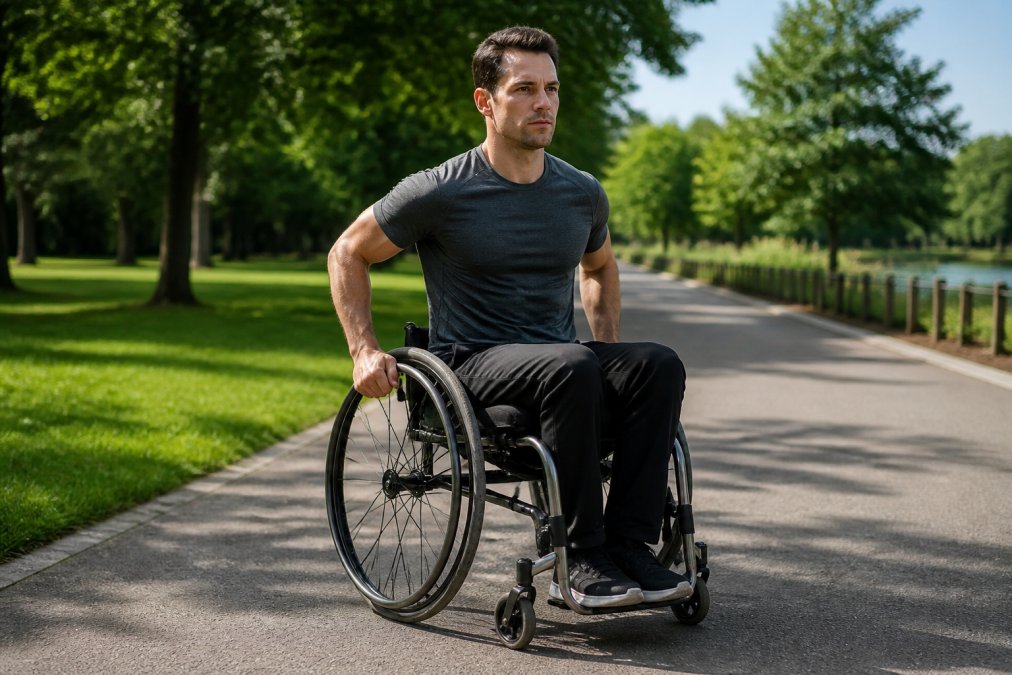
Disadvantages of manual wheelchairs are significant:
- Upper body strength requirement: Propulsion demands consistent arm and shoulder strength
- Shoulder strain: Repetitive propulsion can cause rotator cuff injuries, particularly over years of use
- Limited range: Users tire after 5-15 km depending on fitness and terrain
- Outdoor terrain challenges: Grass, gravel, and slopes become difficult or impossible
- Curb climbing: Requires significant strength and skill; many users cannot manage independently
- Weather dependency: Rain, wind, and cold reduce grip and control
- Fatigue accumulation: Daily propulsion effort compounds over time, limiting social activities
The shoulder strain issue deserves emphasis. Many long-term manual wheelchair users develop chronic pain or rotator cuff injuries (peer-reviewed research). This isn't a minor inconvenience, it can eventually force a switch to a powerchair anyway, making the initial investment feel wasted.
Pros and Cons of Power Wheelchairs
Powerchairs solve the physical demand problem entirely. The electric motor handles propulsion, leaving you to control direction and speed via joystick. This independence matters enormously for users with limited arm strength, arthritis, or progressive muscle-wasting conditions.
Advantages of powerchairs include:
- No physical propulsion required: Users with minimal arm strength maintain full independence
- Extended range: Battery range of 15-25 km per charge covers most daily errands
- Terrain capability: Dual motors and suspension handle grass, gravel, slopes, and curbs
- All-day mobility: No fatigue from propulsion effort
- Postural support options: Recliners and tilt functions reduce pressure injuries
- Weather independence: Motor function unaffected by rain or cold
- Customisation: Joystick sensitivity, speed settings, and control options adapt to individual needs
- Social participation: Users maintain energy for activities beyond mobility
The Etech Mobility Freedom Pro ST, priced at £845.50, demonstrates modern powerchair capability, with 700W dual motors, 24 km range, and multi-terrain suspension in a folding frame that fits most car boots.

Disadvantages of powerchairs are real:
- Cost: £750-£1,500+ for quality folding models (versus £130-£400 for manual wheelchairs)
- Weight: 25-35 kg makes lifting into cars difficult without assistance or a vehicle hoist
- Battery dependency: Requires daily charging; range anxiety on longer outings
- Maintenance complexity: Motors, batteries, and electronics need periodic servicing
- Portability limits: Folding powerchairs are compact but heavier than manual equivalents
- Noise: Motor hum can be noticeable indoors
- Learning curve: Joystick control takes practice for some users
- Repair costs: Motor or battery failure is expensive (£200-£600+ for repairs)
Battery range anxiety deserves honest discussion. Many users report anxiety about battery depletion during shopping trips or social outings. While 15-25 km covers most daily needs, unexpected detours or longer routes create genuine concern. The twin-battery option on Etech Mobility's Freedom Pro ST (second battery purchased separately) addresses this by doubling range, but adds cost and weight.
Manual Wheelchair vs Powerchair for Travel
Travel context fundamentally shifts the comparison. Manual wheelchairs dominate for frequent travellers because they fold to 24-30 cm width and weigh 13-18 kg, easily fitting car boots, train racks, and aircraft holds. Airlines accept them without additional fees. No charging infrastructure worries.
Powerchairs present travel challenges. A 29 kg folded powerchair requires lifting strength most people lack. Airlines allow them but often require advance notice and battery removal (lithium batteries have strict carriage rules). Vehicle hoists or ramps become essential for independent travel.
However, lightweight folding powerchairs have narrowed this gap. The Freedom Pro ST weighs 29 kg with battery but folds to 44x62x76 cm, still manageable for two people lifting together, and far more practical than older 40+ kg models. For users with arthritis in shoulders or wrists, the ability to sit down and let the motor handle inclines and slopes makes travel less painful, even if lifting requires assistance.
The benefits of lightweight folding electric wheelchairs become clear in travel contexts: independence from propulsion effort during the journey itself. A manual wheelchair user arriving at a destination after an hour of propulsion is fatigued. A powerchair user arrives ready to explore. For holidays or day trips, this distinction matters.
Benefits of Lightweight Folding Electric Wheelchairs
Lightweight folding powerchairs represent a genuine innovation. Traditional powerchairs weighed 40-50 kg, made travel impractical, and required vehicle hoists. Modern folding designs like Etech Mobility's range use aluminium alloy and carbon fibre frames to achieve 26-29 kg, changing what's possible.
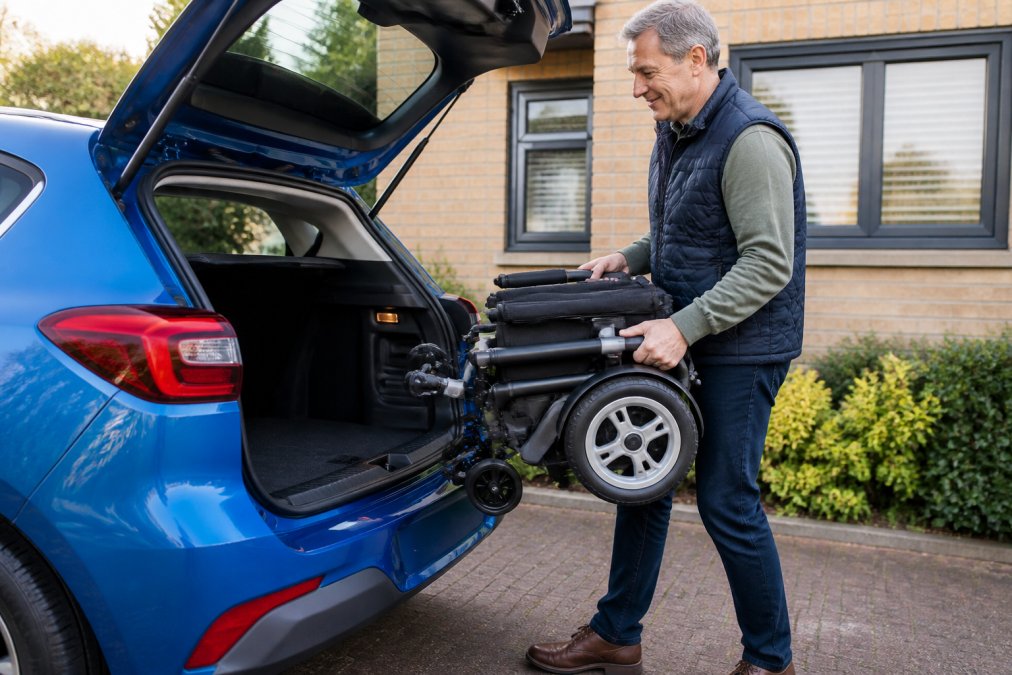
Specific advantages of lightweight folding powerchairs:
- Portability without sacrifice: 26-29 kg weight allows two people to lift into vehicles without hoists
- Compact folding: 44x62x76 cm folded size fits most car boots
- Multi-terrain capability: Suspension and dual motors handle surfaces manual wheelchairs cannot
- Battery range: 15-25 km covers daily activities without anxiety
- Foldability and battery separation: Newer models allow battery removal while folded, reducing lifting strain (remove battery separately, store chair in boot)
- Airline approval: Lithium batteries meet aviation standards; chairs fit aircraft holds
- Customisation: Joystick sensitivity, speed presets, and control options suit different abilities
- Long-term sustainability: Users can maintain independence longer as age or condition progresses
The foldability advantage deserves emphasis. A manual wheelchair user with arthritis in shoulders faces a choice: propel despite pain, or stop using it. A powerchair user with the same arthritis can continue indefinitely. This matters for long-term independence and quality of life.
The battery-removal feature on Etech Mobility's Freedom Pro ST specifically addresses a common objection: "I've got arthritis in my shoulders - will I actually be able to fold this thing myself, or am I just going to end up in pain every time I need to put it away?" The answer: remove the battery first (lightweight), then fold the chair (now 26 kg instead of 29 kg), store it in the boot, and take the battery inside to charge. This practical design detail removes a real barrier.
Factors to Consider When Choosing Your Mobility Aid
Choosing between a powerchair and manual wheelchair requires honest assessment of several factors. This isn't a theoretical exercise, the wrong choice leads to an expensive device gathering dust.
Upper Body Strength and Physical Requirements
Assess your current upper body strength realistically. Can you propel a manual wheelchair 5 km without fatigue? 10 km? If pushing a shopping trolley causes shoulder pain, manual propulsion will too. Progressive conditions like multiple sclerosis or motor neurone disease suggest powerchairs because your capabilities will decline, purchasing a manual wheelchair now means purchasing a powerchair later anyway.
A simple test: can you perform 20 shoulder circles without discomfort? Can you push a heavy door open? These basic movements predict manual wheelchair usability. If arthritis, weakness, or pain limit these, a powerchair removes the guesswork.
Portability and Transportation Considerations
Measure your car boot width and depth. A manual wheelchair folds to roughly 24 cm width; a powerchair to 44-63 cm. Both fit most boots, but powerchairs require more space. If you travel frequently, weight matters, can you or a companion lift 29 kg repeatedly? If not, a vehicle hoist or ramp becomes essential (adding £1,500-£3,000 to total cost).
For public transport users, manual wheelchairs' lightweight advantage is decisive. A 13 kg wheelchair you can fold and carry onto a bus yourself beats a 29 kg powerchair that requires assistance every journey. Context determines the answer.
Indoor vs Outdoor Maneuverability
Manual wheelchairs excel indoors. They turn tightly, navigate narrow corridors, and fit under tables. Powerchairs have wider turning radiuses (typically 1.2-1.5 metres) and may not fit through standard doorways if the seat width exceeds 45-50 cm.
Outdoors, powerchairs dominate. Grass, gravel, slopes, and curbs become navigable. Manual wheelchair users face genuine barriers, a steep ramp or grass verge can be impassable. If your daily life involves outdoor terrain, a powerchair isn't optional.
Cost and Budget Considerations
Manual wheelchairs cost £130-£400. Quality folding powerchairs cost £750-£1,500. This 5-10x price difference matters for many families. However, factor in long-term costs: a manual wheelchair user who develops shoulder injuries may require physiotherapy and eventually need a powerchair anyway. The total cost of "buy cheap manual, develop injuries, buy expensive powerchair" often exceeds "buy powerchair from the start."
Etech Mobility's pricing reflects this reality. The Stride Transit Manual Wheelchair at £129.99 offers genuine value for users whose strength allows it. The Freedom Pro ST at £845.50 suits others. Neither is inherently better, your situation determines the value.
Some users benefit from hybrid approaches. The Horizon 7 multi-terrain powerchair at £759.99 offers budget entry into powered mobility, making it accessible to users who assumed powerchairs were unaffordable.
NHS Wheelchair Assessment Criteria
The NHS Wheelchair Service provides free or heavily subsidised wheelchairs through local services. However, eligibility and provision vary significantly by region. Generally, you'll need:
- A referral from a healthcare professional (GP, occupational therapist, or physiotherapist)
- Evidence of permanent mobility impairment affecting daily activities
- Assessment showing manual wheelchair inadequate for your needs
The NHS typically provides basic manual or powered wheelchairs, though options are limited. Waiting times range depending on region. If you need a specific feature (lightweight frame, folding design, multi-terrain capability) the NHS may not provide it, requiring private purchase to supplement.
This is crucial: NHS provision doesn't prevent private purchase. Many users receive an NHS manual wheelchair, then purchase a private powerchair for travel or outdoor use. Understanding what the NHS will provide helps you budget for what you'll need to purchase privately.
Making Your Decision: Which Option Is Right For You
This decision requires honest answers to three questions.
First: Can you physically propel a manual wheelchair without pain or excessive fatigue? If yes, a manual wheelchair's portability and cost advantages are real. If no, a powerchair isn't optional, it's essential.
Second: How often do you travel, and what terrain do you navigate daily? Frequent travellers benefit from manual wheelchairs' lightweight portability. Users navigating grass, slopes, or rough terrain need powerchairs. Users doing both might benefit from owning both (manual for travel, powerchair for daily use).
Third: What's your realistic budget, and what's the cost of not choosing correctly? A manual wheelchair user who develops shoulder injuries faces months of pain and eventual powerchair purchase. A powerchair user with limited budget faces immediate cost but eliminates long-term injury risk. These aren't equivalent trade-offs.
For many users, the answer is clear. Active users with strong shoulders and frequent travel choose manual wheelchairs. Users with limited arm strength, arthritis, or progressive conditions choose powerchairs. Users doing both might own both.
If you're uncertain, request an NHS wheelchair assessment. The occupational therapist will evaluate your strength, home environment, and daily activities, providing professional guidance. This assessment costs nothing and clarifies your options before spending hundreds of pounds.
Etech Mobility's approach is to help you find the right solution for your life, not to push you toward the most expensive option. The Stride Transit Manual Wheelchair at £129.99 suits many users perfectly. The Freedom Pro ST at £845.50 suits others. Neither is universally correct, your circumstances determine which serves you better.
Choosing the right mobility aid is one of the most important decisions you'll make for your independence. If you're uncertain whether a powerchair or manual wheelchair suits your needs, Etech Mobility offers personalised guidance to match you with the right solution. Our lightweight folding powerchairs, including the Freedom Pro ST with its innovative battery-removal design, are built for everyday independence and easy transport. Contact us today to discuss your specific situation and find the mobility solution that keeps you active and independent.
Frequently Asked Questions
Q: What are the main differences between a powerchair and a manual wheelchair?
A: Manual wheelchairs rely on user propulsion through arm strength and hand-rim control, offering independence and simplicity but requiring significant upper body strength. Powerchairs use electric motors and joystick control, requiring no propulsion effort and providing greater range and terrain capability. Manual wheelchairs are lighter, more portable, and lower-cost; powerchairs offer comfort on longer journeys and are suitable for users with limited arm strength. The choice depends on your physical ability, lifestyle, and independence priorities.
Q: Can I use a powerchair if the battery dies?
A: Most powerchairs cannot be propelled manually if the battery is depleted, as the motor and weight make hand propulsion impossible. This is a key consideration if you rely on a powerchair for independence. To mitigate this risk, check the battery range before outings, carry a charger when possible, and consider models with dual-battery slots, like the Freedom Pro ST (£845.50), which allow you to extend your range. If you need backup mobility, a lightweight manual wheelchair provides security.
Q: How do I know if I'm eligible for an NHS wheelchair assessment?
A: Your GP or healthcare professional can refer you for an NHS wheelchair assessment if your mobility is significantly limited by illness, injury, or disability. The assessment evaluates your functional abilities, home environment, and lifestyle needs to recommend the most suitable mobility aid. Assessments consider factors like upper body strength, postural support requirements, terrain use, and transportation needs. Contact your local NHS wheelchair service or ask your GP to arrange a referral. Assessment criteria vary by region, so check with your local service for specific details.
Q: What should I consider when choosing between a manual and electric wheelchair for travel?
A: For travel, consider portability, weight, and ease of storage. Lightweight manual wheelchairs like the Stride (13 kg, £129.99) fold compactly and require no charging, ideal for short trips and airline travel. Folding powerchairs like the Freedom Pro ST (26 kg folded, £845.50) offer comfort on longer journeys and multi-terrain capability but need charging access. Manual wheelchairs suit car travel and public transport if you have arm strength; powerchairs suit extended outings where battery range and terrain coverage matter. Check airline policies, both types must meet size and weight restrictions.