
Simple Storage vs Extended Range: Which Powerchair Fits Your Life
Table of Contents
- Simple Storage vs Extended Range: Understanding the Core Trade-Off
- What Defines a Lightweight Folding Mobility Scooter for Everyday Use
- Extended Battery Range: When You Need to Go Longer
- Compact Design and Portability: The Simple Storage Advantage
- Real-World Range: What Actually Affects Battery Performance
- Lightweight Folding Powerchairs for Public Transport
- Making Your Choice: Daily Routine Framework
- Conclusion
- Frequently Asked Questions
Last Updated: October 10, 2026
Simple Storage vs Extended Range: Understanding the Core Trade-Off
When comparing simple storage vs extended range, the choice isn't about picking the objectively "better" option. It's about matching your actual lifestyle to the right tool. A lightweight folding powerchair optimised for simple storage prioritises portability and easy lifting, making it ideal for daily trips around town and public transport. An extended-range model sacrifices some compactness to give you the freedom to spend entire days out without worrying about battery depletion.
The trade-off: convenience versus distance.
Most people overestimate their range needs. If you're doing short errands, visiting friends locally, or using public transport, a lightweight folding powerchair with simple storage solves real problems extended range doesn't address: you can lift it yourself, it fits in your hallway, and you avoid paying for unused capability.
What Defines a Lightweight Folding Mobility Scooter for Everyday Use
Lightweight folding powerchairs prioritise ease of handling and storage over distance. They fold to compact dimensions and handle indoor navigation and pavements.
The LiteMax 2 weighs 19.8 kg and folds to 26 × 58 × 78-94 cm, small enough for most car boots and light enough for self-lifting. The standard 12Ah battery delivers up to 15 miles, covering shopping trips, visits to friends, and appointments.

Everyday powerchairs assume multiple short trips rather than long expeditions. This affects motor power, wheel size, and suspension. Smaller motors reduce weight; solid tyres need less maintenance; controls are straightforward.
Comfort is secondary to practicality. The goal is reliable daily independence, not luxury features that add weight.
Extended Battery Range: When You Need to Go Longer
Extended range becomes essential when your lifestyle demands it. An extended-range powerchair carries a larger battery that roughly doubles driving distance, at the cost of weight and folded size.
The Horizon 7 offers extended range through a twin-slot battery design. It ships with one 12Ah battery and accepts a second, letting you double range when needed. This flexibility suits inconsistent needs: some weeks local trips, others full-day exploring, without carrying extra weight daily.
Extended range becomes practical when you're:
- Regularly spending 6+ hours outdoors in a single outing
- Visiting locations 15+ miles away from home
- Exploring new areas where you can't easily recharge mid-journey
- Managing a condition where fatigue makes returning home difficult
- Maintaining an active outdoor lifestyle (countryside walks, day trips, extended social events)
Real-world range depends on user weight, speed, terrain, temperature, and acceleration. Cold weather drains batteries faster. Gentle acceleration extends range; aggressive driving depletes it quickly.
The 20Ah lithium battery for the LiteMax 2 costs £295.50 and adds 2 kg. For the Horizon 7, a second battery doubles range without permanently increasing everyday weight, you only carry both for long outings.
Compact Design and Portability: The Simple Storage Advantage
Compact design solves a problem extended range doesn't: how to live with your powerchair in a real home. A chair that folds compactly fits hallways, cupboards, and car boots. The Horizon 7 requires more planning.
Simple storage means the chair is accessible and convenient, not squeezed into corners or left in hallways. You're not asking your carer to help manoeuvre it into the car every time. It doesn't dominate your living space.
Weight matters as much as dimensions. For users with shoulder arthritis or limited upper-body strength, it's the difference between using the chair and avoiding it.
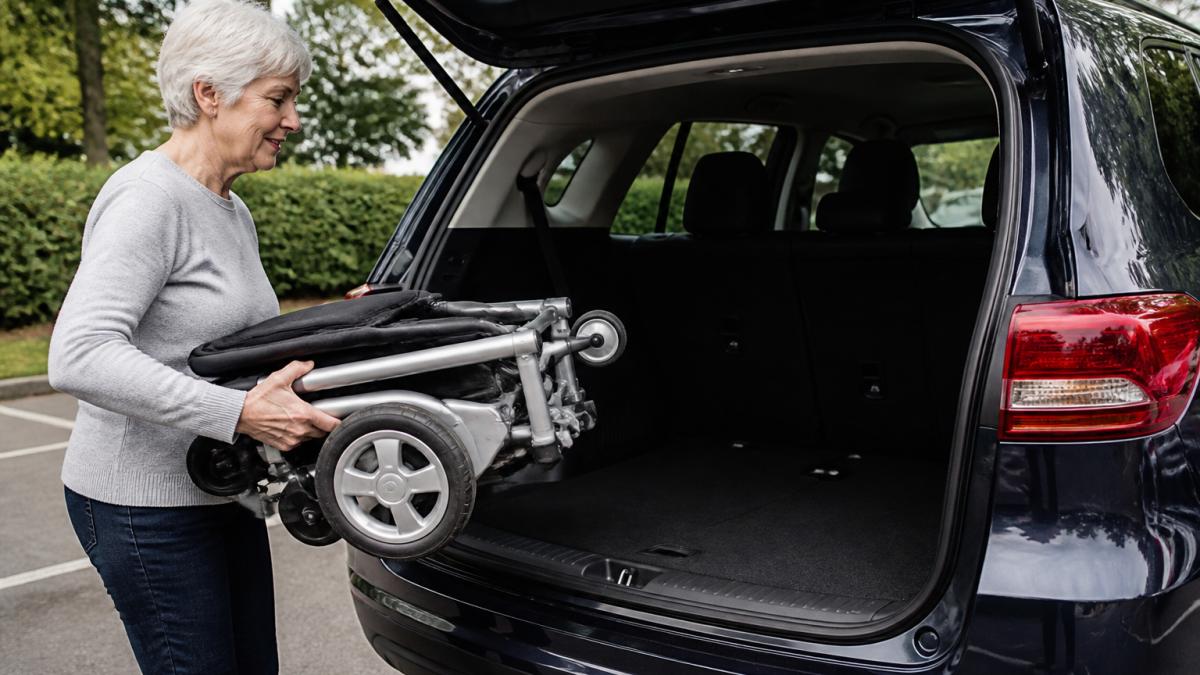
A lightweight, compact powerchair is genuinely portable on public transport. You can manage it on buses, trains, and coaches without special assistance. It fits in aeroplane cabins as checked luggage (the standard 12Ah battery is airline-friendly).
The LiteMax 2 (19.8 kg, 58 cm width) folds to a parcel you can carry without exhaustion. That's the difference between independent outings and depending on someone else's schedule.

Real-World Range: What Actually Affects Battery Performance
Spec sheet range figures are "up to" estimates. Understanding these factors helps you choose the right battery capacity.
User weight is the biggest factor. Range scales with weight: lighter users get more miles per charge. Etech Mobility models support up to 120 kg.
Terrain has dramatic effect. Smooth pavements deliver best range. Hills are more demanding. Significant terrain variation requires bigger safety margins than spec sheets suggest.
Gentle acceleration and moderate speed (3-4 mph) extend range significantly. Aggressive acceleration and full-speed driving drain batteries quickly. If range anxiety concerns you, adjust your driving style.
Grade A Refurbished Silver LiteMax 2 | Ultra-Lightweight Folding Electric →
Temperature affects lithium batteries noticeably. Cold weather reduces range. Hot weather is less problematic but still noticeable. Winter journeys deliver shorter range than summer ones on the same battery.
Battery age and maintenance matter. A new battery delivers its rated capacity. Proper charging (using the supplied charger, not overcharging) extends battery life. Lithium batteries prefer partial charges to full depletion and recharge cycles.
Lightweight Folding Powerchairs for Public Transport
Public transport changes the equation entirely. A powerchair that works for local driving doesn't automatically work on buses, trains, and coaches. Weight, folded dimensions, and ease of handling determine whether you can genuinely use public transport independently or whether you're dependent on assistance.
A 19-20 kg chair with a 58 cm width is public-transport-friendly. You can fold it, carry it onto a bus or train, and stow it in designated spaces without requiring staff assistance. You can manage it independently or with minimal help from a travel companion.
The LiteMax 2's compact folded size (26 × 58 × 78-94 cm) and light weight (19.8 kg) make it practical for regular public transport use. The standard 12Ah battery is airline-friendly, so you can travel by air without worrying about battery restrictions. That opens up travel possibilities that extended-range models (with non-airline-friendly 20Ah batteries) cannot offer.

Buses and coaches present specific challenges. Space is limited, and staff have safety protocols about where powerchairs can be positioned. A compact chair that folds to a manageable size is more likely to fit comfortably in designated wheelchair spaces.
If public transport is part of your regular life, lightweight and compact design aren't optional, they're essential. An extended-range model might deliver more miles, but if you can't actually get it onto the bus, the extra range is theoretical.
Making Your Choice: Daily Routine Framework
The best way to decide is to audit your actual life, not your aspirations. Most people overestimate how far they travel and underestimate how much they value convenience and independence.
Start by tracking your journeys for two weeks. Record:
- How far you travel on your longest outing
- How many times per week you go more than 10 miles
- Whether you use public transport, and how often
- Whether you lift and store the chair yourself, or do you rely on someone else
- What terrain you encounter regularly (pavements, grass, hills, mixed)
If your longest regular outing is under 12 miles, and you do that fewer than twice a week, a lightweight everyday model with simple storage probably fits you better. You're not sacrificing real capability, you're gaining independence and convenience.
If you regularly spend 6+ hours outdoors, travel 15+ miles in a single outing multiple times per week, and have reliable access to charging infrastructure, extended range becomes practical. You're trading some convenience for genuine freedom.
The middle ground is often the right answer. A lightweight model with the option to add an extended-range battery (like the Horizon 7's twin-slot design) gives you both. You get everyday simplicity and portability, with the flexibility to extend range when you need it.
| Factor | Simple Storage Priority | Extended Range Priority |
|---|---|---|
| Typical weekly longest trip | Under 12 miles | 15+ miles regularly |
| Public transport use | Frequent | Occasional or never |
| Lifting/handling | User does it independently | Carer assists or stored permanently |
| Home storage space | Limited (hallway, cupboard) | Garage or dedicated space |
| Travel frequency | Local errands and short visits | Day trips and exploration |
| Battery anxiety | Acceptable for local trips | Needs confidence for longer days |
| Terrain | Mostly pavements | Mixed (grass, gravel, hills) |
Etech Mobility's LiteMax 2 is built for the simple-storage priority. At 19.8 kg with a 58 cm width, it delivers everyday independence without compromise. The Horizon 7 serves users who need extended range and terrain capability, with the flexibility to add a second battery for longer outings.
Conclusion
The choice between simple storage and extended range isn't about which specification is objectively better. It's about which one solves your real problem. Simple storage solves the problem of independence, convenience, and living with your powerchair in a real home. Extended range solves the problem of spending entire days outdoors without battery anxiety.
Most users benefit from starting with a lightweight, compact model and adding extended-range capability later if their needs change. That's why we designed the Horizon 7 with twin-battery flexibility, you're not locked into a choice you might outgrow.
At Etech Mobility, we're committed to helping you find the right fit for your life. Our LiteMax 2 combines lightweight portability with reliable everyday performance, while the Horizon 7 delivers multi-terrain capability and expandable range. Both ship with free UK delivery and our commitment to exceptional customer support. Contact us today to discuss which model matches your lifestyle, and we'll help you make the right choice with personalized guidance.
Frequently Asked Questions
How far can a powerchair travel on a single charge?
Range depends on battery capacity, user weight, terrain and driving habits. The LiteMax 2 with a standard 12Ah battery reaches up to 15 miles, whilst the 20Ah option extends this to 25 miles. The Horizon 7 offers similar range with one battery and roughly double with two. Real-world distance is typically shorter than maximum estimates. Flat, smooth pavements and lighter users achieve longer range; hills, rough ground and heavier users reduce it significantly.
What makes a lightweight folding mobility scooter suitable for everyday use?
Everyday suitability comes from three factors: weight you can handle independently, battery capacity for your typical outings, and a folding mechanism simple enough to use regularly. The LiteMax 2 weighs just 20 kg and folds to 26 x 58 x 78-94 cm, fitting most car boots and home storage. A standard 12Ah battery suits short trips to shops and social visits; if you regularly travel further, a 20Ah battery or dual-battery setup prevents range anxiety and lets you maintain independence without constant charging.
Can I take a folding powerchair on public transport?
Yes, lightweight folding powerchairs are designed for public transport use. The LiteMax 2's compact 58 cm width navigates bus aisles and train corridors; its 20 kg weight allows independent folding and storage. Check with your local transport provider for their specific policies on powered mobility aids. Most accept airline-friendly batteries (the standard 12Ah LiteMax 2 battery qualifies), making travel easier. Compact folding size and light weight are essential for public transport practicality.
How do I know if I need extended battery range or simple storage?
Consider your daily routine and typical outings. If you shop locally, visit friends nearby and stay out for 2-4 hours, simple storage and a standard battery meet your needs. If you take longer outings, visit distant locations regularly or want flexibility without planning around charging, extended range is worth the trade-off in weight and storage space. The Horizon 7's twin-battery design offers flexibility: start with one battery for everyday use, add a second when you need longer range without replacing your chair.