
Travel Mobility Scooter Cost UK 2026: Real Prices
Table of Contents
- Travel Mobility Scooter Cost 2026: What You Actually Pay
- Foldable Mobility Scooter Cost: Entry, Mid-Range and Premium
- Best Travel Mobility Scooter Picks for 2026
- Carbon Fibre Mobility Scooter Price: Is the Premium Worth It?
- Mobility Scooter for Public Transport: What to Check Before You Buy
- Total Cost of Ownership: Battery, Servicing and Airline Rules
- Used, Refurbished and Rental: The Cheaper Routes Compared
- Conclusion
- Frequently Asked Questions
Last Updated: October 17, 2026
Travel Mobility Scooter Cost 2026: What You Actually Pay
Travel mobility scooter cost now runs from roughly £760 to £1,400 for a folding powered model, and the spread is explained almost entirely by frame material, battery capacity and folded size. Below: real prices, what each tier buys you, and the ownership costs most guides leave out.
The single most useful thing to understand: a travel scooter is priced by what it weighs and how small it folds. Everything else is secondary.
What Sits Inside a Travel Scooter Price
Every travel scooter price is built from five components. The frame sets the floor: aluminium is the cheap, corrosion-resistant workhorse, magnesium alloy costs more but cuts weight further, and carbon fibre sits at the top, the reason a carbon model can cost several hundred pounds more than a similar-sized aluminium one.
Then come the motors, batteries, folding mechanism and certification. A Class 2 scooter, limited to 4 mph and legal on pavements, needs UKCA marking and BS EN 12184 compliance, testing baked into every legitimate price.
Battery capacity is the other big lever: a 6Ah pack keeps price and range modest, while 12Ah or a twin-battery setup adds cost but can extend how far you can realistically go.
Foldable Mobility Scooter Cost: Entry, Mid-Range and Premium
Foldable mobility scooter cost splits into three clear bands in 2026, each buying a genuinely different machine.
Entry level, around £760 to £850. You get an aluminium folding frame, a single battery, and enough range for shopping trips and short outings.
Mid-range, around £795 to £1,000. Here you pay for lighter weight and better folding.
Premium, above £1,300. Carbon fibre territory. The Vantage Carbon at £1,395.99 gives you a full carbon frame, and the option to self-propel by hand if the battery runs low.
| Tier | Typical Price | Frame | Best For |
|---|---|---|---|
| Entry | £759.99 - £849.99 | Aluminium | Everyday local trips |
| Mid-range | £794.99 - £999.99 | Aluminium / magnesium | Frequent travel, lifting |
| Premium | £1,395.99 | Carbon fibre | Maximum portability, comfort |
Best Travel Mobility Scooter Picks for 2026
Our MagNeo is a pick for pure portability: 12.3 kg without batteries, 35 cm folded, quick-release batteries, and two 24V packs giving up to 15 miles combined.

For comfort over longer days, the Vantage Carbon's rear wheels can make a noticeable difference on pavements and promenades.
If budget leads, the Horizon 7 can handle grass, gravel and ramps with all-round suspension, and you can add a second battery later rather than paying upfront.
Side-by-Side Specification Comparison
| Model | Price | Weight (no battery) | Range | Max Speed |
|---|---|---|---|---|
| Horizon 7 | £759.99 | 23 kg | 15 miles (30 with 2 batteries) | 4 mph |
| LiteMax 2 | £794.99 | 19.8 kg | 15 or 25 miles | 4 mph |
| Aeron | £849.99 | 15.4 kg | Up to 20 miles | 4 mph |
| MagNeo | £999.99 | 12.3 kg | Up to 15 miles | 4 mph |
| Vantage Carbon | £1,395.99 | 16 kg | Up to 8 miles | 4 mph |
Carbon Fibre Mobility Scooter Price: Is the Premium Worth It?
The honest limitation is range. Our Vantage Carbon manages up to 8 miles on its single 24V 6Ah battery, well short of the Aeron's 20. Carbon frames are also a bigger upfront commitment.
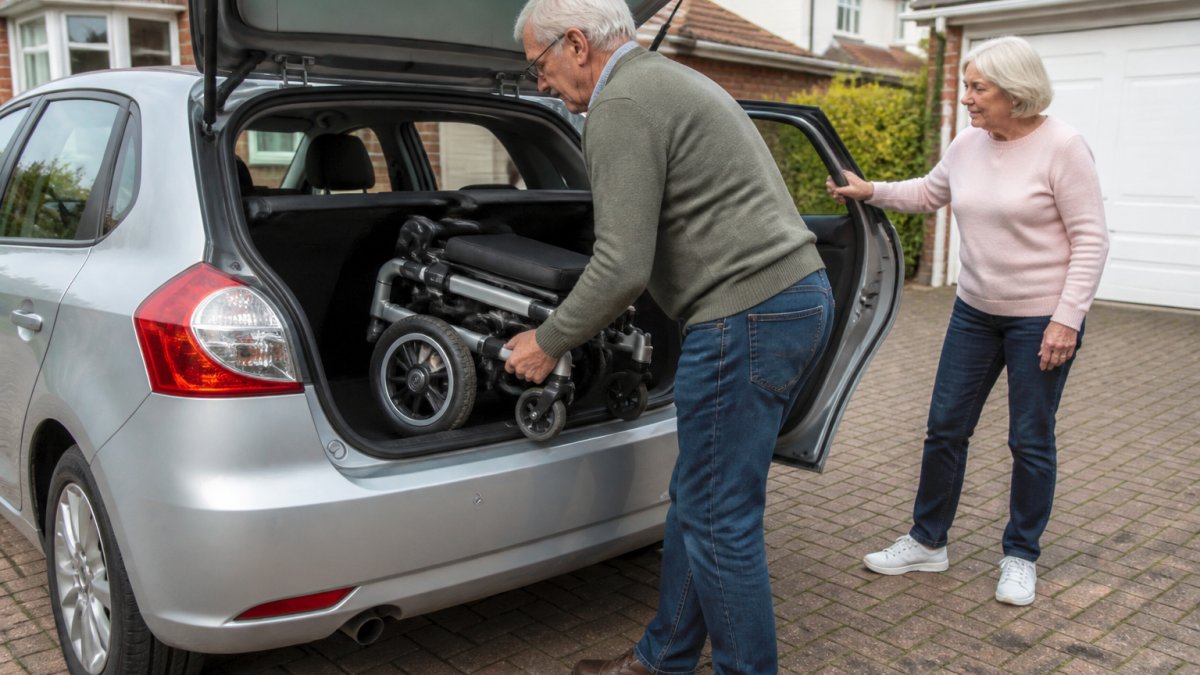
Where carbon earns its price: small car boots, narrow hallways, stairs at a friend's house, and any situation where the machine has to be moved by hand rather than rolled.
Mobility Scooter for Public Transport: What to Check Before You Buy
A mobility scooter for public transport use must fit the space the operator provides, a stricter test than fitting your hallway.
Three checks matter most: overall width, since aisle and bay space is tight; turning circle, for confined manoeuvring; and battery type and removability, as some operators ask for batteries to be isolated or carried separately.
Our MagNeo's 56 cm width and quick-release batteries suit this pattern well. The LiteMax 2 at 58 cm wide is similarly manageable.
Total Cost of Ownership: Battery, Servicing and Airline Rules
The purchase price is only the first number. Total cost of ownership covers replacement batteries, servicing, insurance, warranty and air travel rules, the part most price guides skip.
MagNeo – 12.3kg Ultra-Lightweight Magnesium Electric Wheelchair →
What the sticker price includes in 2026
Before comparing any two scooters, confirm what the quoted figure covers. Displayed prices often include VAT at 20%, but delivery, assembly and a first battery can vary, and some retailers advertise ex-VAT prices that grow at checkout. Ask three questions of any quote: is VAT included, is delivery included, and is the battery included or an add-on. Our own range is quoted inclusive of VAT with free UK delivery and a 1-year warranty.
Replacement batteries: the biggest long-term line
Lithium packs degrade with age and charge cycles, so expect useful capacity for roughly two to four years of regular use and budget for replacement. Cost scales with capacity: a small 6Ah pack is cheapest to replace, while a twin 24V setup or larger 12Ah pack costs more. Ask the seller for the replacement battery price at the point of sale, the most useful ownership number, and few buyers ask.
Servicing, tyres and brakes
Servicing is modest on a well-built machine. Brushless motors need little attention, but tyres, brakes and the folding mechanism deserve an annual check. Tyres and brake pads are wear-dependent and usually inexpensive, but rough pavements wear them faster. The folding hinge wears most, so have it checked at every service.
Insurance and warranty
Insurance is optional for private Class 2 use but worth pricing if you leave the scooter outside or use public transport; premiums vary widely by provider and postcode. Warranty is the more reliable protection: our models carry a 1-year warranty. Check the exclusions, batteries are commonly treated as consumables with shorter cover than the frame.
Air travel rules
Air travel has its own rules. UK Civil Aviation Authority guidance on flying with mobility aids sets out what airlines require, and individual carriers add their own conditions. The key practical point is that airline acceptance and battery limits vary by carrier, so the same scooter may be accepted by one airline and refused by another. Removable, airline-friendly batteries like ours are easier to declare, but always confirm with the airline in advance and get the confirmation in writing.
| Cost Area | What to Budget | Frequency |
|---|---|---|
| Replacement battery | Scales with capacity; ask at point of sale | Every few years with heavy use |
| Annual safety check | Low tens of pounds, indicative | Yearly |
| Tyres and brake pads | Wear-dependent, usually inexpensive | As needed |
| Insurance (optional) | Quote-dependent by provider and postcode | Annually |
| Warranty | Included, 1 year on our models | Check exclusions |
| Airline approval | No charge, but needs notice | Before each trip |
Used, Refurbished and Rental: The Cheaper Routes Compared
Buying used can cut the upfront figure substantially, but the savings carry risk. Here is a like-for-like comparison of used, refurbished and rental against new, with the checks that decide whether the saving is real.
Used: biggest discount, biggest unknown
A private used travel scooter commonly sells for a fraction of its new price, but the discount is only worth having if the battery is sound, a tired pack can cost more to replace than the discount was worth. Ask the battery's age, how often it was charged, and whether it was stored flat over winter. Test the range on a known route before committing, and check the frame for cracks at the hinge and the folding mechanism for wobble.
Refurbished: checked machine, short warranty
Refurbished models from a reputable seller sit in the middle: a checked machine, often a replaced battery, and usually a short warranty, a fair trade against a private sale. Ask what the refurbishment covered, since a new battery and tyres is a very different proposition from a clean and a charge. Confirm the warranty length and whether it covers the battery, the part most likely to fail.
Rental: pay for the weeks you need
Rental suits occasional use: a holiday, a family wedding, a few weeks of recovery. Short-term hire costs more per week than ownership but nothing once you hand it back. For a two-week holiday, rental usually beats buying; beyond a few months, buying usually works out cheaper. Check what the rental includes, delivery, insurance, breakdown cover and a spare battery can swing the comparison.
The break-even rule
A simple way to decide: estimate how many weeks you will actually use the scooter in a year. If it is a handful, rent. If it is most weeks, buy new or refurbished. Used sits between the two and makes sense when you can verify the battery and the seller is local enough to inspect before paying.
| Route | Upfront Cost | Battery Risk | Warranty | Best For |
|---|---|---|---|---|
| Used (private) | Lowest | Highest, verify age and range | Usually none | Confident buyers who can inspect |
| Refurbished | Middle | Lower, often replaced | Short, check battery cover | Buyers wanting a checked machine |
| Rental | Per day or week | None, provider's problem | Included in hire | Holidays and short-term needs |
| New | Highest | None, full pack | 1 year on our models | Regular, long-term use |
Conclusion
Working out travel mobility scooter cost comes down to matching weight and folded size to how you will actually move the machine. Get that right and the price tier follows naturally.
At Etech Mobility, we help you choose rather than guess. Our range includes the 12.3 kg MagNeo, the carbon fibre Vantage Carbon, and the accessible Horizon 7, all with free delivery and a 1-year warranty.

Frequently Asked Questions
How much does a foldable mobility scooter cost?
Folding electric wheelchairs and travel scooters in the Etech Mobility range start at £759.99 for the Horizon 7 multi-terrain model and rise to £1,395.99 for the carbon fibre Vantage Carbon. The LiteMax 2 sits at £794.99, the Aeron at £849.99 and the MagNeo at £999.99. Prices include free delivery, and each model carries a one-year warranty. What pushes the figure up is frame material, battery capacity and wheel size rather than the folding mechanism itself.
What is the best travel mobility scooter for public transport?
For buses, trains and trams, the deciding factors are folded size, weight and a removable airline-friendly battery. The MagNeo folds to 51 x 56 x 35 cm and weighs 12.3 kg without batteries, which makes it the easiest of the range to lift onto a vehicle. Its 4 mph top speed and 120 kg capacity suit Class 2 use on pavements and public transport. Check the operator's own carriage rules before travelling, as policies vary between providers.
Are lightweight mobility scooters more expensive?
Not automatically. The MagNeo, at 12.3 kg, costs £999.99, while the heavier 23 kg Horizon 7 costs £759.99. Frame material drives the difference: magnesium alloy and carbon fibre cost more per kilogram than aluminium. What you pay extra for is lifting ease and folded compactness, not range. If your priority is distance rather than portability, a heavier aluminium model can work out cheaper.
Is a carbon fibre mobility scooter worth the extra cost?
Carbon fibre earns its price when weight and folded size decide whether you can use the scooter independently. The Vantage Carbon costs £1,395.99 and weighs 16 kg without the battery, with rear wheels that let you self-propel if the charge runs low. That manual backup matters if you travel alone. If someone else lifts the chair for you, an aluminium model at a lower price delivers similar daily range.
What affects the price of a travel mobility scooter?
Four things move the price most: frame material, battery capacity, wheel size and motor power. Aluminium frames cost least, magnesium and carbon fibre cost more. Battery capacity sets range, from around 8 miles on the Vantage Carbon to roughly 20 miles on the Aeron with both batteries fitted. Larger wheels and 300W motors, as on the Horizon 7, add cost and capability. Delivery, VAT and any after-sales support plan sit on top of the headline figure.