
Ultra Lightweight Powerchair Storage Tips: 2026 Guide
Table of Contents
- Why Ultra Lightweight Powerchair Storage Matters
- Folding Powerchair Storage Solutions for Small Spaces
- Electric Wheelchair Battery Maintenance During Storage
- Protecting Your Powerchair From Moisture and Damp
- Mobility Equipment Winter Storage: Cold Weather Preparation
- Car Boot Storage and Transport Tips
- Security and Theft Prevention When Storing Your Powerchair
- Conclusion
- Frequently Asked Questions
Last Updated: September 10, 2026
Why Ultra Lightweight Powerchair Storage Matters
Ultra lightweight powerchair storage tips matter because how you store a folding powerchair affects its battery life, frame integrity and how long it stays easy to lift.
Good powerchair storage takes minutes to set up and almost no ongoing effort. The problem is that most owners treat a powerchair like a garden tool. It is a precision mobility aid with a lithium-ion battery, a folding mechanism and electronics that all react badly to damp, cold and neglect.
Below, we break down exactly how to store an ultra lightweight powerchair at home, in a car boot and over winter, plus the battery maintenance routine that keeps it ready to ride.
Folding Powerchair Storage Solutions for Small Spaces
A folded ultra lightweight powerchair needs less floor space than a dining chair, making it practical in flats, bungalows and narrow hallways. Choose a storage method that matches your space rather than forcing the chair into whatever gap is left.
Most guides stop at "stand it in a cupboard". The harder question is how to reclaim the floor area the chair would otherwise eat. Three approaches work well, in ascending order of space efficiency:
- Floor-level placement: the folded chair sits in a hallway, under-stair recess or wardrobe base. Simple, but it still occupies footprint.
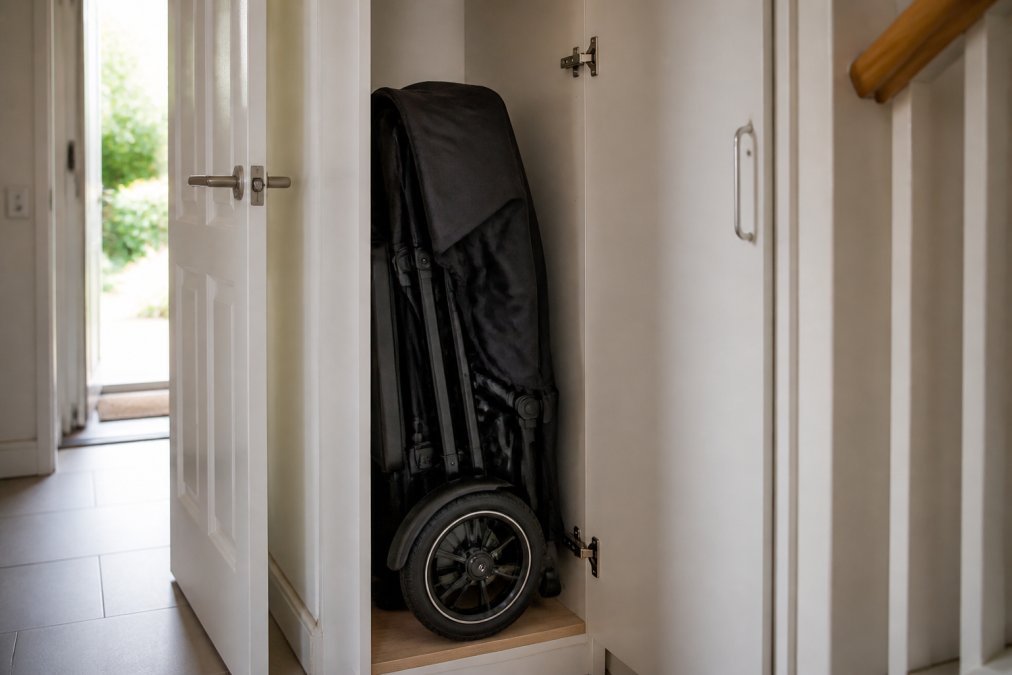
- Vertical storage: the folded chair stands on its rear wheels or base and leans against a wall, inside a cupboard, or on a purpose-made stand. This is where the real space savings are.
- Wall-mounted or suspended storage: a bracket or hook system lifts the folded chair clear of the floor entirely, freeing the space beneath for shoes, a pram or a vacuum.
Vertical Storage and Space-Saving Ideas
Vertical storage is the best answer for small homes because it uses height instead of floor area. A folded ultra lightweight powerchair is often 60-70 cm tall and 30-40 cm deep, so a 40 cm-wide gap between a wall and a door frame can be enough. Measure your folded depth first, a chair 5 cm too deep for a cupboard ends up back in the hallway.
A few practical rules:
- Store the chair on a dry surface, not directly on a concrete floor that draws damp. A rubber mat or offcut of marine ply is enough.
- Keep the folding mechanism slightly engaged rather than forced fully closed, which reduces stress on the latch.
- Make sure the anti-tip wheels are not bearing the full weight of the chair. They are designed for stability at speed, not as a load-bearing foot.
- If you use a storage bag, choose one that leaves the wheels exposed so you can still wheel the folded chair into position.
- Lean the chair against a cloth or foam pad, not bare plaster, to avoid scuffing and to stop the frame sliding.
Wall mounts and stands. For tight footprints, a wall-mounted bracket or freestanding vertical stand is the difference between a chair in the way and one that disappears. Look for a stand rated to at least the folded weight plus a safety margin, a 20 kg chair on a 25 kg stand is a reasonable buffer. Fix wall brackets into masonry or a stud, never plasterboard alone. If you rent, a freestanding stand avoids drilling.

Under-stair and wardrobe placement. A folded carbon fibre frame slips into spaces a manual wheelchair never could. The under-stair cupboard is often the best compromise: out of sight, at floor level so no lifting is needed, and usually the driest cupboard in the house.
A note on communal spaces. If your only option is a shared hallway or landing, check your tenancy or lease first. Many buildings restrict storage in escape routes for fire safety, and a chair blocking a corridor is a hazard. A lockable cupboard or designated store is safer.
Electric Wheelchair Battery Maintenance During Storage
Electric wheelchair battery maintenance is the part of powerchair storage owners get wrong most often, and the most expensive mistake. Lithium-ion batteries do not like being stored completely flat or fully charged for long periods, both shorten their usable life (batteryuniversity.com).
The routine that works:
- Charge the battery to roughly half capacity before storing the chair for more than a few weeks.
- Top it up every two to three months so it never sits at zero.
- Store the chair and battery at room temperature, away from radiators and unheated garages.
- Remove the battery entirely if your model allows quick-release, and store it separately in a dry place.
If unsure how your model handles long-term storage, check the manufacturer's guidance or ask the supplier. Getting this wrong is the fastest way to need a replacement battery.
Lithium-Ion Battery Care for Long-Term Storage
Lithium-ion batteries lose capacity permanently if left discharged for months: a battery stored at zero for a season may never hold a full charge again (peer-reviewed research).
A simple schedule keeps it healthy:
- Every 8-12 weeks: check the charge level and top up to around half.
- Before first use after storage: charge fully, then let the chair rest before riding.
- Never: store the battery in a cold shed, a hot loft or a damp garage.
If you are away for an extended period, ask someone to check the battery.
Protecting Your Powerchair From Moisture and Damp
Moisture is the quiet killer of folding powerchairs. Damp air corrodes metal fixings, damages the controller and shortens battery and wiring life. A protective cover helps, but a cover alone is not enough.
Warm, damp air holds more water than cold air. When it meets a cold metal frame or controller housing, it releases moisture as condensation, the same reason a cold glass beads with water. In an unheated garage or shed, the chair is cold overnight and warms slowly by day, cycling through condensation repeatedly. That corrodes fixings and seeps into the controller.
A made-to-measure storage bag keeps dust and moisture off the frame and electronics while the chair sits unused. The Cover Bag for Freedom Pro and Elite Electric Wheelchair is designed exactly for this: it protects the chair during storage and transport, and because the wheels stay exposed you can still pull the folded chair along by its handles like a suitcase.

For moisture control, a few habits matter more than any gadget:
- Store the chair indoors, in a dry room, wherever possible.
- If it must live in a garage or outbuilding, raise it off the floor on a pallet or shelf. Cold concrete draws damp upward and is the single worst surface to store on.
- Wipe down the frame after wet rides before folding it away. Grit and moisture trapped in the folding joints are what seize a latch.
- Keep the controller and charging port covered when not in use. The charging port is the most exposed electrical point on the chair.
- Leave a small air gap under a cover rather than sealing the chair in tight. Trapped damp air is worse than moving air.
Desiccants and humidity control. In a garage, shed or conservatory, a reusable silica gel desiccant pack inside the storage bag or cupboard absorbs airborne moisture before it reaches the frame. Rechargeable packs change colour when saturated and can be dried on a radiator, so they cost little over time. A cheap hygrometer tells you whether the space is actually dry. If relative humidity sits above about 60% for long periods, you have a moisture problem worth solving, not just covering up (energy.gov).
Protecting the controller specifically. The controller is a critical electronic component and is sensitive to damp. If your model allows it, a small reusable desiccant sachet taped inside the controller housing cover during long-term storage is cheap insurance. Never store the controller directly on a cold floor, and never leave the charging port open to the air.
A quick seasonal check. Once a month, open the cover, feel the frame for condensation, check the desiccant for colour change, and inspect the controller and charging port for damp or green corrosion on the contacts.
Mobility Equipment Winter Storage: Cold Weather Preparation
Mobility equipment winter storage needs more attention than summer storage because cold, damp air is hard on batteries and frames. Preparation takes under an hour.
Before the cold sets in:
- Clean and dry the chair thoroughly, including the underside and the folding joints.
- Charge the battery to around half capacity.
- Apply a light protective wipe to metal fixings if the manufacturer recommends it.
- Cover the chair and move it to the driest, least cold space you have.
- Set a reminder to check the battery every two to three months.
If your only option is an unheated outbuilding, the battery should come indoors with you. It is the component most vulnerable to cold, and the one most expensive to replace.
Car Boot Storage and Transport Tips
Car boot storage is where an ultra lightweight folding powerchair proves its worth. A carbon fibre frame folds into a compact package most owners can lift into a hatchback or estate boot without help, the whole point of choosing a lightweight model.
A few things make loading easier:
- Fold the chair fully and check the latch is secure before lifting.
- Lift with your legs, not your back, and hold the frame close to your body.
- Slide the chair in wheels-first so the heavier motor end sits over the axle.
- Use a boot liner or mat to protect both the chair and your car interior.
- Secure the chair with a strap so it cannot slide during the journey.
The Etech Mobility Wheelchair Backpack and the Armrest Storage Bag for Wheelchairs & Mobility Scooter keep everyday essentials organised so nothing rattles around the boot.

Security and Theft Prevention When Storing Your Powerchair
Security is the angle most storage guides skip. A powerchair is a high-value mobility aid, and one left visible in a porch, communal hallway or car boot is an easy target.
Practical steps:
- Store the chair out of sight from windows and front doors.
- Use a heavy-duty lock or cable through the frame if it must stay in a communal area.
- Mark the frame with a UV pen or register it with your insurer.
- Keep the battery with you where possible, since a chair without a battery is far less useful to a thief.
- Photograph the chair and note the serial number for insurance purposes.
If you live in shared accommodation, ask about a secure store. Most landlords and building managers will help once they understand the chair is essential mobility equipment.
Conclusion
Good powerchair storage comes down to three things: keep it dry, keep the battery topped up, and keep it somewhere you will actually use it. Get those right and an ultra lightweight folding powerchair stays easy to lift, quick to deploy and reliable for years.
At Etech Mobility, our premium carbon fibre range is built for everyday independence: light enough to lift into a car boot, compact enough to store in a hallway cupboard, and backed by free delivery and support to help you choose the right model. Explore our folding electric wheelchairs and see how simple storage can be.
Frequently Asked Questions
How should I store my power wheelchair to protect the battery?
Store your powerchair with the battery charged to between 50% and 80% for long periods. Avoid leaving it fully charged or completely flat. Keep it in a dry, temperature-controlled space away from radiators and direct sunlight. If storing for more than a month, check the charge every four to six weeks and top it up as needed. This routine protects the lithium-ion cells and helps maintain range for when you next use the chair.
Is it safe to store a folding powerchair in a garage?
A garage can work if it is dry and frost-free. Damp and extreme cold damage batteries and speed up corrosion on the frame. Use a protective cover such as the Etech Mobility Cover Bag for Freedom Pro and Elite Electric Wheelchair (£29.99) to keep dust and moisture off the chair. Raise it off a concrete floor on a pallet or shelf, and avoid garages that flood or reach freezing temperatures in winter.
What are the best storage solutions for small homes?
Vertical storage makes the most of limited floor space. Fold the powerchair, remove quick-release components where possible, and stand it upright in a hallway, under stairs or in a cupboard. A made-to-measure cover bag keeps it protected and lets you pull it along like a suitcase if you need to move it. Wall-mounted hooks or a slim storage rack also work well if you can fix them securely.
How do I prepare my powerchair for long-term storage?
Clean and dry the frame first, then check for any corrosion or loose bolts. Charge the battery to around 50-80%, disconnect it if your model allows, and store it separately in a dry spot. Cover the chair to keep dust and moisture off the controller and motor. Store in a dry, ventilated space away from damp. Check the battery charge monthly and give the chair a brief run every few months if you can.
If your current chair is too heavy to lift or too bulky to store, it is time to look at something lighter. Etech Mobility offers ultra lightweight carbon fibre folding powerchairs designed for easy lifting and simple storage, with free delivery and personal guidance to match you with the right model. Get started with Etech Mobility and find a powerchair that fits your home, your car and your life.