
Mobility Extra Alternatives for Wheelchairs: 2026 Guide
Table of Contents
- Why Look Beyond a Standard Wheelchair?
- Mobility Scooter vs Powerchair: Key Differences
- Lightweight Folding Electric Wheelchairs for Travel
- Power Add-Ons for Manual Wheelchairs
- Walking Aids and Rollators for Short Distances
- Comparing the Options: Prices and Practicalities
- Choosing the Right Alternative for Your Needs
- Frequently Asked Questions
Last Updated: September 23, 2026
Why Look Beyond a Standard Wheelchair?
Wheelchair alternatives are any devices that provide seated or supported movement without the weight and bulk of a traditional manual chair. For many people, the real barrier is not the chair but everything around it: the car boot, the narrow hallway, the steps.
The Weight and Portability Problem
Weight is the number one reason people start looking for an alternative. A heavier chair limits where you go and who you go with. If you cannot lift it alone, you depend on someone else being free.
Who Benefits From an Alternative?
The people who gain most can still stand and transfer, even briefly:
- Ambulatory users who tire quickly over distance
- People with arthritis or shoulder pain who struggle to self-propel
- Active seniors who want to keep up outdoor routines
- Caregivers who need something easy to lift into a car
Mobility Scooter vs Powerchair: Key Differences
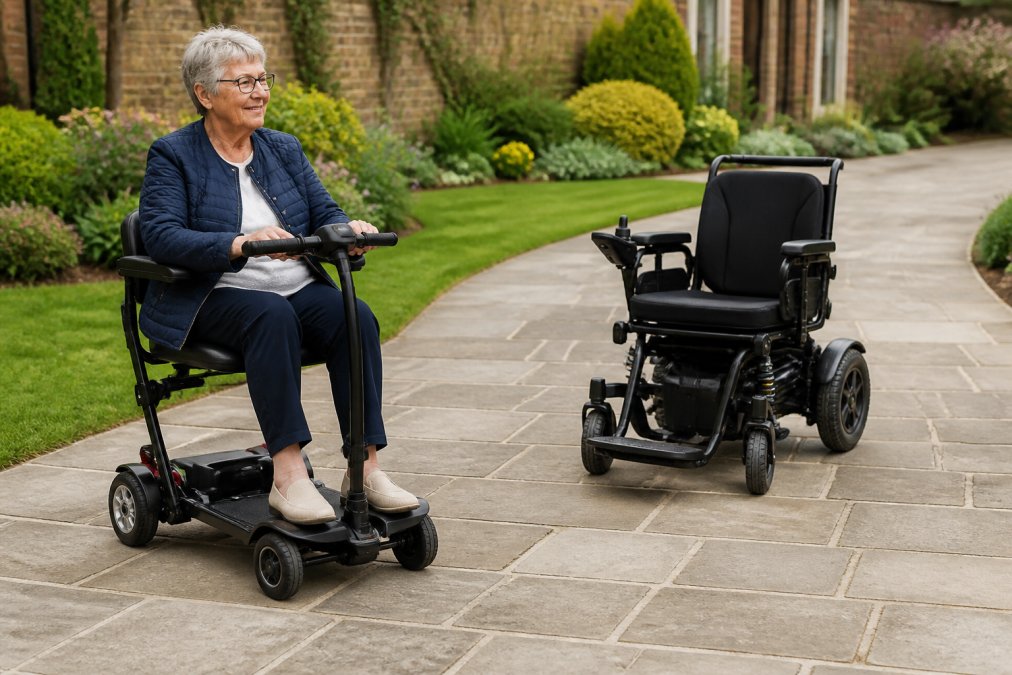
The core difference is steering and seating. A mobility scooter uses a tiller, like a bicycle handlebar, steered with the hands and arms. A powerchair uses a joystick and suits a seated user who transfers less often.
| Feature | Mobility Scooter | Powerchair |
|---|---|---|
| Steering | Tiller, handlebar style | Joystick |
| Best for | Ambulatory users, outdoor trips | Full-time seated users |
| Turning circle | Wider, needs more space | Tighter, better indoors |
| Folding options | Common, travel-friendly | Less common |
| Typical weight | 21-24 kg (folding models) | Heavier, often 40 kg+ |
| Battery range | Up to 10-11 miles | Varies widely |
Steering, Stability and Turning Circles
Scooters are more stable at speed and easier to mount because the seat swivels or the armrests lift. The trade-off is manoeuvrability. A tiller-steered scooter needs a wider turning circle, which matters in narrow hallways and small kitchens.
Lightweight Folding Electric Wheelchairs for Travel
Travel is where folding electric wheelchairs earn their place: models you fold, lift into a boot, and take on a train or plane without a second pair of hands.
Power Add-Ons for Manual Wheelchairs
Power add-ons for manual wheelchairs are motors that attach to an existing chair and turn it into a powered one, for people who want assistance without buying a whole new device.
There are two main types:
- Hub motors, fitted to the rear wheels, which push the chair forward
- Front-mounted units, which clamp to the frame and pull the chair along
Walking Aids and Rollators for Short Distances
A rollator is a wheeled walking frame with a seat, often the right answer when the problem is stamina rather than mobility. If you can walk 50 metres but not 500, it keeps you upright and gives you somewhere to sit.
Comparing the Options: Prices and Practicalities
Prices vary widely by category, so it helps to see these wheelchair alternatives side by side. The table below summarises the main options and what each is genuinely good at.
| Option | Price | Weight | Best For |
|---|---|---|---|
| MS-270 Folding Scooter | £695.50 | 21 kg | Travel and daily errands |
| Phantom Auto-Fold Scooter | £899.99 | 23.8 kg | Effortless folding, style |
| Sentinel Class 3 Scooter | £1,595.99 | Approx. 105 kg | Long distances, road use |
| Vista Rollator | £79.99 | 5.8 kg | Outdoor walking support |
| Vera Rollator | £58.99 | 7.2 kg | Indoor and smooth surfaces |
The Purchase Price Is Not the Whole Cost
Most buyers focus on the sticker price and are surprised by what follows. Budget for these alongside the device:
- Battery replacement. Lithium packs typically last a few years before range drops noticeably, and a replacement can cost a meaningful fraction of the original price. Ask the supplier for the replacement cost before you buy.
- Servicing and safety checks. Class 3 scooters used on the road benefit from an annual once-over on brakes, tyres and lights. Many suppliers offer this as a paid service.
- Insurance. Cover for theft, accidental damage and public liability is optional for most private users but sensible if you leave a scooter outside shops or travel with it. Premiums vary with the device's value and where it is stored.
- Spares and consumables. Tyres, inner tubes, brake cables and seat cushions are wear items. Ask what a typical set costs.
- Accessories. A carry bag, a second charger for work or a relative's house, and a rain cover are common additions.
Funding Routes Worth Checking Before You Pay in Full
This is the part most buying guides skip, and it is often the difference between affording the right device and settling for the wrong one.
Lightweight Mobility Scooter →
A Practical Way to Compare Two Options
Put the numbers side by side rather than in your head:
- Purchase price, with or without VAT relief
- Expected battery replacement cost, divided over the years you expect to keep it
- Annual servicing and insurance
- Any funding you can access, subtracted from the total
Choosing the Right Alternative for Your Needs
Start with three questions, in this order.
Where will you use it most? Indoors and short trips point to a rollator or a folding scooter. Long outdoor journeys point to a Class 3 model.
Measure Your Home Before You Measure the Device
Most returns happen because a device fits the buyer's needs but not their hallway. Before you commit, walk your home with a tape measure and note the following. A scooter or powerchair needs clearance to pass, and a scooter needs extra room to turn because of its wider turning circle.
- Front door and internal doorways. Measure the clear opening with the door open, not the frame width. A standard internal door is often narrower than people assume once the door itself and any handles are accounted for.
- Hallway width and any tight turns. A straight corridor is easy. A right-angle turn at the end of it is where a tiller-steered scooter struggles.
- Thresholds and lips. A raised door threshold, a step down into a conservatory, or a lip into a garage can stop a small-wheeled device. Measure the height and check the device's climbing ability.
- Lifts. If you live in a flat, measure the lift door and the internal depth. A folding scooter may fit where a rigid one will not.
- Storage and charging point. You need a spot near a socket where the device can sit without blocking a walkway, and ideally somewhere it is not exposed to damp or extreme cold, both of which shorten battery life.
- The car boot, if you travel by car. Measure the boot opening height and the floor depth, then compare against the device's folded dimensions rather than its unfolded ones.
Match the Device to Your Body, Not Just Your Home
Home layout is half the decision. The other half is how the device suits you physically.
- Can you transfer independently? If you can stand and pivot, a scooter with a swivel seat or lifting armrests is workable. If you cannot bear weight, a powerchair with a joystick and a supportive seat is the safer route.
- How is your grip and upper-body strength? A tiller needs a reasonable grip and the ability to hold a steady line. A joystick needs fine control but far less strength.
- How long will you sit in it at a time? Short errands suit a basic seat. All-day use needs proper cushioning and back support, and possibly a pressure-relieving cushion.
- Do you need to carry anything? Baskets, bags and oxygen cylinders all add weight and change the balance of a scooter.
A Simple Test Before You Buy
If you can, try the device in the environment you will actually use it in, not just a showroom floor. Ask the supplier whether a home demonstration or a trial period is available. A short trial in your own hallway and boot will tell you more than any specification sheet.
Frequently Asked Questions
What are the main alternatives to a wheelchair for limited mobility?
The main alternatives are mobility scooters, powerchairs, lightweight folding electric wheelchairs, rollators, and power add-ons for manual wheelchairs. Each suits a different level of mobility and lifestyle. A rollator works well if you can walk short distances with support. A mobility scooter or powerchair suits longer journeys. A power add-on converts an existing manual wheelchair into a powered one without buying a whole new device. The right choice depends on your strength, your home layout, and how you travel.
How does a mobility scooter vs powerchair comparison help me decide?
A mobility scooter vs powerchair comparison comes down to steering and seating. Scooters use a tiller and are easier to mount, making them ideal for shopping and outdoor trips. Powerchairs use a joystick and have a tighter turning circle, which suits indoor use and users with limited upper-body strength. Scooters generally cost less and fold more compactly. Powerchairs offer better posture support but weigh more. Try both before deciding.
Are power add-ons for manual wheelchairs a viable alternative?
Yes, power add-ons for manual wheelchairs are a practical alternative if you already own a manual chair you like. They attach to the frame and provide motorised assistance, reducing strain on your shoulders and arms. This matters if you have arthritis or fatigue. They are usually cheaper than buying a new powerchair and keep the chair's familiar fit. Check that the add-on is compatible with your specific wheelchair model before buying.
What should I look for in lightweight folding electric wheelchairs?
Focus on three things: weight, folded dimensions, and battery range. A chair you cannot lift into a car boot is no use, so check the frame weight and folded size against your vehicle. Battery range should cover your typical outing with some margin. Also check the folding mechanism, since a one-handed or automatic fold helps if you have weak grip or shoulder pain. Confirm the weight capacity and whether the battery is airline-friendly if you travel.
How does the NHS assess eligibility for mobility equipment?
Eligibility for NHS wheelchair services is based on a clinical assessment of your mobility needs, not on a specific diagnosis. A healthcare professional evaluates how your condition affects daily movement and whether a chair would help. Waiting times and the range of equipment available vary by local service. If you are considering buying privately, ask your GP or an occupational therapist for advice, and check the official NHS guidance for your area before committing.