
Wheelchair Lifts for Cars: A 2026 Guide
Table of Contents
- Types of Wheelchair Lifts for Cars
- Car Boot Hoists for Mobility Scooters: How They Work
- Weight Capacity and Load Limits
- Motability Scheme Vehicle Adaptations and Funding
- Installation: Professional vs. DIY Approaches
- Safety Features and Standards
- Choosing the Right Wheelchair Lift for Your Needs
- Frequently Asked Questions
Last Updated: September 18, 2026
Types of Wheelchair Lifts for Cars
Wheelchair lifts for cars come in several distinct configurations, each designed to address different vehicle types, user preferences, and accessibility needs. Understanding the differences between these options is essential for selecting the right solution for your situation.
The most common wheelchair lifts for cars fall into two main categories: fixed in-car boot hoists and portable alternatives. Fixed hoists are permanently installed within your vehicle's boot, while portable options offer flexibility and can be moved between vehicles or stored away when not needed. Each approach has distinct advantages depending on your lifestyle, vehicle type, and how frequently you transport your mobility equipment.
Inboard Boot Hoists
Inboard boot hoists are permanently installed lifting systems mounted directly within your car's boot. These systems feature a motorised platform that raises and lowers your wheelchair or mobility scooter to boot level at the push of a button, eliminating the need for manual lifting or disassembly.
Fixed boot hoists typically require professional installation, which involves securing the lifting mechanism to your vehicle's floor or structure. Once installed, they become a seamless part of your vehicle setup, offering consistent performance and reliability. However, they do reduce available boot space and are vehicle-specific, meaning they cannot be transferred to another car without additional installation work.
The main advantage of inboard systems is their permanent integration. You don't need to set up or store the equipment each time, simply load your mobility device and activate the hoist. This is particularly valuable for daily users who transport their wheelchair or scooter multiple times per week.
Portable and Underfloor Lifts
Portable wheelchair lifts for cars offer a flexible alternative to fixed installations. These systems are designed to be compact, lightweight, and easy to store, making them ideal for people who switch between vehicles or want to avoid permanent vehicle modifications.
The Portable Car Boot Hoist by Etech Mobility exemplifies this approach, providing an electric lifting platform that operates via battery power and hand controller. With a 50 kg weight capacity and dimensions of 75×48×24-91 cm, it fits easily into most car boots when not in use. The aluminium frame keeps the overall weight to just 12 kg, making it manageable for most users to position and secure.

Portable lifts typically come with secure straps and stabilisers to keep your mobility device firmly in place during transport. The detachable battery can be charged separately from the hoist itself, adding convenience to your routine. These systems are particularly suited to people who own multiple vehicles, frequently travel, or prefer to avoid permanent vehicle modifications.
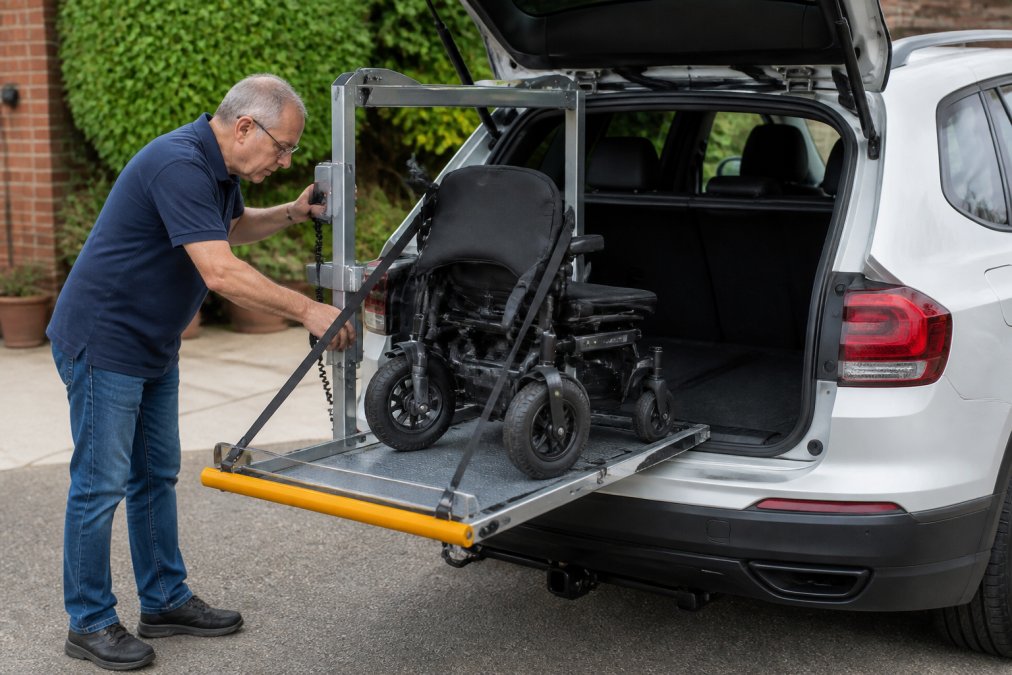
Car Boot Hoists for Mobility Scooters: How They Work
A car boot hoist for mobility scooters is an electric lifting device that raises your mobility equipment from ground level to boot level, allowing safe and effortless loading without manual strain. The system operates through a simple hand controller, which activates a motorised platform that smoothly elevates your scooter or powerchair.
The mechanism works by applying electric force to lift the platform gradually. Once your mobility device is positioned on the platform and secured with straps, you activate the controller. The platform rises until it reaches boot level, at which point you can slide or manoeuvre your equipment into the vehicle. The reverse process lowers it back to ground level when unloading.
Safety is built into the design through multiple features. Secure tethering straps prevent your mobility device from shifting during the lift cycle. Stabilisers and locking wheels keep the platform steady throughout operation. Many systems include a manual override function, allowing you to lower the platform manually if the power system fails.
Weight Capacity and Load Limits
Weight capacity is one of the most critical specifications when choosing a wheelchair lift for your car. Most portable systems are designed to handle standard powerchairs and mobility scooters, but capacity varies considerably between models.
The Portable Car Boot Hoist by Etech Mobility, for example, has a maximum weight capacity of 50 kg. This is sufficient for many lightweight folding powerchairs and compact mobility scooters, particularly the carbon fibre models that Etech Mobility specialises in. However, heavier users or those with larger, more strong mobility equipment may find this capacity limiting.
When assessing whether a lift suits your needs, you need to know the exact weight of your mobility device. Many modern electric wheelchairs range from 20-35 kg when fully assembled, while larger scooters can exceed 50 kg. If your equipment is close to the maximum weight limit, consider that additional factors like battery charge level and any accessories mounted on your device will add to the total load.
Exceeding the weight capacity of a lift is dangerous and can damage the equipment. It may also void your warranty. Always verify the specifications of both your mobility device and the lifting system before purchase. If your equipment is heavier than available portable options, a fixed in-car boot hoist with higher capacity may be necessary, or you may need to consider a vehicle with greater boot space and lifting capability.
Motability Scheme Vehicle Adaptations and Funding
The Motability Scheme is a government-backed programme that helps disabled people lease or purchase adapted vehicles (Financial help if you're disabled: Vehicles and transport). If you receive certain mobility-related benefits, you may be eligible to use your allowance towards a vehicle that includes specialist adaptations, such as wheelchair lifts for cars.
Portable Car Boot Hoist for Mobility →
Through the Motability Scheme, you can access funding to cover the cost of vehicle adaptations. This can include both inboard boot hoists and the costs associated with professional installation. The scheme works by allowing you to use your mobility allowance as a contribution towards the lease or purchase of an adapted vehicle from an approved provider.
To explore whether wheelchair lift adaptations are available through the Motability Scheme, you'll need to contact the scheme directly or work with an approved vehicle provider who can advise on eligible adaptations. Eligibility criteria apply, and not all adaptations are covered under every circumstance, so it's important to discuss your specific needs with a specialist advisor.
Beyond the Motability Scheme, some local authorities and charitable organisations offer grants or funding assistance for vehicle adaptations. These vary by region and circumstance, so contacting your local council's social services department or disability support organisations can help identify what funding may be available to you.
Installation: Professional vs. DIY Approaches
Installing a wheelchair lift for your car requires careful consideration of both safety and practicality. The choice between professional installation and attempting a DIY approach depends on the type of lift, your technical skills, and your vehicle's compatibility.
Professional installation is the recommended approach for fixed inboard hoists. These systems require secure mounting to your vehicle's structure, electrical integration with your car's power system, and thorough safety testing. A specialist installer has the expertise to ensure the hoist is properly secured, electrically safe, and compliant with relevant safety standards. Professional installation typically takes several hours and may require your vehicle to be out of service for a day or more.
The advantage of professional installation is peace of mind. You receive a warranty on the work, and if problems arise, the installer is responsible for rectification. Additionally, professional installation ensures your vehicle's structural integrity is maintained and that all electrical connections are safe.
DIY installation is generally only suitable for portable lifts, which require no permanent modifications to your vehicle. Portable hoists like the Etech Mobility model are designed for users to position and secure themselves. Setup involves placing the hoist in your boot, connecting the battery, and securing your mobility device with the provided straps. This process takes minutes and requires no technical expertise. Maintaining this level of independence often requires broader accessible home modifications to ensure that your living space remains as functional as your vehicle.
However, even with portable systems, careful attention to the manufacturer's instructions is essential. Improper positioning or inadequate securing of your mobility device can result in unsafe loading conditions. Always read the manual thoroughly before first use, and consider asking someone to supervise your initial attempts until you're confident in the process.
For fixed hoists, attempting DIY installation risks damaging your vehicle, creating electrical hazards, and voiding your warranty.
Safety Features and Standards
Safety is paramount when transporting a mobility device in your car. Modern wheelchair lifts for cars incorporate multiple safety features designed to protect both you and your equipment during the loading and transport process.
Choosing the Right Wheelchair Lift for Your Needs
Selecting the right wheelchair lift for your car requires honest assessment of your lifestyle, vehicle type, mobility equipment, and budget. Here are the key factors to consider.
Frequently Asked Questions
How much does a wheelchair lift for a car cost?
Costs vary by type and capacity. Portable car boot hoists start from £399.99, while ramps range from £89.99 to £149.99 depending on length and load capacity. Fixed in-car hoists typically cost more due to installation. Your choice depends on your vehicle type, mobility device weight, and whether you need a permanent or portable solution. Contact a mobility specialist to get a personalised quote for your specific needs.
What is the difference between a boot hoist and a platform lift?
A boot hoist uses an electric motor and platform to raise your wheelchair or mobility scooter to boot level at the push of a button, eliminating manual lifting. A platform lift (or ramp) provides a sloped surface you drive or are pushed up into the vehicle. Boot hoists work best for heavier devices and users with limited upper-body strength, whilst ramps suit lighter wheelchairs and those with good hand control. Ramps require more boot space but need no battery or electricity.
Can a wheelchair lift be fitted to any car?
Most vehicles can accommodate a wheelchair lift, but compatibility depends on boot size, floor strength, and electrical systems. Smaller cars may struggle with fixed hoists due to limited space. Portable hoists work with almost any vehicle since they don't require permanent installation. Before purchasing, check your vehicle's boot dimensions, load-bearing capacity, and whether it has a 12V power supply. A vehicle assessment by a qualified installer can confirm what's suitable for your specific car model.
Are there VAT exemptions for mobility vehicle adaptations?
Yes. In the UK, VAT relief is available on mobility aids and vehicle adaptations for disabled people. Wheelchair lifts, ramps, and related equipment may qualify for zero-rated VAT if supplied to an eligible person. To claim relief, you typically need to provide evidence of your disability status. Check with the supplier at the point of purchase, as eligibility criteria and documentation requirements apply. The HMRC website and your mobility equipment supplier can provide specific guidance on your circumstances.