
Foldable Electric Wheelchair for Sale: 2026 Buying Guide
Table of Contents
- Why Choose a Foldable Electric Wheelchair?
- Key Features to Compare Before You Buy
- Travel-Friendly Electric Wheelchairs: Air, Train and Car
- Carbon Fibre Powerchair Benefits: Weight vs Durability
- VAT Relief on Mobility Equipment: Are You Eligible?
- Comparing Our Best Folding Electric Wheelchairs
- Common Mistakes to Avoid When Buying Online
- Final Verdict: Which Foldable Wheelchair Fits Your Life?
- Frequently Asked Questions
Last Updated: September 8, 2026
Why Choose a Foldable Electric Wheelchair?
A foldable electric wheelchair for sale in the UK market today combines the independence of a powered chair with the practicality of folding for storage in a car boot or hallway cupboard. For ambulatory users who tire easily or caregivers who must lift and transport a chair, the folding design solves problems traditional powerchairs cannot. A folding electric wheelchair is a motorised mobility aid with a frame that collapses into two or three compact sections, making it possible to lift into a standard car, carry onto a train, or store in a space that would never accommodate a rigid powerchair.
Key Features to Compare Before You Buy
Before comparing models, focus on specifications that affect daily use. Weight is the first number to check: most lightweight folding chairs weigh between 18 kg and 25 kg, and that difference matters enormously if you lift it regularly. Battery range deserves equal attention: a realistic range of 10 to 20 miles suits most trips, but for longer excursions look for a larger lithium-ion battery. The folding mechanism separates the market: manual folding chairs require you to pull a lever and fold the frame yourself, while automatic folding chairs do the work at the press of a button, often with a remote control, for someone with shoulder arthritis, this can be the difference between independence and dependence. Weight capacity and motor performance complete the picture: chairs supporting up to 160 kg suit many users, while dual motors provide torque for kerbs and slopes.

Travel-Friendly Electric Wheelchairs: Air, Train and Car
Travel-friendly electric wheelchairs have transformed holidays and day trips. The key is understanding the rules for each mode of transport, and for air travel, the regulations are stricter than most expect.
Car Travel: Measure the Boot Opening, Not Just Capacity
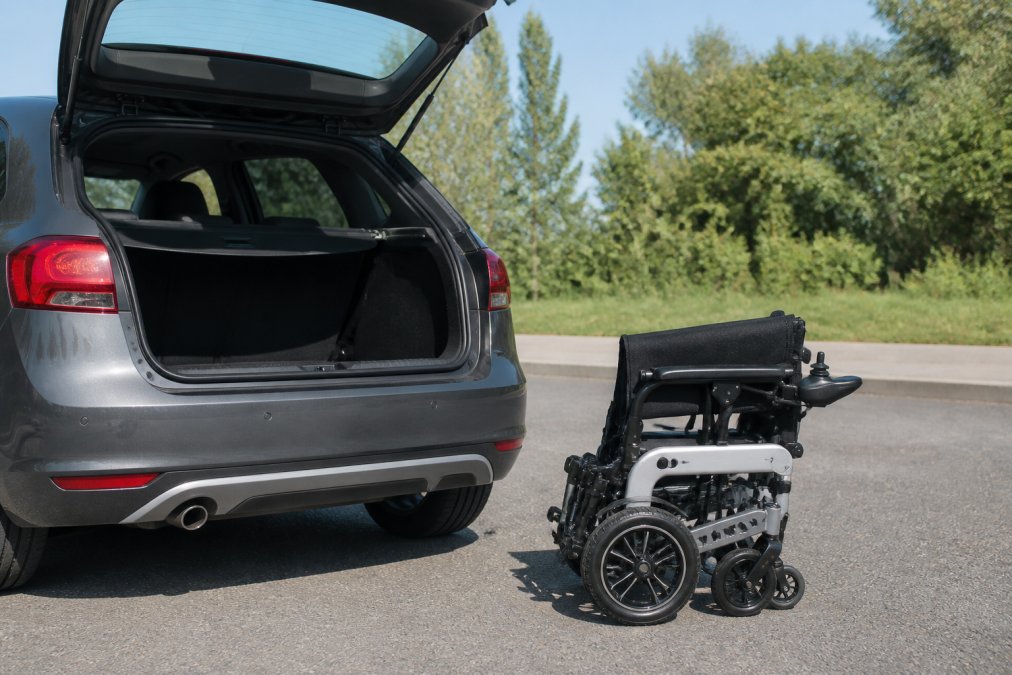
For car travel, measure the folded dimensions of the chair against your boot opening, not just boot capacity. Most folding chairs fit a standard hatchback or estate boot, but a few seconds with a tape measure saves frustration. Also check the chair's weight against your lifting ability, a 22 kg chair might be fine in the showroom but a struggle at the end of a long day.
Trains and Coaches: Know the Operator's Policy
Trains and coaches in the UK generally accommodate folding wheelchairs without issue, store the folded chair in the luggage area or beside your seat. However, each operator has its own policy on battery-powered aids: most allow lithium-ion batteries under 300 Wh, but some require booking assistance in advance. If you travel alone, practise folding and unfolding at home until it becomes second nature.
Air Travel: The Lithium-Ion Battery Rules Most Guides Miss
Air travel is where planning becomes essential. The rules are set by IATA and enforced by individual airlines, centring on the battery, not the chair itself.
- Battery watt-hour (Wh) rating is the deciding factor. IATA regulations classify lithium-ion batteries by watt-hours, not just voltage. Most folding electric wheelchairs use batteries rated between 150 Wh and 300 Wh. Batteries under 100 Wh are generally treated as spare consumer batteries. Batteries between 100 Wh and 300 Wh require airline approval in advance. Batteries over 300 Wh are typically prohibited on passenger aircraft.
- You must inform the airline at least 48 hours before departure. This is not a courtesy, it is a requirement. The airline needs to confirm the battery rating and decide whether the chair travels in the cabin or the hold.
- The battery must be removable. Most folding electric wheelchairs have removable lithium-ion batteries, which is a major advantage. If the battery is non-removable, the chair may not be accepted at all. Check your chair's specification sheet for the battery's Wh rating and whether it detaches without tools.
- Spare batteries must be carried in the cabin. IATA rules prohibit spare lithium-ion batteries in checked luggage. You must carry the spare in your hand luggage, with the terminals protected against short circuits (usually with tape or a plastic cover).
- The chair itself is usually stowed in the hold. The airline will typically take the folded chair at the aircraft door and return it at the destination. Ask for a 'gate check' tag when you check in.
IATA guidance on travelling with mobility aids and lithium batteries provides the full regulatory framework. The practical takeaway is this: contact your airline at least 48 hours before departure, confirm your battery's Wh rating, and carry a printed copy of the battery specification sheet with you.
A Pre-Flight Checklist
Before you book any flight with a folding electric wheelchair, run through this checklist:
- Confirm the battery's Wh rating (look for the label on the battery).
- Verify the battery is removable without tools.
- Call the airline at least 48 hours before departure, do not rely on the website.
- Ask whether the chair is collected at the gate or must be checked in with luggage.
- Pack the battery in your cabin bag with terminals protected.
- Carry a printed copy of the chair's specification sheet.
Carbon Fibre Powerchair Benefits: Weight vs Durability
Carbon fibre powerchair benefits come down to one trade: weight versus durability. Carbon fibre is significantly lighter than steel or aluminium, making the chair easier to lift, fold and manoeuvre, transformative for frequent travellers or those with limited upper body strength.
Carbon fibre is exceptionally strong for its weight, does not rust, a real advantage in the damp climate, and maintains structural integrity far longer than cheaper alternatives. But the frame material is only part of the story: the quality of the joints, motor, battery and braking system determines how long the chair lasts. A lightweight frame with a poor-quality motor will still leave you stranded, look for reputable components and proper after-sales support.
VAT Relief on Mobility Equipment: Are You Eligible?
VAT relief on mobility equipment can reduce the cost of a new chair significantly, but the rules are specific. The VAT exemption scheme for disabled people means you do not pay VAT on mobility equipment designed for your personal use, provided you meet the eligibility criteria.
The relief applies to goods designed solely for disabled people. A folding electric wheelchair qualifies, but you must be buying it for your own use or on behalf of a disabled person. The scheme covers the chair and essential accessories. home health devices.
To claim the relief, you must provide a declaration to the seller confirming your eligibility. It is a simple form but must be completed accurately, if unsure, the seller should guide you through the process.
GOV.UK guidance on VAT relief for disabled people provides the official criteria and explains who can claim the exemption. The relief can represent a substantial saving, so it is worth confirming your eligibility before you compare prices.
Comparing Our Best Folding Electric Wheelchairs
Rather than listing every specification, focus on the models that suit the most common needs. The Freedom Pro ST is our best value folding powerchair, combining a compact fold with a weight capacity of up to 160 kg, ideal for a reliable everyday chair without paying for unused features.

The Freedom Pro AF adds automatic folding with a remote control, making a real difference if you have limited hand strength or arthritis, the chair folds and unfolds at the press of a button.
For the lightest possible option, the LiteMax 2 is our ultra-lightweight model, designed for users who need to lift their chair frequently into a car boot or up a step.
| Model | Key Feature | Weight Capacity | Best For |
|---|---|---|---|
| Freedom Pro ST | Manual fold, best value | Up to 160 kg | Everyday use on a budget |
| Freedom Pro AF | Automatic folding, remote control | Up to 160 kg | Users with limited hand strength |
| LiteMax 2 | Ultra-lightweight frame | Standard capacity | Frequent lifting and travel |
Common Mistakes to Avoid When Buying Online
The biggest mistake buyers make is focusing on price alone. A chair that is cheaper but has a shorter battery range, weaker motor or less reliable folding mechanism will cost more in the long run. The deeper issue is the true cost of ownership over five years.
Mistake 1: Ignoring the Cost of Replacement Batteries
A folding electric wheelchair's battery is its most expensive consumable component. Most lithium-ion batteries last between 18 and 24 months with regular use, roughly 300 to 500 charge cycles, before you notice reduced range and longer charging times.
- What does a replacement battery cost? For a typical folding electric wheelchair, a genuine replacement lithium-ion battery can be a significant cost. Some budget chairs use proprietary batteries that cost more and are harder to source. Ask the seller for the exact replacement battery price before you buy.
- Is the battery covered by warranty? Most manufacturers offer a 12-month battery warranty, but some extend this to 24 months. Confirm the warranty period in writing.
- Can you buy a spare battery? If you travel frequently, a second battery is a practical investment. Check that the chair's battery is swappable without tools and that spares are in stock.
Mistake 2: Overlooking Servicing and Parts Availability
A folding electric wheelchair has moving parts, motors, brakes, folding joints and castors, that will eventually need servicing. The question is not whether something will wear out, but how quickly the seller can fix it.
Before you order, ask these three questions:
- Where is the service centre? Some online sellers import chairs with no UK-based service network. If the chair breaks, you may face shipping it back at your own cost or waiting weeks for parts.
- Are spare parts held in the UK? Motors, joysticks, control boxes and wheels are the most common replacements. A seller with UK stock can typically resolve issues within days; one without can leave you immobile for weeks.
- What does a standard service cost? Most mobility dealers offer an annual service, which includes checking the brakes, tightening the folding mechanism and testing the battery. Factor this into your budget.
Mistake 3: Not Measuring Your Home for Turning Circles and Doorways
A chair that fits through a wide showroom doorway may not fit through your narrow corridor or bathroom door, and turning circles matter just as much as doorway width. Use this simple checklist before you buy:
- Doorway widths: Measure every door the chair must pass through, including bathroom and bedroom doors. Standard UK internal doors are approximately 762 mm wide, but older properties may have doors as narrow as 660 mm.
- Turning circles: A folding electric wheelchair typically needs a turning circle of 1.2 to 1.5 metres to reverse or turn in a corridor. Measure the width of your hallway and the space at the end of it. If you cannot turn the chair around, you will need to reverse out, which is difficult with a joystick.
- Thresholds and ramps: Measure any steps or raised thresholds between rooms and at external doors. A chair with a ground clearance of less than 50 mm may struggle with a standard threshold.
Mistake 4: Assuming 'Lightweight' Means 'Easy to Lift'
Do not assume all folding chairs are easy to lift. A specification that reads "lightweight" on paper may still be too heavy in practice, an 18 kg chair feels very different when lifting it into a car boot at the end of a long day. Try lifting a similar chair before you commit, and ask whether the seller offers home demonstrations.
Final Verdict: Which Foldable Wheelchair Fits Your Life?
Choosing the right foldable electric wheelchair comes down to matching the chair to your routine. If you travel frequently and lift your chair into a car several times a day, weight and folded size are priorities. If you have limited hand strength, an automatic folding mechanism is worth the extra cost. If you need maximum range, battery capacity takes precedence. Start by measuring your home and car, then honestly assess how much you can lift and how far you typically travel. At Etech Mobility, our range of folding electric wheelchairs covers each of these needs, from the best-value Freedom Pro ST to the ultra-lightweight LiteMax 2. Every model includes free UK delivery, and our team provides personalised guidance to help you find the chair that fits your life.

Buying a folding electric wheelchair is a significant decision, and the wrong choice can leave you with a chair that is too heavy, too wide or too limited for your needs. Etech Mobility has helped thousands of customers across the UK find the right mobility solution through a combination of quality products and genuine after-sales support. Trustpilot reviews for Etech Mobility reflect our commitment to customer satisfaction. Contact our team to discuss your requirements and we will help you choose the chair that keeps you independent, active and mobile.
Frequently Asked Questions
What is the cheapest folding electric wheelchair available?
Prices vary based on features and materials. The Etech Mobility LiteMax 2 offers an ultra-lightweight folding design with a joystick and remote control for £794.99. The Freedom Pro ST, a multi-terrain model supporting up to 160 kg, starts at £845.50. Automatic folding models with remote controls start from £995.50. Always check if you qualify for VAT relief, which can reduce the final cost.
Are folding electric wheelchairs suitable for public transport?
Yes, most travel-friendly electric wheelchairs are designed with public transport in mind. Their compact, foldable frames fit into car boots, train luggage areas, and comply with airline size restrictions when the battery is removable. Before travelling, check with the operator for specific dimensions and battery policies. Models like the Freedom Pro AF fold automatically, making transfers easier in busy stations.
What are the weight limits for lightweight folding powerchairs?
Weight capacity varies between models. Many standard lightweight powerchairs support up to 115 kg or 125 kg. However, heavy-duty options exist; for example, the Etech Mobility Freedom Pro ST and Freedom Pro AF models support a weight capacity of up to 160 kg. Always check the specific specification for the model you are considering to ensure it meets your needs safely.
How do I know if I qualify for VAT relief on a wheelchair?
VAT relief on mobility equipment is available to individuals with a physical or mental impairment that limits their ability to walk. If you buy the wheelchair for your personal use, you can declare eligibility. The retailer will provide a declaration form to sign. It is your responsibility to confirm you meet the criteria set by HMRC, so review the official guidance before purchasing.